Category Archives: Spending

CEI Podcast for April 14, 2011: Avoiding a Government Shutdown

Have a listen here.

Warren Brookes Journalism Fellow Kathryn Ciano analyzes the Continuing Resolution passed by the House today that will keep the federal government open for another 6 months. She also looks at proposals from President Obama and Rep. Paul Ryan to reduce the budget deficit over the next decade.

In Politics, Inertia Always Wins

The GOP has been bragging that its budget deal that passed the House today will save $38 billion. The CBO took a closer look, and it turns out the actual figure is $353 million, or 0.02 percent of this year’s budget deficit.

In The Daily Caller, I point out that this is one more example of the iron law of politics — inertia always wins.

Much Ado about Nothing: Budget Cut Edition

Democrats want the federal budget to be about  $3,730,000,000,000. Republicans want it to be about $3,630,000,000,000. As with many other issues, the difference between the two parties is less than three percent. Even so, it nearly led to a federal government shutdown.

The deal that the two parties recently struck to avoid a government shutdown meets somewhere in the between. It is advertised as cutting $38.5 billion of spending. But on closer inspection, it would actually cut $14.7 billion. That would cut total federal spending by 0.39 percent.

I have a hunch that even those small cuts may not actually happen. This blog post I wrote in 2005 explains why.

The rules of the game in Washington are severely stacked in favor of spending increases. Presidents Bush and Obama grew the federal government by about 100 percent in only a decade with little political pain. And it apparently takes the specter of a government shutdown to reduce spending by 0.39 percent.

If anyone is looking for a reason for fundamental institutional reform, that would be a big one.

$6 Billion More in Cuts

On Tuesday, the House will probably vote on a Continuing Resolution to avoid a government shutdown. Republicans are asking for $6 billion in spending cuts as part of the package. If they succeed, this year’s budget deficit will go from about $1.6 trillion to $1.594 trillion.

Never let it be said that congressional Republicans don’t think big!

Regulation of the Day 166: Cowboy Poetry

This year’s budget battle is especially heated. Democrats want the federal budget to be $3.7 trillion. Republicans want it to be $3.6 trillion. Both sides are willing to shut down the federal government rather than give in.

That’s where cowboy poetry, of all things, comes in. This traditional American art form, which I’d never heard of until today, has suddenly become the latest front in the epic struggle over the size and scope of government.

It is currently official federal policy to financially support cowboy poetry. But the GOP wants to cut $61 billion, or 1.6 percent, out of President Obama’s proposed budget. And cowboy poetry funding is on the chopping block.

The main element of federal cowboy poetry policy is a week-long annual festival in Nevada. Nevada is also the home state of Sen. Harry Reid. He is furious about this dire threat to cowboy poets everywhere, calling his opponents “mean-spirited.”

Without the funding, he adds, “the tens of thousands of people who come there [to the festival] every year would not exist.”

If Sen. Reid is right, tens of thousands of people could literally vanish into non-existence if Republicans get their way. Maybe they should reconsider.

If only politicians had that kind of existential power over the $1.6 trillion budget deficit. Oh, wait. They do. All they have to do is spend less.

(via Dan Mitchell)

CEI Podcast for February 24, 2011: On, Wisconsin

Have a listen here.

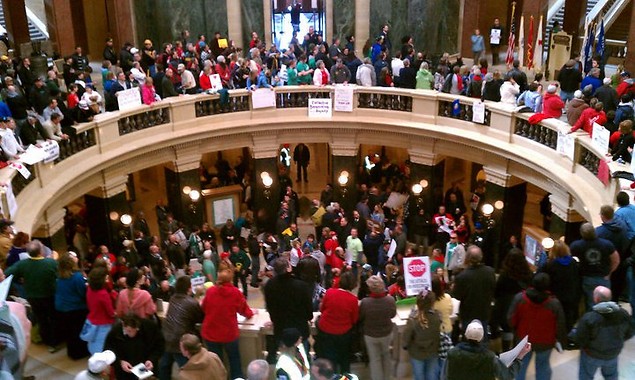
Vice President for Strategy Iain Murray discusses the labor reforms that have led to a thousands-strong sustained protest in Madison, Wisconsin. While the reforms themselves are relatively minor, both sides know that the stakes are high. This may prove to be at a watershed moment in the relationship between public sector unions and taxpayers.

Are the Wisconsin Protests Backfiring?

Protests in Wisconsin over public sector compensation cuts have been the big story this week. Over at the Daily Caller, I explain why some of the tactics that union members and supporters are using are actually backfiring.

The teacher sickout is classic bad PR. The parents who have to find and pay for last-minute daycare are now less likely to side with teachers’ unions, not more.

The nationwide saturation coverage is actually doing far more damage. Millions of people are learning about the sweetheart salary and benefit deals that many public sector union members get. Even if Gov. Walker’s cuts pass, the protesting workers will still be much better paid than their non-union counterparts. Both are better compensated in turn than most private sector workers.

Read the whole thing here.

More Corporate Welfare on the Way?

Politico headline from today: “Qualcomm exec calls for small-business research funding.”

Alternative headline: “Businessman asks government to give money to businesses.”

Government should not give money to private businesses, period. Businesses should compete in the marketplace, not Washington. There is a lot of money to be made by selling people things they want. Companies that do a good job of that deserve every cent they earn.

Subsidies are not earned. Nor are they given to companies make things people want. Companies already doing that don’t need handouts. In short, corporate welfare is allocated by politics instead of economics.

What Mr. Jacobs is asking for would be a boon for lobbyists and politically favored businesses. But it would be a drag on everyone else. And not only because they would be paying for the handouts. Lost innovations are part of the price. The money spent on corporate welfare is money not spent on more worthy projects.

See also Wayne Crews and I on corporate welfare in the new edition of CEI’s Agenda for Congress.

The Cut that Isn’t

President Obama announced a plan today to cut federal spending by $1.1 trillion over the next ten years. That’s an average of $110 billion per year, or a little less than 3 percent of federal spending. My employer, CEI, issued a press release about the proposal today that quotes several of our experts. Here’s what I said:

$400 billion of President Obama’s proposed budget cuts would come from freezing non-security discretionary spending, which means it would stay the same. A cut is when spending goes down. While this proposal is better than nothing, at least a third of it is based on false advertising.

You can read the full press release here.

Bush’s Third Term Continues

President Obama’s policies are remarkably similar to President Bush’s. Most of their differences are in matters of degree, not principle. Both presidents believe in expanding federal involvement in health care, education, energy, you name it. Both grew regulation, spending and deficits at tremendous rates. Even their foreign policy is almost identical.

Over at the Daily Caller, I analyze last night’s State of the Union address (I also live-blogged it here) and find it wanting. There are some real stretches of logic:

In 1957, the Soviet Union launched a satellite into space. Therefore, taxpayers should give more money to politically favored corporations. This is not a rigorous line of thought. But it was typical of yesterday’s State of the Union address.

It wasn’t all bad, though:

There was some good in yesterday’s speech. The president would like to lower corporate tax rates. After Japan’s recent rate cuts, America now has the highest corporate tax rate in the developed world — nearly 40 percent in most states. This is not the way to encourage businesses to invest in America.

I wish the president had spent a little more time on the rate cut. He could have explained to the country and his party that businesses don’t actually pay corporate taxes. That’s because businesses pass on their costs. Consumers — you and I — foot the bill.

Read the whole thing here.