Monthly Archives: December 2010

Favre Inactive; Ripken’s Streak Remains Safe

Brett Favre, who is expected to retire after this season, will never reach baseball great Cal Ripken’s record of 2,632 straight starts. He is inactive for tonight’s Vikings-Giants game, ending his record consecutive starts streak at 297. Counting playoff games, the streak was 322 games. He injured his shoulder last week when he was tackled by Buffalo Bills linebacker Arthur Moats.

The streak began against the Pittsburgh Steelers on September 27, 1992. George H.W. Bush was president. Boyz II Men’s “End of the Road” was atop the Billboard charts. Children born that week are now high school seniors.

Between then and now, two Bushes and a Clinton run the White House, and a fourth president would also make his home there. The compact disc would supplant the cassette tape, and would be eclipsed in turn by the mp3. Favre would even become a grandfather, the only known active NFL player to achieve that honor. The federal budget would climb from less than $1.4 trillion to over $3.5 trillion.

The times, they have changed. Brett Favre playing on Sundays was about the only thing that stayed the same.

There was some hope that Favre would be starting tonight and keep constancy alive; mother nature did all she could to buy Brett some extra time to heal. Winter weather stranded the Giants in Kansas City on Saturday night, delaying the game for a day. Then the Metrodome’s inflatable roof collapsed, covering the indoor stadium’s field in snow. The game was moved to Detroit’s Ford Field, which has the advantage of an intact roof.

But it wasn’t enough. Brett Favre will be there when his Vikings try to beat the New York Giants tonight on an unfamiliar field in Detroit. But he won’t be starting, and he won’t be playing, which is at least as unfamiliar sight to the sports world.
The Insanity of Ethanol Policy

My  colleague Brian McGraw skewers the ethanol lobby in this video he made. Warning: contains a bit of adult language.

TSA’s Bad Policies Aren’t Going Away

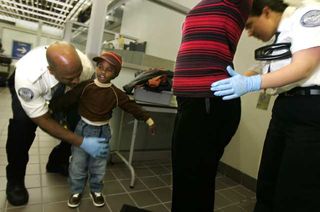
Public outrage at the TSA’s new policies has died down. That’s a real shame. If people stop pressing the issue, full-body scanners and pat-downs aren’t going anywhere. People are still having experiences like this:

I told her I had never undergone this process and was a bit afraid, and she laughed at me and told me I didn’t know what I was talking about.

The woman grabbed my wrist and said she had to look at my plastic watch. I tried to take it off and hand it to her, and she yelled at me not to interfere with her search.

Then, with no explanation, she pulled up my shirt, exposing my stomach and the top of my underwear, and stuck the top half of her fingers inside the waistband of my pants. I yanked my shirt down and told her she was not showing the top of my underwear and my naked stomach to anyone.

She put her hand up in front of me, threatened to call security and have me arrested if I “tried to get away from her again,” and called security for a private screening.

It is well past time to abolish the TSA. The resources it squanders on security theater would be better used on security.

A Bit of Smithian Wisdom

“[T]he law ought always to trust people with the care of their own interest, as in their local situations they must generally be able to judge better of it than the legislature can do.”

-Adam Smith, The Wealth of Nations, Book IV, Ch. 5.

This sentence must have had a tremendous influence on Hayek’s thought.

Intentions Are Not Results

CEI Podcast – December 8, 2010: What’s Driving Ethanol Subsidies

Have a listen here.

CEI Research Associate Brian McGraw talks about the federal government’s multi-billion dollar subsidies for ethanol, which is now dismissed even by environmental groups as an inferior alternative to gasoline. He also explains what lies in ethanol’s near future. Brian was also recently interviewed on RTV’s Thom Hartmann Show, which you can watch here.

Wow. Just Wow.

Dueling Headlines

U.S. to Host World Press Freedom Day

Hillary Clinton: WikiLeaks release an ‘attack on international community’

Printing Money Troubles

There is a lot of talk lately about the Fed’s quantitative easing policy. It is an indirect way of printing money, and also a huge mistake. It turns out the Fed can’t even print money the direct way without making mistakes. A new $100 bill that is harder to counterfeit has been rolling off the presses recently. 1.1 billion of them have been printed so far, at a cost of $120 million.

CNBC reports:

An official familiar with the situation told CNBC that 1.1 billion of the new bills have been printed, but they are unusable because of a creasing problem in which paper folds over during production, revealing a blank unlinked portion of the bill face.

A second person familiar with the situation said that at the height of the problem, as many as 30 percent of the bills rolling off the printing press included the flaw, leading to the production shut down.

The total face value of the unusable bills, $110 billion, represents more than ten percent of the entire supply of US currency on the planet, which a government source said is $930 billion in banknotes.

Coincidentally, these would be the first bills to feature Timothy Geithner’s signature.

Fuzzy Math on Foreign Aid Shows Why Spending Cuts Are Difficult

According to a new poll, the average American thinks that 25 percent of the federal budget is spent on foreign aid (or, more accurately, government-to-government transfers). They would like it cut to about 10 percent.

The actual figure is under 1 percent.

As Aid Watch’s Laura Freschi points out, that means most Americans want to increase government-to-government transfers ten-fold from current levels while also cutting them in half.

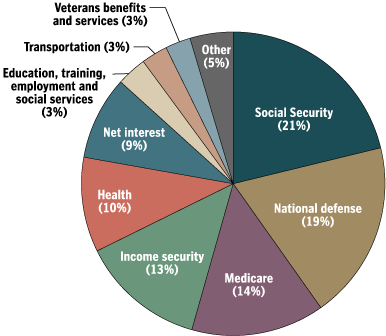
That most people think like this is a major reason why cutting the federal government’s $3.5 trillion budget is so difficult. The issues that people get worked up about tend to be small potatoes, in budgetary terms.

Besides transfer payments to other governments, earmarks are another lightning-rod issue. But even if earmarks were abolished entirely, that’s only about 2 percent of the budget. It would put the smallest of dents in spending.

Entitlement spending is the single largest driver of current and future deficits. That’s where the battle is. Aid spending and earmarks are not threatening to bankrupt the country. Social Security and Medicare are. And those programs are extremely popular. No politician with an eye on 2012 would be willing to cut them.

The government has made promises it can’t possibly keep. But most people refuse to believe that. So they don’t. As a guarding mechanism, they instead make grand assumptions about how much things like transfer payments to other governments and earmarks cost.