Tag Archives: Stimulus

Friday Regulation Roundup

Some of the stranger governmental goings-on I dug up over the week:

-The federal government is spending $73m this year on the Agricultural Water Enhancement Program.

-The federal government has 5,647 words of formaldehyde regulations for the workplace.

-The federal government has an Arthritis Advisory Committee. They’re meeting on May 12 if you care to attend.

-Government spends $2,000,000 on phone lines for a town of 80 people, some of whom already own satellite dishes.

OSHA considers sand a poison because it contains silica.

-Vermont to spend $150,000 to build a tunnel for salamanders to cross a road safely.

-The federal government has a Highbush Blueberry Council.

-A fish hatchery in South Dakota is getting $20,000 in stimulus money for new light fixtures.

-In Virginia, it is illegal in many instances to turn on your air conditioning before May 1. Cato’s Tom Firey has more.

EPA says that de-icing fluid for windshields is an environmental hazard. Worried airline pilots say the EPA is the real safety hazard.

-It is illegal in Kentucky for anyone under 18 to play pool without photo ID and written parental consent.
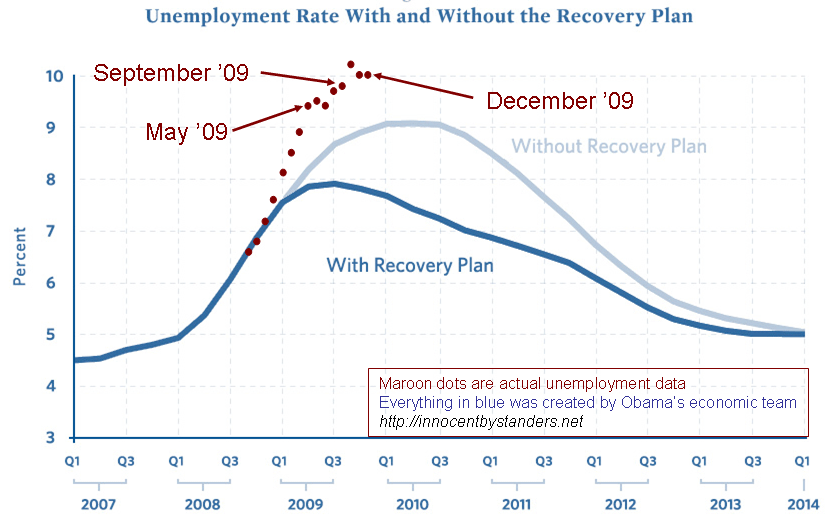

How Wisely Is Stimulus Money Being Spent?

Not at all, to be honest. For starters, the very notion of stimulus violates basic economics. Taking money out of the economy and then putting it back in has no net effect. But it gets worse. Much worse.

When that money is put back into the economy, it goes to the weirdest places — $3.4 million is going to Florida to build a tunnel under U.S. Highway 27, so turtles can cross safely. A fish hatchery in South Dakota is getting $20,000 for new light fixtures. $50,000 is being spent to resurface a tennis court in Bozeman, Montana.

And so on.

These boondoggles aren’t getting nearly enough press. To help fill the vacuum, the good folks at Citizens Against Government Waste have put up a new website, MyWastedTaxDollars.org. Click on over and check it out. The best feature is an interactive map that shows just how unwisely stimulus funds are being spent all over the country.

Stimulus is worse than a zero-sum game. It is actively harmful. It is government saying that it knows how to spend your money better than you do; stimulus is the ultimate act of hubris. Kudos to CAGW and MyWastedTaxDollars.org for providing hundreds of examples of why government hubris should be replaced with government humility.

Senate Passes $18,000,000,000 Spending Bill: Will it Create Jobs?

The Senate just passed an $18 billion spending bill. Since the House already passed it, the legislation is now headed to President Obama’s desk to await his signature and become law.

The hope is that the spending will create jobs. If you’re reading this blog, then you probably know enough about economics to know that isn’t what will actually happen. Remember: anything that Washington giveth, it must first taketh away from somewhere else. It’s a zero-sum game. All those new jobs that politicians will be touting for the cameras will have come at the expense of other jobs elsewhere. On net, they’re not creating a thing.

Take the payroll tax break for small businesses that’s in the bill. Yes, those small businesses benefit. Maybe the money they save will even be used to hire more workers. That’s easy enough to see. But that money had to come from somewhere. That is harder to see. Too hard for the Senate to see, at the very least.

The reason is this: the government is foregoing some payroll tax revenue. But since it isn’t cutting spending to match, it has to borrow more. And there’s only so much investment capital to go around. Because Washington is borrowing more, less is left over for private investment opportunities. At the very least, companies will have to offer investors higher interest rates to lure them away from government bonds.

That makes getting loans more expensive. And when something gets more expensive, there tends to be less of it. Because of today’s bill, about $18 billion less capital will be available for the private sector to create jobs.

The legislation the Senate passed today is no jobs bill, at least on net. It is a spending bill. It doesn’t create jobs, it only redirects them.

Voltaire on Government

Voltaire defined government as  “a device for taking money out of one set of pockets and putting it into another.”*

It appears Keynesian stimulus was debunked two and a half centuries before Keynes even came up with the idea. Economic growth comes from the creation of new wealth. The best government can do is shuffle around wealth created by others.

(*cf. Albert Jay Nock, Our Enemy, the State, p. 128)

Stimulus Spending Helps the Few, Hurts the Many

Here is a letter I sent recently to The New York Times:

February 17, 2010

Editor, The New York Times
620 Eighth Avenue
New York, NY 10018

To the Editor:

Michael Cooper’s article, “Stimulus Jobs on State’s Bill in Mississippi” (February 16, page A1), lists several people who have directly benefited from the stimulus package.

The article names none of the roughly 300 million people directly hurt by that same stimulus package. The money that pays for Roshonda Bolton’s factory job was taken away from other people. They would have spent that money in other job-creating ways.

The stimulus doesn’t actually create jobs. It rearranges them. The best possible result is no net effect. Stories touting jobs saved or created by government are at best incomplete.

Ryan Young
Warren T. Brookes Journalism Fellow
Competitive Enterprise Institute
Washington, D.C.

The Economic Way of Thinking about Stimulus Packages, Part II

In light of the news about stimulus job creation statistics not being as advertised — complete with made-up Congressional districts — I offer another surprisingly relevant insight from Mises’ Human Action. Turns out there is a reason stimulus advocates are resorting to trickery:

“If government spending for public works is financed by taxing the citizens or borrowing from them, the citizens’ power to spend and invest is curtailed to the same extent as that of the public treasury expands. No additional jobs are created.”

-Ludwig von Mises, Human Action, 4th ed., (Irvington-on-Hudson New York: Foundation for Economic Education, 1996 [1949], p. 776.

The Economic Way of Thinking about Stimulus Packages

“[A] government can spend or invest only what it takes away from its citizens… its additional spending and investment curtails the citizens’ spending and investment to the full extent of its quantity.”

-Ludwig von Mises, Human Action, 4th ed., (Irvington-on-Hudson New York: Foundation for Economic Education, 1996 [1949], p. 744.

Dog Bites Man

I am shocked — shocked — that $6 million of stimulus money went to a company accused of “overbilling, bribery of union officials and other alleged improprieties on several large New York projects.” Such lapses in oversight never happen with government spending projects!