Category Archives: Economics

Making Hayek More Approachable

Hayek’s The Constitution of Liberty is a work of great depth. It’s one of those books that one doesn’t read, so much as study. But the extra effort brings ample rewards. Still, it isn’t the most approachable book. For one, its length requires a commitment that many readers aren’t willing to make. For another, Hayek’s verbose prose style does not make for easy reading.

Fortunately, the good folks at IEA have just released Eugene Miller’s summary of all the arguments Hayek makes in The Constitution of Liberty. You can download it for free here. Besides being a good companion to read alongside the original, it looks easier for more casual readers to digest.

IEA has given similar treatments to some of Hayek’s other works. Take a look if you’re new to Hayek, or would like a refresher course on works you’ve already read.

Mission Creep

Documents Reveal TSA Research Proposal To Body-Scan Pedestrians, Train Passengers

The Wealth of Nations Turns 235

Adam Smith’s An Inquiry into the Nature and Causes of the Wealth of Nations was published 235 years ago today.

Over at Cafe Hayek, Russ Roberts links to a few short resources about that long, long book (which I nonetheless recommend reading). Worth checking out.

Regulation of the Day 166: Cowboy Poetry

This year’s budget battle is especially heated. Democrats want the federal budget to be $3.7 trillion. Republicans want it to be $3.6 trillion. Both sides are willing to shut down the federal government rather than give in.

That’s where cowboy poetry, of all things, comes in. This traditional American art form, which I’d never heard of until today, has suddenly become the latest front in the epic struggle over the size and scope of government.

It is currently official federal policy to financially support cowboy poetry. But the GOP wants to cut $61 billion, or 1.6 percent, out of President Obama’s proposed budget. And cowboy poetry funding is on the chopping block.

The main element of federal cowboy poetry policy is a week-long annual festival in Nevada. Nevada is also the home state of Sen. Harry Reid. He is furious about this dire threat to cowboy poets everywhere, calling his opponents “mean-spirited.”

Without the funding, he adds, “the tens of thousands of people who come there [to the festival] every year would not exist.”

If Sen. Reid is right, tens of thousands of people could literally vanish into non-existence if Republicans get their way. Maybe they should reconsider.

If only politicians had that kind of existential power over the $1.6 trillion budget deficit. Oh, wait. They do. All they have to do is spend less.

(via Dan Mitchell)

How to Help Small Businesses

Politicians love small businesses. Almost every campaign stump speech gushes about how important they are for the economy. Never afraid to put our money where their mouth is, politicians even started a Small Business Administration in 1953 to transfer money from taxpayers to small businesses. Today, the SBA’s budget is nearing $1 billion.

Given how much taxpayer money politicians lavish on small businesses, most of elected officials are confident that they are helping, not hurting. They should listen more closely to the consituency they claim to love so much. The Bush-Obama era has been one of ever-increasing regulation. Over 30,000 new rules hit the books under Bush. Obama is regulating at an even faster pace. Many of their rules hurt small businesses.

Paychex, Inc., a payroll service provider that works with many small businesses, recently commissioned a survey. They asked small business owners their thoughts on the economy, and what the biggest obstacles are to growing their businesses. The most common gripe? Regulation. 47 percent of small business owners say that regulations have “slowed or prevented” their business from growing.

The Rochester Business Journal reports that the types of regulations that most concern small business owners are “tax changes (56 percent), health care reform (39 percent) and state regulations in response to budgetary challenges (25 percent). The research found 61 percent of respondents have seen more government regulation over the past five years.”

If Congress is genuinely interested in helping small businesses while speeding up economic recovery, it’s time for a different approach.

Transferring money from taxpayers to small businesses doesn’t help the economy on net. It actually hurts it. One reason is that the prospect of free money encourages small businesses to redirect their energy from entrepreneurship to K Street. Another is that government largesse tends to be given out according to political interests, not consumers’ interests.

Federal regulation alone costs $1.75 trillion to comply with. Congress should lighten the load. 47 percent of small business owners say that regulation has made their business grow more slowly. Letting that 47 percent grow more quickly would go a long way toward getting the economy growing again.


CEI Podcast for February 24, 2011: On, Wisconsin

Have a listen here.

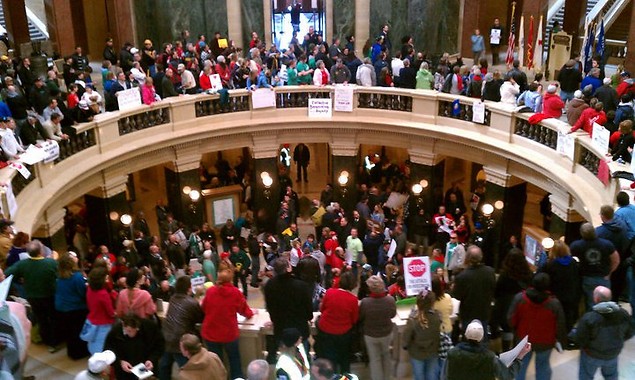
Vice President for Strategy Iain Murray discusses the labor reforms that have led to a thousands-strong sustained protest in Madison, Wisconsin. While the reforms themselves are relatively minor, both sides know that the stakes are high. This may prove to be at a watershed moment in the relationship between public sector unions and taxpayers.

Are the Poor Getting Poorer?

Steve Horwitz thinks the poor are better off than they used to be. The data agree with him.

Are the Wisconsin Protests Backfiring?

Protests in Wisconsin over public sector compensation cuts have been the big story this week. Over at the Daily Caller, I explain why some of the tactics that union members and supporters are using are actually backfiring.

The teacher sickout is classic bad PR. The parents who have to find and pay for last-minute daycare are now less likely to side with teachers’ unions, not more.

The nationwide saturation coverage is actually doing far more damage. Millions of people are learning about the sweetheart salary and benefit deals that many public sector union members get. Even if Gov. Walker’s cuts pass, the protesting workers will still be much better paid than their non-union counterparts. Both are better compensated in turn than most private sector workers.

Read the whole thing here.

More Corporate Welfare on the Way?

Politico headline from today: “Qualcomm exec calls for small-business research funding.”

Alternative headline: “Businessman asks government to give money to businesses.”

Government should not give money to private businesses, period. Businesses should compete in the marketplace, not Washington. There is a lot of money to be made by selling people things they want. Companies that do a good job of that deserve every cent they earn.

Subsidies are not earned. Nor are they given to companies make things people want. Companies already doing that don’t need handouts. In short, corporate welfare is allocated by politics instead of economics.

What Mr. Jacobs is asking for would be a boon for lobbyists and politically favored businesses. But it would be a drag on everyone else. And not only because they would be paying for the handouts. Lost innovations are part of the price. The money spent on corporate welfare is money not spent on more worthy projects.

See also Wayne Crews and I on corporate welfare in the new edition of CEI’s Agenda for Congress.

The Cut that Isn’t

President Obama announced a plan today to cut federal spending by $1.1 trillion over the next ten years. That’s an average of $110 billion per year, or a little less than 3 percent of federal spending. My employer, CEI, issued a press release about the proposal today that quotes several of our experts. Here’s what I said:

$400 billion of President Obama’s proposed budget cuts would come from freezing non-security discretionary spending, which means it would stay the same. A cut is when spending goes down. While this proposal is better than nothing, at least a third of it is based on false advertising.

You can read the full press release here.