Regulation of the Day 138: Dwile Flonking

Britons sure do seem to have a lot of time on their hands. Take, for example, the colorfully-named pastime of dwile flonking. Players soak a rag in beer and put it on top of a pole. Then they use the pole to hurl the rag at other players.

A player who misses twice in a row is called a “flonker.” Flonkers are required to drink a beer before the opposing team can pass the errant rag all the way around him in a circle.

This year’s dwile flonking world championship was to be held in Norfolk. Then regulators got involved. As one can tell by the rules, dwile flonking is a drinking game. And drinking games are forbidden now. Legislation passed earlier this year banning them.

The American journalist H.L. Mencken defined Puritanism as “The haunting fear that someone, somewhere, may be happy.” He may as well have been talking about regulators.

And thanks to the new Puritanism, we may never know who the world’s top dwile flonkers are.

Will Durant on Human Achievement

I spent a good chunk of the long weekend engrossed in Will Durant’s autobiography, Transition. Durant and his wife Ariel were best known for their 11-volume The Story of Civilization series, which is a fine introduction not just to history, but to literature, philosophy, art, music, science, and all the other cantos in the poem of human life.

Transition is mainly the tale of Durant’s transition from seminarian to secularist, and from his youthful flirtations with socialist anarchism to a gentler, more tolerant and mature worldview that saw humanity as a good but flawed creature, set in his ways, yet capable of breathtaking progress and achievement. This passage, describing Durant’s first trip to Europe in 1912 aboard an oceanliner, captures that transition in microcosm:

One night there was no moon, nor any star; then our great ship, ghastly alight in the engulfing dark, seemed like a phosphorescent insect struggling in the sea. But as we neared the rocks of Britain’s ancient shore the mood of my thinking changed, and I marveled not at the vastness of the ocean but at the courage of man, who had ribbed it everywhere with the paths of his floating cities; who had dared to make great arks of heavy iron and fill them with thousands of tons of the products of human hands; who had built upon these frames luxurious homes for many hundred men; who had made engines capable, through the expansion of a little steam, of propelling this enormity of steel and flesh safely and quickly across the widest seas, making the rage of the ocean impotent. It was man that was marvelous, I said, as I stood secure and relieved on the solid soil of England.

(Transition, pp. 218-19)

Federal Register hits 30,000 Pages

With a notice from the Defense Department that it is selling $122 million of equipment to Great Britain, the 2010 Federal Register passed 30,000 pages.

After 103 working days, the total page count is 30,265. Assuming 250 working days in a year, this year’s Federal Register is on pace for 73,459 pages.

The average count during the Bush administration was 73,416 pages.

Like most of President Obama’s policies, this represents less than a one percent change from the Bush years.

Brownies around the Web

My colleague Lee Doren made a short video on the Pentagon’s 26-page brownie recipe. Have a look:

NPR’s All Things Considered also ran a segment on the recipe over the weekend. They had a local chef prepare brownies according to the directions, and dug up a streamlined version of the recipe that is — wait for it — 31 pages long. Have a listen here.

The humor site Fark picked up on Reason‘s write-up.

So did food sites like Chow and Slashfood.

The Chicago Tribune has a blurb on it, St. Louis Post-Dispatch has an editorial, and the tabloid Weekly World News has its own article. The Huffington Post covered the story, along with their friends across the aisle at National Review.

CBS News picked up on it, along with Canada’s The Globe and Mail.

Lots of bloggers are having at it as well, including Instapundit.

Good to see so many people from across the political spectrum coming together for a good laugh!

The Two Americas

Maybe there is something to John Edwards’ “Two Americas” conceit after all. Except the warring factions aren’t the haves and have-nots. They are what Steven Malanga calls tax eaters and tax payers. And the two see the world very differently. See this revealing excerpt from today’s WSJ Political Diary (subscription required).

Pollster Scott Rasmussen uses several questions to break down voters demographically, but one of his most original tweaks is to differentiate between those voters he calls the “Political Class” and those he calls “Mainstream Americans.” The “Political Class,” representing about 14% of the electorate, tend to express “trust” in political leaders while rejecting suggestions that government is its own special interest and often works with big business against consumers. In contrast, “Mainstream Americans” represent about 75% of the voting public and identify with or lean toward a more populist skepticism about the intentions and actions of political leaders.

Striking is how the two groups divide on the question of repealing ObamaCare. “Mainstream Americans” support repeal by an overwhelming 73%, while the numbers are almost exactly reversed among the “Political Class,” 72% of whom oppose repeal.

Get Spit On, Take Three Months Off

New Yorkers have a reputation for being rude. But they are also a sensitive lot. Especially bus drivers. Last year, angry customers literally spit on bus drivers 51 times. The experience was so harrowing for one unidentified driver that he or she needed 191 days of paid leave to recover. The average driver took 64 days of paid leave after being spat upon.

Seems a bit much. But union leaders think it’s justified.

“Being spat upon — having a passenger spit in your face, spit in your mouth, spit in your eye — is a physically and psychologically traumatic experience,” said John Samuelsen, the union’s president. “If transit workers are assaulted, they are going to take off whatever amount of time they are going to take off to recuperate.”

Getting spit on is not fun. And it can certainly ruin one’s day. But the recovery time for most people is measured in minutes, not months.

Raul Morales, 52, has been driving city buses for five years, but his first encounter with spit came early.

“A guy wanted to get on the bus; I told him the fare; he didn’t want to pay it,” Mr. Morales said. “So, he spat at me.”

The spittle landed on his shirt and glasses. He stopped at a nearby McDonald’s to clean himself off, then finished his shift. “I just kept on going.” (An ice slushie was once thrown at him for the same reason.)

Mr. Morales said it did not occur to him to take an extended absence to recover.

Good to see that common sense isn’t completely dead.

It is sad that so many transit employees have no problem taking months-long vacations at taxpayer expense, using the flimsiest of excuses. That kind of behavior wouldn’t fly in the productive sector.

New York City Transit is running a $400 million deficit this year. Saliva-induced vacations alone account for nearly a million dollars of that, based on average salaries. That money could have gone towards softening looming service cuts. It could have gone to repairing aging infrastructure. It could have gone to employees who actually work.

But when labor rules are as generous as they are for many public-sector union workers, it should come as no surprise that some people will game the system.

Which Is More Dangerous: Government or Corporations?

Corporations are not saints, especially the bigger ones. They routinely seek subsidies, tax breaks, and other forms of corporate welfare. And contrary to popular belief, corporations usually favor burdensome new regulations. After all, a large, established company can afford the expense. But smaller upstarts can’t. Too often, regulations are simply a way of keeping competitors out of the market.

The common ingredient in all of that perfidy is government. Markets do not respect special interests; Washington exists to cater to them. Many anti-corporate activists have their heart in the right place. But their ire is misplaced.

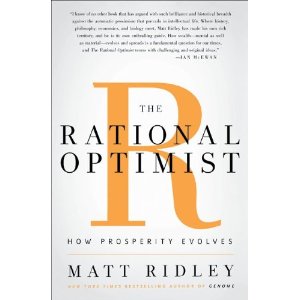
In that vein, here is a bit of wisdom from Matt Ridley’s excellent new book, The Rational Optimist:

Companies have a far shorter half-life than government agencies. Half of the biggest American companies of 1980 have now disappeared by takeover or bankruptcy; half of today’s biggest companies did not even exist in 1980. The same is not true of government monopolies… Yet most anti-corporate activists have faith in the good will of the leviathans that can force you to do business with them, but are suspicious of the behemoths that have to beg for your business. I find that odd.

(p. 111)

A Telling Headline

From The Hill: Vulnerable Democrats defend support for campaign finance legislation

Campaign finance regulations are an incumbent’s best friend. The incumbent already has name recognition, and a deep network of fundraising contacts. Heck, Congress’ franking privilege allows incumbents to send out de facto campaign messages for free. Challengers have none of those advantages.

It takes a lot of money to buy enough ads to get a challenger’s name recognition anywhere near the incumbent’s. Campaign finance regulations make it harder to raise that money, and harder to put up a fight against established officeholders. No wonder so many incumbents from both parties favor strict campaign finance regulations! It’s good for their job security.

Happy 204th Birthday, John Stuart Mill

John Stuart Mill was born on this day in 1806. I wrote an appreciation of him last year, and told a bit of his unusual life story. This year, I’ll write a little bit on his philosophy of utilitarianism.

There are two kinds of utilitarianism: act utilitarianism, and rule utilitarianism. Act utilitarianism leads to absurd conclusions; rule utilitarianism, while more lenient, is one of the strongest philosophical underpinnings of liberalism (in the traditional European sense of the word). Many later liberals, including F.A. Hayek, were rule utilitarians.

Act utilitarians think that each individual act should be judged according to how much good it does. This leads to some problems, since most actions involve at least some small harm to others.

If I drive to work, I can save myself a lot of time. But by contributing to traffic congestion, I hurt each of my thousands of fellow drivers just a little bit. Maybe I cost them more total time than I save, so my driving causes a net loss in utility. So that’s not a good option. The subway, then? Same thing. Not only do I lose some time compared to driving, but I make the train more crowded, which causes disutility to every passenger on the train.

Better to just sit at home, then. But then I don’t get anything done. That’s bad for my career, not to mention my bank account. Act utilitarianism is a bit like Pareto optimality in economics: it leads to paralysis. It is an impossible standard.

That’s why I prefer rule utilitarianism. Instead of judging each act by its utility, put rules in place that give people incentives to act well. No law or institution is perfect. Even the best ones hurt somebody; a law against theft is bad for thieves. But good institutions beget good results, especially in the long run.

A property-rights-based system of government is an excellent example of rule utilitarianism. It will not be perfect. Laws against stealing obviously have not put end to stealing. Even within the law, people inevitably have honest disagreements about what belongs to who. Externalities such as pollution will hurt some peoples’ property. But the results are certainly better than a system without property rights. The whole of world history is proof. It’s also better than act utilitarianism, which lacks that overarching institutional-level standard.

Rule utilitarianism is one of the greatest gifts ever given to liberalism’s intellectual toolkit, and we have Mill to thank for it. Happy birthday to you, John Stuart Mill.

Solving America’s Problems

The days of trillion-dollar deficits, multiple land wars in Asia, and other catastrophes may soon be coming to an end. Congress continues to work long and hard to solve America’s most important problems. Take a look at some of the legislation that passed on May 18:

H. Res. 1256: congratulating Phil Mickelson on winning the 2010 Masters golf tournament

H. Res. 792: honoring Robert Kelly Slater for his outstanding and unprecedented achievements in the world of surfing and for being an ambassador of the sport and excellent role model

H. Res. 1297: supporting the goals and ideals of American Craft Beer Week.

H.R. 4491: to authorize the Secretary of the Interior to conduct a study of alternatives for commemorating and interpreting the role of the Buffalo Soldiers in the early years of the National Parks, and for other purposes

I applaud each and every one of these bills, frivolous though they are. Each one took a good deal of time to write and to put through committee. Each one was given 40 minutes of floor debate, though less than that was typically used. All of that time and effort was not spent further destroying the economy with more substantive legislation.

Most states get by with part-time legislatures. Congress would do well to follow suit. In the meantime, as long as Congress is full-time, it should devote as much time as possible to trivial bills like the ones listed above.