Regulation of the Day 153: Pentagon Cybersecurity

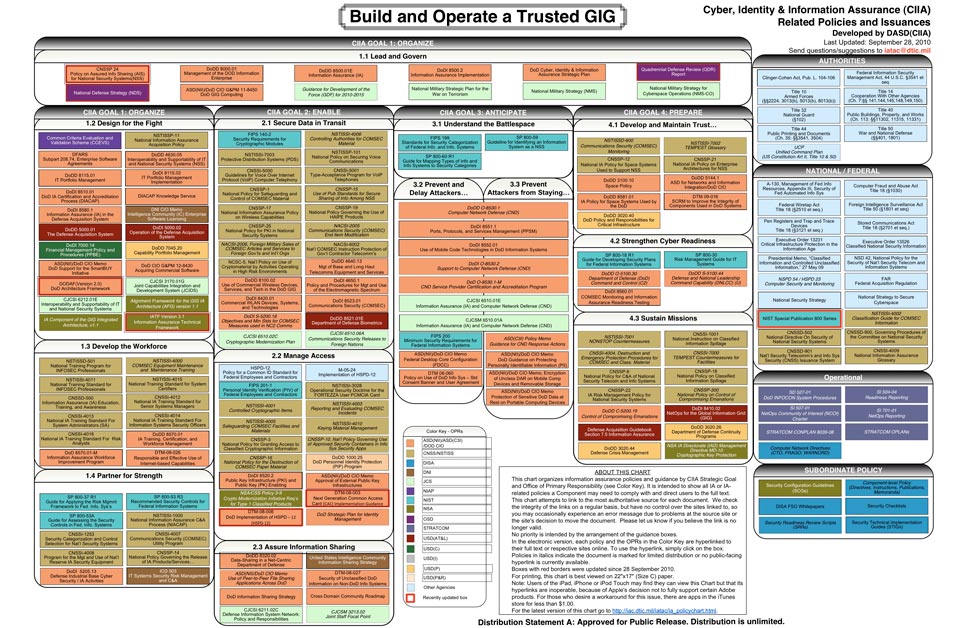
One of the things government regulates is itself. And it sure isn’t shy about it. The military’s cybersecurity experts are governed by 193 policy documents. They are all conveniently listed in a chart. It is two feet long.

The U.S. is currently fighting two land wars in Asia. Keeping military computer networks secure is literally a matter of life and death. Let us not forget for a second how important the Pentagon cybersecurity team’s work is for keeping troops safe. But Wired makes the point that too much regulation just might hinder security more than it helps:

Obviously, operating networks for the millions of people who make up the world’s largest military is no simple task: The financial, legal, organizational and technical issues are nothing short of staggering. On the other hand, the hackers trying to break into those networks don’t have to check 193 different policy documents before they launch their malware. It’s hard not to think that gives the attackers an edge.

CEI Podcast – October 14, 2010: Antitrust Follies and Regulatory Reform

Have a listen here.

CEI Vice President for Policy Wayne Crews talks about why antitrust actually hurts competition, and offers some ideas for regulatory reform based on his recent articles for BigGovernment.com and The Washington Times, and on his annual Ten Thousand Commandments report.

Why Trade and War Are Different

There is lots of talk about trade wars lately. We especially need to get tough on China, our politicians tell us. Over at The American Spectator‘s AmspecBlog, I highlight why real wars and trade wars are very, very different
. It’s time to put that misguided analogy to rest.

Foreign Money Is Not the Problem

President Obama has caused a stir recently by declaring that the Chamber of Commerce, which is running ads critical of his policies, is funded with foreign money.

It’s a weak criticism. And not just because the amount of foreign money involved is trivial. Or because labor unions and other political groups across the spectrum also accept small amounts of foreign money.

President Obama seems to be saying that people are smart enough to know whether or not a candidate or a political party is bamboozling them in their campaign ads. But people suddenly lose their wits when an outside group, or – gasp! – someone from another country does the exact same thing. That kind of cognitive dissonance must be difficult to live with.

Because arguments against foreign money in politics are so weak, people who use those arguments are either ill-informed or lying.

Lying is much more likely in this case. If your own arguments are weak, a common tactic is to distract your audience and hope they don’t notice. It works more often than not. Here, President Obama is taking advantage of the fact that almost all people suffer from anti-foreign bias. Not racism. Anti-foreign bias. They’re different. And pandering to that bias can be extremely useful politically.

Why does such a cheap tactic work? It’s because anti-foreign bias is in our DNA. Our hunter-gatherer ancestors lived in small bands. Anybody outside that band was a very real threat to steal food, clothing, or potential mates. So people learned to be wary of outsiders. It was good for one’s life expectancy.

As tribes became villages, towns, cities, and now nations, the number of people we consider insiders has grown. And we treat outsiders much better than we used to. Trade is more common than war in most places. But most people are still instinctively leery of outsiders. It is our nature.

That’s why it’s disappointing to see President Obama so cynically play that card. Clearly he and the Chamber of Commerce prefer different policies. It would be nice to see the President engage the Chamber at a higher level than the ad hominem.

Regulation of the Day 152: Locking Your Car Door

Most car thefts happen to unlocked cars. The government of Bucks County, Pennsylvania, thinks it can help. It plans to issue $25 fines to people who forget to lock their cars. First-time violators get off with a warning.

Bear in mind that enforcing this policy involves police systematically trying to break into peoples’ cars. First, that’s inherently creepy. Second, that’s a significant privacy violation. It’s also a Fourth Amendment issue. If an officer stumbles upon something illegal and decides to prosecute, he has performed a warrantless search.

It’s also a safety issue. If a thief decides to play dress-up and look like an officer, he could very easily steal valuables from parked cars in broad daylight and no one would be the wiser.

One more problem to add to the pile is corruption. A legitimate officer might be tempted to give himself a quick pay raise at a forgetful car owner’s expense. Policing for profit is all too common.

Better for the government to stay out of this one.

Just Say Neigh

I have a post over at the AmSpec blog about a $4.6 million bridge used by 50 horses and the people who ride them. That’s $92,000 per horse.

First, Try Getting the Little Things Right

Conservatives and progressives believe in the power of government. Conservatives think that government can build democracies abroad and enforce morality. Progressives think government can lift people out of poverty and correct market failures.

This faith in government is simply astounding, given the evidence to the contrary. Government is charged with some big tasks. Some of them are necessary. But often, it can’t even do the little things. Have a look at these two news stories:

Stimulus Checks Sent to the Dead

Postal Union Election Delayed After Ballots Lost in the Mail

Washington has centuries of experience cutting checks and delivering the mail. You’d think they’d have it down by now; apparently not. Even so, politicians from both parties are still pushing for more, more, more. The right wants more military spending. The left wants more entitlement spending. They have all the faith in the world that their proposals will work as intended.

Sometimes, being a classical liberal feels like being the only atheist in a room full of believers.

CEI Podcast – October 7, 2010: Trade, Jobs, and Korea

Have a listen here.

CEI Adjunct Fellow Fran Smith talks about the EU-Korea free trade agreement that takes effect next year, and why the US-Korea FTA stalled, to the economy’s detriment. Fran also talks about NAFTA’s impact on jobs, and why imports are a good thing.

Misplaced Ire

Pundits are having a field day with the fact that a fire department in Tennessee let a house burn down because the owner didn’t pay his annual $75 fire protection fee. Proof that libertarianism is a failure.

Was it? Tom Firey sums it up thusly:

In a nutshell: The firefighters involved were city government firefighters following a city government policy concerning people who didn’t pay a city government fee for a 20-year-old city government program that was adopted in response to a county government decision.

The commentariat is liable to sprain an ankle, jumping to conclusions like that.

Skilled Immigrants: More, Please

Over at the Daily Caller, my CEI colleague Alex Nowrasteh makes the case for doing away with the cap on H-1B visas. The cap limits the number of highly skilled immigrants to 85,000 per year. In most years, all 85,000 spots are filled in a single day. Applications were down last year and this year because of the recession. But they’ll bounce back as soon as the economy does. At the very least, the cap should be substantially raised. It would be better if the cap were eliminated altogether.

The reason the cap exists is that some people think skilled immigrants take jobs away from Americans. Alex explains why that isn’t true:

There is no fixed number of jobs to be divided among Americans.

Foreign skilled workers don’t “take” American’s job; they complement them. Foreigners are not substitutes for U.S.-born workers even when they have similar skills and experience.  In many situations, H-1B workers push Americans into managerial or other higher positions.

Many people also believe that skilled immigrants lower wages for native-born Americans. That isn’t true either:

If cash-strapped businesses could drastically cut wages by hiring more H-1B workers instead of native-born workers, then applications for H-1B visas would increase during recessions as businesses cut costs.  The opposite is true.  H-1B applications fall dramatically during recessions.

Firms that employ H-1B visa workers do so when they are expanding production and have trouble meeting their labor requirements domestically.  Observing this effect, the National Foundation for American Policy reported in 2009 that for every H-1B position requested, U.S. technology firms increase their employment by five workers.

The government’s artificial limit on skilled immigration is prolonging the recession. The H-1B cap needs to be either raised or done away with entirely. American jobs depend on it.