Printing Money Troubles

There is a lot of talk lately about the Fed’s quantitative easing policy. It is an indirect way of printing money, and also a huge mistake. It turns out the Fed can’t even print money the direct way without making mistakes. A new $100 bill that is harder to counterfeit has been rolling off the presses recently. 1.1 billion of them have been printed so far, at a cost of $120 million.

CNBC reports:

An official familiar with the situation told CNBC that 1.1 billion of the new bills have been printed, but they are unusable because of a creasing problem in which paper folds over during production, revealing a blank unlinked portion of the bill face.

A second person familiar with the situation said that at the height of the problem, as many as 30 percent of the bills rolling off the printing press included the flaw, leading to the production shut down.

The total face value of the unusable bills, $110 billion, represents more than ten percent of the entire supply of US currency on the planet, which a government source said is $930 billion in banknotes.

Coincidentally, these would be the first bills to feature Timothy Geithner’s signature.
Fuzzy Math on Foreign Aid Shows Why Spending Cuts Are Difficult

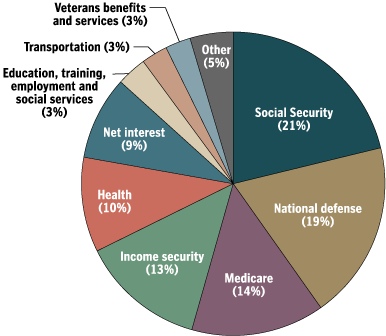
According to a new poll, the average American thinks that 25 percent of the federal budget is spent on foreign aid (or, more accurately, government-to-government transfers). They would like it cut to about 10 percent.

The actual figure is under 1 percent.

As Aid Watch’s Laura Freschi points out, that means most Americans want to increase government-to-government transfers ten-fold from current levels while also cutting them in half.

That most people think like this is a major reason why cutting the federal government’s $3.5 trillion budget is so difficult. The issues that people get worked up about tend to be small potatoes, in budgetary terms.

Besides transfer payments to other governments, earmarks are another lightning-rod issue. But even if earmarks were abolished entirely, that’s only about 2 percent of the budget. It would put the smallest of dents in spending.

Entitlement spending is the single largest driver of current and future deficits. That’s where the battle is. Aid spending and earmarks are not threatening to bankrupt the country. Social Security and Medicare are. And those programs are extremely popular. No politician with an eye on 2012 would be willing to cut them.

The government has made promises it can’t possibly keep. But most people refuse to believe that. So they don’t. As a guarding mechanism, they instead make grand assumptions about how much things like transfer payments to other governments and earmarks cost.

Quotation of the Week

“To err is human; to get paid for it, you have to be an economist.”

Larry Sabato, on unemployment projections being 100,000 off from what was released today.

From Poor and Sick to Healthy and Rich

Via Russ Roberts, this is an amazing video. I’m always impressed with creative, compelling ways to use data to tell a story. And this story is one of the most important in human history: how most of humanity went from being poor and sick to healthy and rich in just 200 years.

There is still a ways to go. But if past is prologue, I’m optimistic about the future.

Federal Register Hits 75,000 Pages

The Federal Register is not a perfect barometer of how active government is. Sometimes rules that ramble on for dozens of pages are almost innocuous. An economically disastrous regulation can take up less than a page. But in general, high page counts mean a more active government.

Over at the AmSpec blog, I break down some of the numbers behind the Federal Register’s latest milestone — 75,000 pages.

President Bush still holds the adjusted page count record. But President Obama is putting up quite a challenge; at its current 327-page per day pace, the 2010 Federal Register would be 81,560 unadjusted pages long.

Like, Totally

Overuse (and misuse) of the word “like” is an obstacle to clear speaking and clear thinking. It is also a signal to the rest of the world that one need not be taken seriously.

Christopher Hitchens has an amusing article on the history of “like,” pointing out that “in some cases the term has become simultaneously a crutch and a tic, driving out the rest of the vocabulary as candy expels vegetables. But it didn’t start off that way, and might possibly be worth saving in a modified form.”

I largely agree. Read the whole thing over at Vanity Fair.

They Must Be Dog People

Report: Kill the Feral Cats

Do You Want the IRS Doing Your Taxes?

The average American spends over 26 hours per year doing taxes. That’s too much. The obvious solution is to simplify the 70,000-page tax code. But that’s politically difficult. So Austan Goolsbee, among others, has an alternative idea: have the IRS do your taxes for you.

This return-free system is a bad idea for a lot of reasons. One of them is the obvious conflict of interest when your tax collector is also your tax preparer.

Another reason is that the IRS is not up to the task. As I explain in an op-ed being distributed by McClatchy News Services, the IRS rarely has all the information it needs to fill out an accurate return for any one individual, household, or business. People change jobs. They have kids. They get married, and sometimes divorced. They buy homes and cars. Who knows what kinds of deductions they qualify for? The IRS probably doesn’t.

And if the IRS makes a mistake on your return, you would be liable for it. If you want to stay on the right side of the law, you would have to calculate your own taxes anyway, to make sure the IRS got it right. So much for saving time.
Return-free systems have already been tried in California and the UK. Neither attempt can be called a success.
It is heartening that officials are looking for ways to reduce the burden of doing taxes. But a return-free system would treat only the symptom, and poorly at that. The root problem is an arcane, 70,000 page tax code. The solution is to simplify it.

CEI Podcast – November 30, 2010: Food Safety, Washington-Style

Have a listen here.

CEI Senior Fellow Greg Conko looks at the major provisions of the food safety bill that the Senate is voting on today. The bill would set in stone ever-evolving best practices. Changes to plant inspection and food recall policies are a mix of ineffectiveness and perverse incentives that could raise food prices. Overall, the FDA is too blunt an instrument to be effective on this sensitive issue.

The Decline and Fall of Modern Art

Headline: Logger hauls away sculpture mistaken for wood pile

The sculptor told CTV, “I think I’ll have to have a sign put up, but part of the art is to work in harmony with nature surrounding it.”

Fortunately, he seems to have taken the incident in good humor.