Category Archives: Economics

Get Spit On, Take Three Months Off

New Yorkers have a reputation for being rude. But they are also a sensitive lot. Especially bus drivers. Last year, angry customers literally spit on bus drivers 51 times. The experience was so harrowing for one unidentified driver that he or she needed 191 days of paid leave to recover. The average driver took 64 days of paid leave after being spat upon.

Seems a bit much. But union leaders think it’s justified.

“Being spat upon — having a passenger spit in your face, spit in your mouth, spit in your eye — is a physically and psychologically traumatic experience,” said John Samuelsen, the union’s president. “If transit workers are assaulted, they are going to take off whatever amount of time they are going to take off to recuperate.”

Getting spit on is not fun. And it can certainly ruin one’s day. But the recovery time for most people is measured in minutes, not months.

Raul Morales, 52, has been driving city buses for five years, but his first encounter with spit came early.

“A guy wanted to get on the bus; I told him the fare; he didn’t want to pay it,” Mr. Morales said. “So, he spat at me.”

The spittle landed on his shirt and glasses. He stopped at a nearby McDonald’s to clean himself off, then finished his shift. “I just kept on going.” (An ice slushie was once thrown at him for the same reason.)

Mr. Morales said it did not occur to him to take an extended absence to recover.

Good to see that common sense isn’t completely dead.

It is sad that so many transit employees have no problem taking months-long vacations at taxpayer expense, using the flimsiest of excuses. That kind of behavior wouldn’t fly in the productive sector.

New York City Transit is running a $400 million deficit this year. Saliva-induced vacations alone account for nearly a million dollars of that, based on average salaries. That money could have gone towards softening looming service cuts. It could have gone to repairing aging infrastructure. It could have gone to employees who actually work.

But when labor rules are as generous as they are for many public-sector union workers, it should come as no surprise that some people will game the system.

Which Is More Dangerous: Government or Corporations?

Corporations are not saints, especially the bigger ones. They routinely seek subsidies, tax breaks, and other forms of corporate welfare. And contrary to popular belief, corporations usually favor burdensome new regulations. After all, a large, established company can afford the expense. But smaller upstarts can’t. Too often, regulations are simply a way of keeping competitors out of the market.

The common ingredient in all of that perfidy is government. Markets do not respect special interests; Washington exists to cater to them. Many anti-corporate activists have their heart in the right place. But their ire is misplaced.

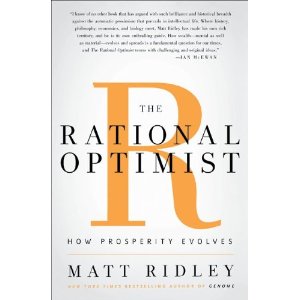
In that vein, here is a bit of wisdom from Matt Ridley’s excellent new book, The Rational Optimist:

Companies have a far shorter half-life than government agencies. Half of the biggest American companies of 1980 have now disappeared by takeover or bankruptcy; half of today’s biggest companies did not even exist in 1980. The same is not true of government monopolies… Yet most anti-corporate activists have faith in the good will of the leviathans that can force you to do business with them, but are suspicious of the behemoths that have to beg for your business. I find that odd.

(p. 111)

Solving America’s Problems

The days of trillion-dollar deficits, multiple land wars in Asia, and other catastrophes may soon be coming to an end. Congress continues to work long and hard to solve America’s most important problems. Take a look at some of the legislation that passed on May 18:

H. Res. 1256: congratulating Phil Mickelson on winning the 2010 Masters golf tournament

H. Res. 792: honoring Robert Kelly Slater for his outstanding and unprecedented achievements in the world of surfing and for being an ambassador of the sport and excellent role model

H. Res. 1297: supporting the goals and ideals of American Craft Beer Week.

H.R. 4491: to authorize the Secretary of the Interior to conduct a study of alternatives for commemorating and interpreting the role of the Buffalo Soldiers in the early years of the National Parks, and for other purposes

I applaud each and every one of these bills, frivolous though they are. Each one took a good deal of time to write and to put through committee. Each one was given 40 minutes of floor debate, though less than that was typically used. All of that time and effort was not spent further destroying the economy with more substantive legislation.

Most states get by with part-time legislatures. Congress would do well to follow suit. In the meantime, as long as Congress is full-time, it should devote as much time as possible to trivial bills like the ones listed above.

How Much Would a Congressional Pay Cut Save?

Rep. Ann Kirkpatrick is proposing a 5 percent pay cut for members of Congress.

“In the face of our ever-deepening federal debt, the federal government must follow their example by finding common-sense solutions to do more with less,” she told The Hill.

A noble sentiment. And one that would save $8700 per member. With 535 members of the House and Senate, the total savings are $4.65 million.

The federal government is on track to spend about $3.8 trillion this year. Trimming $4.65 million means that for every $816,502 the federal government spends, it would save one dollar.

Rep. Kirkpatrick is proposing a 0.00122 percent spending cut. That’s not even a rounding error.

I do not intend to mock Rep. Kirkpatrick. Her spending cut is better than nothing, and I am glad she is proposing it. But placed in proper context, it is very, very small. It is a largely symbolic proposal, and should be treated as such. A 5 percent pay cut for Congress is no austerity measure.

More fundamental solutions would involve fundamental entitlement reform paired with a deregulatory stimulus. Cato’s Chris Edwards has some other spending cut ideas that deserve a serious look. They total $380 billion, or ten percent of federal spending.

Tea Parties and Corporations

Milwaukee’s alternative weekly, the Shepherd Express, recently ran a thought-provoking article by Lisa Kaiser criticizing the tea party movement. I haven’t written a whole lot about the tea party movement. But my reaction has been mixed.

The positive is that a large and vocal constituency is agitating for lower spending and lower taxes. That’s been missing from the protest scene since at least Vietnam.

The negative was summed up almost perfectly by Koch Industries VP Richard Fink: “Some of their worries are… more thoughtful, some of them are less thoughtful.”

If you think about it, tea partiers are the right-wing analogue of Bush-era Iraq war protesters. Both of their main causes are true and just. War against a country that never attacked us is wrong. So is the Bush-Obama spending spree.

But both movements attracted a fringe. A loud fringe. A fringe that, because of their volume, their kookiness, their entertainment value – attracted disproportionate press coverage. Tea partiers have their birthers and John Birchers and so on. The anti-war movement has its Code Pink, truthers, and other strange, fascinating, creatures.

Now suppose you’re a journalist covering one of these protests. You’re on a deadline, and you don’t know a whole lot about what you’re covering.

You could write a story about the ordinary people in jeans and t-shirts, kids in tow, holding up their signs with quiet dignity.

Or you could talk to outlandish – and outlandishly quotable! – nutjobs from Code Pink or the John Birch Society. It’s pretty obvious which tactic gets you the more entertaining story in less time.

An economist would point this out as a classic example of the law of demand. If something costs less, people consume more of it. If it costs more, then less. Since writing a story about colorful kooks costs less time and effort than interviewing ordinary people, no wonder so many newspaper stories are of the cheaper-effort variety.

Which brings us to the article in question.

The words “corporate,” “corporations,” and variations of the same appear nine times. And it is not a long article. Each time, the epithet is unsubtly used as shorthand for “I disagree with this.”

This is a mental shortcut — evidence that Kaiser did not give the issue deep thought. If your gut feeling is that you don’t like something, you can research it to find out for sure. But that is very costly in terms of time and effort. It’s mentally cheaper to just blame “the corporations.”

This is not a rigorous line of thought. Arguments are either right or wrong. The presence or absence of corporate funding has nothing to do with whether an argument is right or wrong.

Take the pull quote from the print edition:

“Americans for Prosperity is a corporate-funded front group that is trying to extract as much of our public dollars as they can and then put it (sic) in the hands of the corporations that fund it.”

That isn’t actually true. AFP is against corporate bailouts. Against corporate subsidies. AFP thinks that corporations should compete in the marketplace. Not in Washington. Public dollars should be kept as far away from corporations as possible. The source who Kaiser quotes is factually inaccurate. And she doesn’t correct him. She agrees with him.

He uses the same mental shortcut that Kaiser does. Just use the word “corporate” to stand for that which he disagrees with. Then he attributes those views to AFP, blissfully unaware of AFP’s actual stances on taxpayer-to-corporation wealth transfers.

This is intellectually lazy. If Kaiser and the activist are against government funding of corporations, they actually have a lot in common with AFP.

Kaiser quotes another activist:

“It’s no coincidence that profits from giant corporations are being pumped into front groups like AFP to further those corporate interests.”

This guy doesn’t get it either. Dollars tend to flow to causes that the donors already agree with. The arrow of causality is pointing in the opposite direction that he thinks.

For example, I favor legalizing same-sex marriage. Suppose that I’m planning to donate money to an organization to advance my view on that issue. Will I get better results by giving to a group that already agrees with me, or by giving to Focus on the Family in hopes of changing their mind?

Koch Industries in particular comes under fire for its longtime support of free-market organizations. And they have much to gain from the crony capitalism they are accused of promoting.

But they aren’t actually promoting crony capitalism. If their political giving actually was made in the name of corporate self-interest, they’d be giving to groups like the Center for American Progress, which openly favors giving billions of taxpayers’ dollars to corporations.

Instead, Koch-funded groups believe, across the board, that corporate welfare is wrong. The Koch brothers are free-market ideologues, and it shows in their philanthropy.

Kaiser’s Shepherd Express article is an interesting read. But not for what it says about tea parties and corporations. It’s interesting because of what it says about her, and about how the law of demand partially explains the poor quality of most journalism.

Department of Redundancy Department

Fun fact: the federal government has both an International Trade Administration and an International Trade Commission.

The Correct Capital Gains Tax Rate Is Zero

Cato’s Dan Mitchell gives a quick primer on the capital gains tax in the latest short video from the Center for Freedom and Prosperity.

President Obama wants to raise the rate from 15 percent to 20 percent. Dan gives six reasons why he should lower it to zero:

-Taxing saving and investment more means there will be less of it.

-Entrepreneurs will take fewer risks since higher capital gains taxes lower their return on investment. Why bother to innovate?

-America’s high capital gains tax rate makes us less competitive than other countries that have a lower tax rate – or no tax at all.

-IRS busybodies nosing around in our investment portfolios is hardly conducive to protecting privacy.

-Investment creates jobs. The capital gains tax lowers investment, and therefore job creation.

-A capital gains tax is inherently unfair. Tax laws should not penalize people based on how they earn, spend, or save their income. Taxes should be as neutral as possible.

Regulation of the Day 134: Not Voting

The lede to this Denver Post article says it all:

RIDGWAY — Residents of this Old West- meets-New Age town can be fined if their fences are too high, they have too many chickens, their dogs aren’t on leashes or their weeds are out of control.

Tom Hennessy would like to add not voting to that list.

There are three things wrong with Mr. Hennessy’s proposed regulation. One is that mandatory voting is a violation of personal freedom. To vote or not is an important choice that people make for themselves. It is not Mr. Hennessy’s place to make that decision for others. Many countries have tried mandatory voting over the years, most notably the Soviet Union.

The second thing wrong with mandatory voting is that it violates freedom of speech. Mr. Hennessy is aware that compelled speech is just as unconstitutional as censored speech. That’s why he proposes a “none of the above” option on ballots. But some people are sending a deliberate message when they choose not to vote. Mr. Hennessy would fine them for sending that message.

The third point is that, maybe, some people shouldn’t vote. If I step into a voting booth not knowing a thing about the candidates or the issues, I am essentially choosing at random. And choosing wrong means voting against everything I stand for.

Even worse, human beings have built-in cognitive biases that affect their voting habits. Economist Bryan Caplan’s book The Myth of the Rational Voter identifies anti-foreign bias, anti-market bias, make-work bias, and pessimistic bias, for starters.

Even relatively informed voters fall prey to these biases. They vote accordingly. The difference of opinion between economists and the general public on economic issues is startling. Nobody argues relativity with a physicist thinking they’ll win. But voters from both parties argue against the laws of economics every election, often in error but never in doubt.

Despite its flaws, democracy has worked tolerably well in this country for a long time. Perhaps the best part of our particular democracy is that people are free to choose their level of engagement with it. That should be your choice. Not Tom Hennessy’s.

(Full disclosure: CEI takes no stance on whether to vote, or for whom. Neither do I. I personally have not voted since 2002, but seriously consider it every year.)

Fixing America’s Immigration Black Market

One of the problems with current immigration laws is that they raise the price of immigrating legally. Basic economics tells us that when something costs more, people consume less of it.

That’s why so many of America’s immigrants are turning to dangerous but cheap immigration black markets to enter the country. This is a problem with an obvious solution. In today’s American Spectator, Alex Nowrasteh and I make the case that lowering the cost of legal immigration through liberalization will reduce the amount of illegal immigration, and shrink cruel black markets.

Basic economics wins again.

Friday Regulation Roundup

Some of the stranger governmental goings-on I’ve dug up recently:

-It is illegal to deface milk cartons in Massachusetts. The punishment is a $10 fine.

-If you aren’t quite sure about the definition of “children’s product,” a proposed regulation would clear that up. Here’s a small sampling: “A determination of whether a product is a ‘children’s product’ will be based on consideration of the four specified statutory factors as further described in the discussion and examples provided in this interpretative rule.”

-The federal government has an Advisory Committee on Immunization Practices.

-The government spends $23m per year on the National Agricultural Library.

-Wondering what the prevailing consensus is surrounding trailer homes? Check out the government’s Manufactured Housing Consensus Committee.

-Stimulus money is being used to replace peoples’ mailboxes – in some cases against their will.

-Eat your vegetables: The federal government has a Dietary Guidelines Advisory Committee.

Seasteaders take note: the federal government has an Outer Continental Shelf Policy Committee.

-$110,000 in stimulus money was spent on an industrial-grade, automated pizza oven.

-It is illegal for a 9th grader to have a mustache in Binghamton, New York.