Category Archives: Economics

Regulation of the Day 123: Donating Blood

If you’re gay, you can’t donate blood. It’s illegal. The ban was put in place in 1983, during the early days of the HIV/AIDS scare. It may have made some sense in those days, when HIV testing was less than trustworthy. But it sure doesn’t now, with modern screening technology.

Obviously, keeping HIV-positive blood out of circulation is a wise policy goal. But most gay people don’t have HIV/AIDS. Rather than screening donors for sexual preference, they should be screened for blood-borne diseases. Straight people already are. And it works quite well. Current policies are keeping healthy, willing donors out of the system.

The outdated ban could soon be coming to an end. Sen. John Kerry and 15 of his colleagues, usually more prone to passing regulations than repealing them, are urging the FDA to repeal this one. You can read their letter here.

The one disconcerting thing about the letter is that every single one of the signees is Democratic. Not one Republican joined in. That could be because Sen. Kerry and the others deliberately excluded them for political reasons. But the GOP is famously behind the curve on gay rights issues. So maybe Republicans were asked, and said no. I don’t know.

Republicans should send their own letter supporting Sen. Kerry’s position. Enlarging the pool of eligible blood donors is an unabashed good. It’s a classic gay rights issue. It’s also a health issue. Blood would be more readily available for patients who need it. Economists would add that increasing the supply of blood will lower its price – a good thing in this age of rapidly rising health care costs.

Voltaire on Government

Voltaire defined government as  “a device for taking money out of one set of pockets and putting it into another.”*

It appears Keynesian stimulus was debunked two and a half centuries before Keynes even came up with the idea. Economic growth comes from the creation of new wealth. The best government can do is shuffle around wealth created by others.

(*cf. Albert Jay Nock, Our Enemy, the State, p. 128)

Stimulus Spending Helps the Few, Hurts the Many

Here is a letter I sent recently to The New York Times:

February 17, 2010

Editor, The New York Times
620 Eighth Avenue
New York, NY 10018

To the Editor:

Michael Cooper’s article, “Stimulus Jobs on State’s Bill in Mississippi” (February 16, page A1), lists several people who have directly benefited from the stimulus package.

The article names none of the roughly 300 million people directly hurt by that same stimulus package. The money that pays for Roshonda Bolton’s factory job was taken away from other people. They would have spent that money in other job-creating ways.

The stimulus doesn’t actually create jobs. It rearranges them. The best possible result is no net effect. Stories touting jobs saved or created by government are at best incomplete.

Ryan Young
Warren T. Brookes Journalism Fellow
Competitive Enterprise Institute
Washington, D.C.

Basic Irony

From yesterday’s WSJ.com Political Diary (subscription required):

The same day President Obama called for another $50 billion to $100 billion stimulus plan (and concomitant increase in the deficit), he also appointed the chairmen of his Deficit Reduction Commission. It says a lot about Washington that almost no one got the irony of those paired announcements.

Indeed it does. Fortunately, the Commission’s job is pretty simple. There are only two ways to cut the deficit. One is to cut spending. The other is to raise taxes. Cutting spending is the right thing to do. But it is also politically difficult. There is a lot of fat to trim from the budget. But government has little incentive to put itself on a diet.

That’s why the Commission is expected to recommend a tax increase, probably in the form of a VAT. A prestigious bipartisan Commission can provide the political cover that Congress and the administration need to avoid the embarrassment of backtracking on their policies.

Wayne Crews and I recently warned why a VAT is a bad idea in Investors’ Business Daily. Hopefully some of the arguments will find themselves into the debate.

Russ Roberts Interview

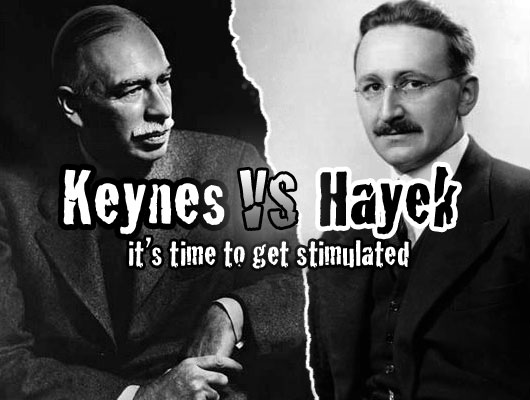
PJTV has an 11-minute interview with Russ Roberts. It’s mainly about the making of the Keynes vs. Hayek rap video. But he also has some wise words to say about the strained relationship between economists and the public. Popularization is both important and neglected.

Worth watching, even if you’re not an economist. Heck, especially if you’re not an economist.

Disappointing, but Not Surprising

Headline from The Hill – “Pay-go gets passed, then it gets bypassed

Pay-go budgeting rules — that any spending increases must be offset with spending cuts or tax hikes elsewhere — have loopholes big enough to drive a truck through. One of them, the emergency exemption, is invoked as early as the second sentence of the article.

In theory, pay-go is supposed to be a way to slow the growth of government. But it’s all for show. Nobody really means it. Just invoke the emergency exemption. Then spend all you like. Appearances matter, especially in Washington. But they should not be confused with reality. And reality is that Congress is going to spend and spend some more, no matter what budgeting rules are in place.

Shame on them for trying to make people think otherwise.

Politics 101: Machiavelli and Public Choice

When Niccolo Machiavelli died in 1527, Washington, DC was still more than two and a half centuries away from being founded. But he understood perfectly how that dismal city would work, as Bertrand Russell reminds:

“In the absence of any guiding principle, politics becomes a naked struggle for power; The Prince give shrewd advice as to how to play this game successfully.”

-Bertrand Russell, History of Western Philosophy, xxii-xxiii.

Machiavelli was, in many ways, the first modern public choice theorist. Had he lived in a post-Adam Smith world, he would have made a fine economist. A politician’s guiding principle is usually not ideology. It is to remain in power. So they behave accordingly. The first lesson of economics is that people respond to incentives. If someone’s incentive is to get re-elected, they will behave in a way conducive to achieving that goal. Morality and the greater good compete for a distant second.

What Do You Do?

In Washington, the first question people ask you is usually, “what do you do?”

“I’m an economist,” I answer. “I work at a think tank.”

“Oh,” the usual response goes. Followed by an immediate change of subject.

So I’m not a hit on the DC cocktail party circuit. But this quotation made me swell with pride when I read it:

“Economics is not a dry subject. It is not a dismal subject. It is not about statistics. It is about human life. It is about the ideas that motivate human beings. It is about how men act from birth until death. It is about the most important and interesting drama of all–human action”

-Percy Greaves

Hat tip: the Foundation for Economic Education, which did much to introduce me to the economic way of thinking when I was younger, and continues to educate and inspire me today.

The Economics of Charging for Airline Amenities

As of May 1, American Airlines will charge $8 to customers who want to use a blanket and pillow. JetBlue and US Airways already charge for them. This is only the latest example of a nickel-and-diming trend that has been going on for at least a decade. Passengers can also expect to be nicked for checked baggage, food, and drinks.

It’s also terrible PR. An unscientific CNN.com poll shows that 96 percent of passengers are unwilling to pay. More than that probably also harbor some resentment against the offending airlines.

Given how much customers resent extra charges, it is a mystery to me why airlines have so many of them. Why don’t they just include those expenses in their ticket prices? People don’t mind paying once. But if they have to take out their wallet a second or a third time, they often get angry. This anger is completely avoidable. Just put those extra nickels and dimes in the initial ticket price.

There has to be a reason why airlines so readily incur their customers’ wrath. My theory is that airlines think the nickel-and-dime approach can lower total costs. If people stick to carry-ons to avoid a checked baggage fee, that saves the airline some money. If they set the fees right, they’ll save more in labor costs than the forego in baggage fees.

Maybe they’re thinking the same theory applies to pillows and blankets. They’re on every seat in every flight. But most people don’t even use them. I rarely do. Seems like a waste of resources, doesn’t it? By only giving blankets to people who want them enough to pay for them, the airline has to buy fewer sets of pillows and blankets. It also has to clean fewer of them. If they’ve calculated correctly, this will result in a net savings. That means lower fares. And hopefully, more business.

I have no idea if this theory is correct. But it does make some sense.

But the fact remains that people are transaction-averse. Southwest Airlines has had great success with its concsious business strategy of keeping its nickel-and-diming to a minimum. While I personally prefer the Southwest approach, there seems to be room for both business models in the market. Time will tell if one eventually proves superior in giving people what they want. Even if it involves much grumbling, cursing, and reaching for wallets.

Sen. Shelby Lifts Holds

Sen. Richard Shelby, who placed holds on over 70 of President Obama’s nominees, has lifted all but three of them. Politico reports:

A spokesman for the senator said Monday that with attention brought to these two concerns, the political maneuver had “accomplished” its goal and was no longer necessary.

Translation: “We were getting too much bad publicity.”

The three holds that Sen. Shelby is keeping in place have directly to do with the Alabama-based pork projects that he believes will make him look good to the Alabama voters he will be facing in November. So, in a way, nothing has changed.

This brings up a legitimate question: can earmarking abuse sometimes be an agent for smaller government?

Few, if any, of President Obama’s appointees will work to decrease the size and scope of government. Now that their path is cleared, they will probably do net harm to taxpayers. This is the nature of government workers, whether Republican or Democratic.

Sen. Shelby’s motive for blocking them is despicable: stealing from taxpayers to improve his re-election prospects. But one wonders if those same taxpayers would have been better off if Sen. Shelby had stuck to his guns.