Tag Archives: Economics

The Economics of Romance

Tim Harford, Financial Times columnist and author of the underrated The Undercover Economist, takes some questions about economics and relationships with the New York Times’ Freakonomics blog.

The first question made me laugh, and also reminded me of my economist self a bit too much for comfort. And the part about engagement rings was enlightening — especially since I bought one not too long ago.

(Hat tip to my fiancee, who thankfully said yes.)

Senate Passes $18,000,000,000 Spending Bill: Will it Create Jobs?

The Senate just passed an $18 billion spending bill. Since the House already passed it, the legislation is now headed to President Obama’s desk to await his signature and become law.

The hope is that the spending will create jobs. If you’re reading this blog, then you probably know enough about economics to know that isn’t what will actually happen. Remember: anything that Washington giveth, it must first taketh away from somewhere else. It’s a zero-sum game. All those new jobs that politicians will be touting for the cameras will have come at the expense of other jobs elsewhere. On net, they’re not creating a thing.

Take the payroll tax break for small businesses that’s in the bill. Yes, those small businesses benefit. Maybe the money they save will even be used to hire more workers. That’s easy enough to see. But that money had to come from somewhere. That is harder to see. Too hard for the Senate to see, at the very least.

The reason is this: the government is foregoing some payroll tax revenue. But since it isn’t cutting spending to match, it has to borrow more. And there’s only so much investment capital to go around. Because Washington is borrowing more, less is left over for private investment opportunities. At the very least, companies will have to offer investors higher interest rates to lure them away from government bonds.

That makes getting loans more expensive. And when something gets more expensive, there tends to be less of it. Because of today’s bill, about $18 billion less capital will be available for the private sector to create jobs.

The legislation the Senate passed today is no jobs bill, at least on net. It is a spending bill. It doesn’t create jobs, it only redirects them.

Stimulus Spending Helps the Few, Hurts the Many

Here is a letter I sent recently to The New York Times:

February 17, 2010

Editor, The New York Times
620 Eighth Avenue
New York, NY 10018

To the Editor:

Michael Cooper’s article, “Stimulus Jobs on State’s Bill in Mississippi” (February 16, page A1), lists several people who have directly benefited from the stimulus package.

The article names none of the roughly 300 million people directly hurt by that same stimulus package. The money that pays for Roshonda Bolton’s factory job was taken away from other people. They would have spent that money in other job-creating ways.

The stimulus doesn’t actually create jobs. It rearranges them. The best possible result is no net effect. Stories touting jobs saved or created by government are at best incomplete.

Ryan Young
Warren T. Brookes Journalism Fellow
Competitive Enterprise Institute
Washington, D.C.

Russ Roberts Interview

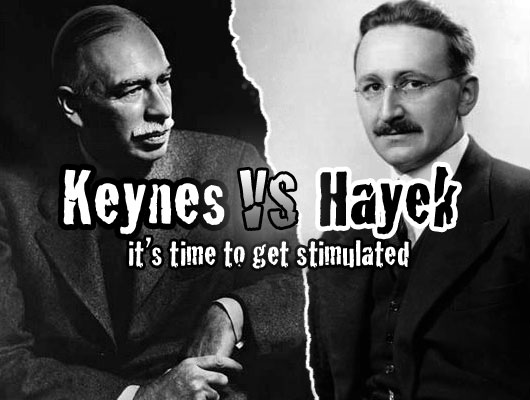
PJTV has an 11-minute interview with Russ Roberts. It’s mainly about the making of the Keynes vs. Hayek rap video. But he also has some wise words to say about the strained relationship between economists and the public. Popularization is both important and neglected.

Worth watching, even if you’re not an economist. Heck, especially if you’re not an economist.

What Do You Do?

In Washington, the first question people ask you is usually, “what do you do?”

“I’m an economist,” I answer. “I work at a think tank.”

“Oh,” the usual response goes. Followed by an immediate change of subject.

So I’m not a hit on the DC cocktail party circuit. But this quotation made me swell with pride when I read it:

“Economics is not a dry subject. It is not a dismal subject. It is not about statistics. It is about human life. It is about the ideas that motivate human beings. It is about how men act from birth until death. It is about the most important and interesting drama of all–human action”

-Percy Greaves

Hat tip: the Foundation for Economic Education, which did much to introduce me to the economic way of thinking when I was younger, and continues to educate and inspire me today.

The Economics of Charging for Airline Amenities

As of May 1, American Airlines will charge $8 to customers who want to use a blanket and pillow. JetBlue and US Airways already charge for them. This is only the latest example of a nickel-and-diming trend that has been going on for at least a decade. Passengers can also expect to be nicked for checked baggage, food, and drinks.

It’s also terrible PR. An unscientific CNN.com poll shows that 96 percent of passengers are unwilling to pay. More than that probably also harbor some resentment against the offending airlines.

Given how much customers resent extra charges, it is a mystery to me why airlines have so many of them. Why don’t they just include those expenses in their ticket prices? People don’t mind paying once. But if they have to take out their wallet a second or a third time, they often get angry. This anger is completely avoidable. Just put those extra nickels and dimes in the initial ticket price.

There has to be a reason why airlines so readily incur their customers’ wrath. My theory is that airlines think the nickel-and-dime approach can lower total costs. If people stick to carry-ons to avoid a checked baggage fee, that saves the airline some money. If they set the fees right, they’ll save more in labor costs than the forego in baggage fees.

Maybe they’re thinking the same theory applies to pillows and blankets. They’re on every seat in every flight. But most people don’t even use them. I rarely do. Seems like a waste of resources, doesn’t it? By only giving blankets to people who want them enough to pay for them, the airline has to buy fewer sets of pillows and blankets. It also has to clean fewer of them. If they’ve calculated correctly, this will result in a net savings. That means lower fares. And hopefully, more business.

I have no idea if this theory is correct. But it does make some sense.

But the fact remains that people are transaction-averse. Southwest Airlines has had great success with its concsious business strategy of keeping its nickel-and-diming to a minimum. While I personally prefer the Southwest approach, there seems to be room for both business models in the market. Time will tell if one eventually proves superior in giving people what they want. Even if it involves much grumbling, cursing, and reaching for wallets.

Federal Government Shuts Down Due to Snow

Few people outside of the DC area are likely to notice, but the recent snowstorm shut down the federal government today. Another big snow is on the way, so the feds are also taking tomorrow off.

The Washington Post reports:

Official estimate [sic] that closing the federal government for a day due to the weather costs roughly $100 million in lost productivity and opportunity costs, meaning this weekend’s storm will have potentially cost taxpayers at least $250 million, for last Friday’s early dismissal and Monday’s and Tuesday’s closures.

That is dwarfed, of course, by the opportunity costs of having a $3.8 trillion federal government in the first place. Not to mention the productivity losses.The federal government spends $49.1 billion enforcing regulations that cost nearly $1.2 trillion. if even half of that were freed up, imagine the good that would come of it.

The billions and billions of dollars spent on earmarks and stimulus would do far more good if that money stayed in the productive sector, subject to the self-correcting mechanisms of profit and loss.

In short: America benefits when Washington busybodies take a few days off. So enjoy it while it lasts.

There is great wisdom in Mark Twain’s famous adage: “No man’s life, liberty, or property are safe while the congress is in session.”

Regulation of the Day 102: The Size of Banks

Louis Brandeis was a hero of the Progressive Era. One of the central tenets of his philosophy is that when it comes to business, big equals bad. Even if consumers benefit. Doesn’t matter. Big is bad.

This is not an exaggeration. Business historian Thomas McCraw wrote that “a deep-seated antipathy toward bigness clouded his judgment.”*

Then there is Brandeis on consumers: “servile, self-indulgent, indolent, ignorant.” That’s a direct quote, by the way.** It was his justification for wanting to fix prices in favor of small businesses. Consumers invariably prefer low prices. The problem is that sometimes big businesses offer those low prices. And this upset Brandeis to no end. How dare consumers take price into account! The size of the business is more important!

This is not a rigorous line of thought.

But it’s one the current administration has bought into. The White House is expected to propose today a maximum allowable size for banks. Because big is bad.

This reform is unlikely to have its desired effect. The reason banks behaved so badly during the housing bubble is because the regulatory and political climate gave them an incentive to. It had nothing to with size. The solution, then, is to channel incentives in a better direction. Reward good behavior. Punish bad behavior. Any reform that ignores incentives will fail every time.

On one hand, as long as bankers know that the government will bail out their losses, they’ll take as many crazy risks as they can. Where’s the incentive to be careful if taxpayers will cover the bill when you mess up?

On the other hand, a size cap might actually make banks too risk-averse. Loans are risks taken in the hope of future profit. But too much profit — too much good lending — could potentially make a bank run into size problems with the government. This is not the kind of incentive structure the administration should be shooting for.

Today’s fixation on size is just as misguided as Brandeis’ was. Consumers and banks alike would be better served by letting profits encourage risk, and losses encourage prudence, as Russ Roberts put it. That means no size restrictions. No bailouts either.

*Thomas McCraw, Prophets of Regulation, p.99.
**McCraw, p. 107.

Health Insurance and Campaign Contributions


Congressional Democrats are thinking of revoking the health insurance industry’s antitrust exemption; some insurers have spent as much as $20,000,000 opposing the current legislation.

Of course, insurers also gave $20,175,303 to President Obama’s 2008 campaign, roughly triple what McCain netted.

On one hand, this might look like the dog biting the hand that feeds. But really, it isn’t.

If the health care legislation passes, there is a good chance that every American would be required to purchase health insurance.

Suppose that happens. $40 million and change plus some antitrust troubles is a really small price to pay for a legal guarantee of vastly increased business, forever, plus looking like you didn’t want the favor.

As my friend Jeremy Lott is so quick to remind, it’s a wonder that politicians can be bought off so cheaply, given what they could charge for their services.

It is just as surprising that insurers would spend $20 million opposing legislation that would yield many times that in profit. As economist Bruce Yandle notes, “industry support of regulation is not rare at all; indeed, it is the norm. And in the United States it is as American as apple pie.”

Are Economists Cheap?

According to an amusing article in today’s Wall Street Journal, some are:

Children of economists recall how tightfisted their parents were. Lauren Weber, author of a recent book titled, “In Cheap We Trust,” says her economist father kept the thermostat so low that her mother threatened at one point to take the family to a motel. “My father gave in because it would have been more expensive,” she says.

and some aren’t:

[T]he principles that can make economists seem cheap sometimes lead them to hire help, because they are taught to value their own time.

Ms. Stevenson and Justin Wolfers, also of the Wharton School, gave a friend $150 to hire movers instead of helping him themselves. Harvard University economist David Laibson pays to have a driver pick up his sister from the airport rather than driving himself.

So are economists just cheap, or does their fixation on tradeoffs make them act in ways that only make them appear cheap? You be the judge.