Regulation of the Day 145: Unregistered Chariots

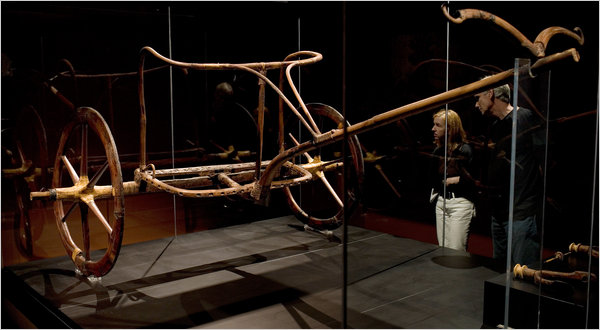
When King Tutankhamen’s tomb was discovered in 1922, six chariots were among the artifacts found inside. One of them even had some wear and tear; maybe Pharaoh had personally used it for hunting.

It is even possible that falling off that very chariot caused the broken leg that is believed to have ultimately killed him at the age of 18 or so. That chariot is now on display in New York as part of a traveling exhibition of Tutenkhamen’s artifacts.

Getting the chariot from Egypt to New York was quite an ordeal. At roughly 3,300 years of age, the wood is fragile. First it was carefully packed into a truck and driven to Cairo from the Luxor museum. Then it was loaded onto a New York-bound cargo jet. A curator was by its side at all times.

Once it arrived stateside, the New York Times tells of an unexpected regulatory hurdle through which the chariot had to pass before leaving JFK International Airport for its Times Square destination and painstaking reassembly:

When New York traffic officials reviewed the papers required for the oversize truck that would transport the chariot into Manhattan, they saw that the cargo inside was classified as a vehicle, and demanded its Vehicle Identification Number.

“I’m totally serious,” said Mr. Lach, the exhibition’s designer. “But we got it cleared up.”

Good for them. The exhibit is on until January 2 if you care to look for the chariot’s VIN yourself.

Ancient Noise Ordinances

Some types of regulations go back a very long way.  Some of this is likely only legend, but according to the historian Donald Kagan, local noise ordinances date all the way back to ancient Greece:

At the Gulf of Taranto lay the Greek city of Sybaris, whose citizens’ taste for luxurious living has provided a synonym for voluptuaries. They were said to honor cooks with golden crowns and give them the same honors for preparing a fine meal that they gave to choregoi for staging winning tragedies. They taught their horses to dance and were once defeated in battle when their opponents played tunes on the flute that lured their cavalry away. They went to parties at night and slept all day, imposing the first anti-noise legislation; even roosters were barred from the town.

-Donald Kagan, Pericles of Athens and the Birth of Democracy,  p. 125.

Hayek on History

“[I]f it is too pessimistic a view that man learns nothing from history, it may well be questioned whether he always learns the truth.”

Capitalism and the Historians, (F.A. Hayek, ed.), p.3

Understanding the Health Care System

One of the worst parts of the current health care system is its sheer complexity. Because most of the payments are made by third parties, the paperwork burden is enormous. Co-pays, deductibles, ever-shifting networks, and so on. Unfortunately, that complexity is about to get a lot worse because of this year’s health care bill. Check out this flow chart of what the health care system will look like once Obamacare is implemented:

You can also download a PDF version of the chart that allows you to zoom in more closely. It’s worth taking a few minutes to look at all the agencies and bureaucracies in greater detail.

This chart was released by Rep. Kevin Brady, a partisan Republican. But whatever your politics, you should be wary of any scheme as grandiose as Obamacare. This represents a re-ordering of one sixth of the American economy.And not only is the government tasked with making this flow chart flow smoothly. It is also tasked with fighting two land wars in Asia. With delivering the mail. With developing new energy technologies. With overhauling the nation’s entire financial system. No organization can do all those things and do them well. Doesn’t matter how talented and well-meaning the people behind it are. It is beyond the limits of anyone’s ability to plan.

As Dan Mitchell points out, real health care reform would have just two parties to most transactions: buyer and seller.

There are two other things I’d like to see. One is that health insurance should not be linked to your job. Under both the current system and Obamacare, if you lose your job, you lose your insurance at exactly the time you need it most. This can be done by treating employer-provided insurance exactly the same as individual insurance in the tax code. Employer-provided insurance is currently given special treatment.

Real reform would also fundamentally change the way we use health insurance. The purpose of insurance is to insure against unexpected risks. Your annual physical does not fit that description. Having insurers pay for routine, expected expenses is like using your auto insurance to pay for a tank of gas and a car wash. No wonder premiums are so high. Health insurance isn’t really insurance. It’s pre-paying for your health care. And it also has one whopper of a principal-agent problem that explains a large portion of why health costs are so shockingly high.

Disclosure and Campaign Finance

Regarding my last post on the ill-fated DISCLOSE Act, commenter Ben Hoffman writes:

How the [expletive] is disclosure “abridging freedom of speech[?]” There’s nothing wrong with knowing who paid for an ad, especially when it contains lies.

Ben raises a good point, if not very tactfully. The answer to his question is that freedom of speech includes the right to make speech anonymously.

Politics is such a combative sport that even donors are viciously attacked by the other side. Think of how Republicans treat George Soros. Now think of how Democrats treat Charles and David Koch. They are punching bags.

This is a deterrent to speech. It has a chilling effect on people who want to have their say, but would prefer not endure those ad hominem attacks. Or in some cases, threats of physical violence. People like Soros and the Kochs have much thicker skin than most people to endure all the ad hominems thrown their way on a daily basis. Think of how many potential donors stay silent because of that. How much speech is left unspoken?

Supporters of California’s wrong-headed Proposition 8 to ban same-sex marriage feared physical retaliation for their political donations when some activists published the names and addresses of donors who supported the measure, along with unsubtle hints that they deserved retaliation. Opponents of same-sex marriage are wrong on the merits of the issue. But they do not deserve to be threatened for being wrong. For them, the right to remain anonymous is a key part of respecting their freedom of speech.

Mandatory disclosure actively harms the right to free speech. It would cause a lot of people to stay silent when they would rather speak. That is wrong.

But that isn’t commenter Ben’s only concern. He worries that anonymity would embolden people to tell lies in political ads. Would it?

After all, under today’s partial disclosure system, both parties already tell plenty of lies in their ads every election cycle. Partisanship trumps truth for Republican and Democrat alike. But that does not mean that therefore, more disclosure is needed.

Ads that contain the real names of donors are taken with added credibility by people. Anonymous ads are taken with a grain of salt. And sometimes for good reason. That means anonymity has a cost. People hold an anonymous message to a higher standard before taking it seriously. Shockingly, voters are smart enough to come to their own conclusions.

According to the law of demand, raising the cost of anonymity means there will be less of it. If an anonymous ad has less impact of an otherwise identical disclosed ad costing the same amount of money, any rational donors will disclose their names unless they place very high values on avoiding Soros-Koch-style attacks. And if they feel that’s a fair tradeoff for reduced credibility, that’s their right.

There are already plenty of regulations for truth in advertising, libel, and the like. Let’s try doing a better job of enforcing those instead of passing more restrictions on the right to free speech.

The World Is Not Perfect

We shall never prevent the abuse of power if we are not prepared to limit power in a way which occasionally may prevent its use for desirable purposes.

-F.A. Hayek

Serious thinkers need to keep that in mind more often. Human imperfection is exactly why human freedom is a good policy for the world in which we live. By its very definition, utopia — “no place” — is a poor goal for this place.

Bill to Regulate Political Speech Fails

The Hill:”Senate fails to advance campaign finance bill

The First Amendment: “Congress shall pass no law… abridging the freedom of speech.”

Good news for anyone who wants to engage in political speech. But how sad that this happened because of politics, not principle.

It was mostly Democrats who favored the DISCLOSE Act. And according to today’s Senate vote, it was only Democrats who favored the bill. But Republicans are no heroes on this issue. Don’t believe their posturing. If the political winds were currently favoring Democrats, Republicans would be working their tails off to pass similar legislation.

The primary effect of campaign finance regulation is to stack the rules of the game in favor of incumbents. Both parties know this. And both parties will seek to use campaign finance regulation to their advantage however they can.

Regulation of the Day 144: Underage Senior Citizens

Bob Russ is 66 years old. Last weekend, he and his wife went to the Oregon Brewer’s Festival in Portland. Or rather, they tried to. He was denied entry. The reason? He was unable to prove that he was over 21 years old. At 66, Mr. Russ is Medicare-eligible.

In a letter to the Oregonian, he writes that “At two entry gates, staff told us the OLCC [Oregon Liquor Control Commission] requires a current photo ID for large alcoholic events, period.”

In addition to an apology, Mr. Russ asks for “the use of common sense by the OLCC and the city of Portland that will prevent entering into festival permit agreements that deny entry to unsuspecting “underage” senior citizens.”

The goal of photo ID laws is to prevent underage drinking. Keeping 66-year old men out of festivals for lack of valid photo ID does not prevent underage drinking. If anything, it wastes resources that could otherwise be spent stopping underage drinking.

This is one regulation where the OLCC should allow for some discretion. Doing so might prevent a lot of bad PR.

(Hat tip to Jacob Grier)

On the Radio – Unemployment Benefits

At 4:00 this afternoon, I’ll be on the Richard Dixon Show to talk about the unemployment benefit extension. If you live in Alabama, tune in to WAPI-FM.

Economists vs. Economics

Are economists ruining economics? Over at the American Spectator, I say why that may well be be the case. Key points:

-Economists can’t even predict whether the stock market will go up or down tomorrow. Yet many economists tell everyone who will listen that they know how to solve the financial crisis and dig out of a near-global recession. No wonder people aren’t taking them as seriously as they used to.

-Economics isn’t the problem. The economic way of thinking is as powerful a tool as any for understanding the world around us. But it has its limits. Too many economists have pretended those limits away out hubris, or for political reasons.

-Any economist saying he understands global business cycles when he can’t even understand the pencil poking out of his breast pocket is a charlatan. But the discipline he dishonors is as beautiful as poetry. Interested readers should take a look at Leonard Read’s classic short essay, “I, Pencil,” as a case in point.