Category Archives: Elections

Bill to Regulate Political Speech Fails

The Hill:”Senate fails to advance campaign finance bill

The First Amendment: “Congress shall pass no law… abridging the freedom of speech.”

Good news for anyone who wants to engage in political speech. But how sad that this happened because of politics, not principle.

It was mostly Democrats who favored the DISCLOSE Act. And according to today’s Senate vote, it was only Democrats who favored the bill. But Republicans are no heroes on this issue. Don’t believe their posturing. If the political winds were currently favoring Democrats, Republicans would be working their tails off to pass similar legislation.

The primary effect of campaign finance regulation is to stack the rules of the game in favor of incumbents. Both parties know this. And both parties will seek to use campaign finance regulation to their advantage however they can.

Making a Difference – A Very Small Difference

The House passed a budget enforcement resolution yesterday. It sets 2011’s discretionary spending $7 billion below what President Obama has requested.

Next year’s discretionary spending target is $1.12 trillion for next year. The $7 billion difference represents savings of 0.625 percent. Barely a rounding error. If total spending (including mandatory and defense spending) ends up at $3.5 trillion next year, the savings becomes 0.2 percent.

Of course, 2010 discretionary spending was $1.39 trillion. 2011 spending will very likely end up much closer to that than the targeted $1.12 trillion. The appropriations process is not kind to non-binding resolutions, however well-intentioned. Especially when the resolution “doesn’t detail how Congress should reach that [deficit reduction] goal.”

Congress lacks the will to cut $270 billion of spending. The interests benefitting from that spending will scream bloody murder the second their programs are put on the chopping block. In an election year when incumbents are more fearful than usual, no politician worth his salt wants to cause an uproar.

Congress need not worry too much, though. Even in anti-incumbent years, re-election are almost always above 90 percent. The vast majority of congressional turnover happens through retirement, running for other office, or death.

The pattern is holding this year, so far. The University of Virginia’s Larry Sabato recently pointed out that 5 incumbents have lost their state primary elections this year, while 240 were re-nominated. That’s a 98 percent success rate. There will be a few more casualties, especially in the November general elections.

Most members are safe. They can, and should, rock the boat by cutting unnecessary spending. If anything, the most aggressive cutters might become folk heroes like Chris Christie in New Jersey. They just don’t have the guts.

I will be more than happy if Congress proves me wrong. We’ll find out over the next few months.

“All of My Motives Are Ulterior”

This spot-on political ad parody has been making the rounds. Enjoy.

A Telling Headline

From The Hill: Vulnerable Democrats defend support for campaign finance legislation

Campaign finance regulations are an incumbent’s best friend. The incumbent already has name recognition, and a deep network of fundraising contacts. Heck, Congress’ franking privilege allows incumbents to send out de facto campaign messages for free. Challengers have none of those advantages.

It takes a lot of money to buy enough ads to get a challenger’s name recognition anywhere near the incumbent’s. Campaign finance regulations make it harder to raise that money, and harder to put up a fight against established officeholders. No wonder so many incumbents from both parties favor strict campaign finance regulations! It’s good for their job security.

Political Wisdom

“The hardest thing about any political campaign is how to win without proving that you are unworthy of winning.”

-Adlai Stevenson

Regulation of the Day 134: Not Voting

The lede to this Denver Post article says it all:

RIDGWAY — Residents of this Old West- meets-New Age town can be fined if their fences are too high, they have too many chickens, their dogs aren’t on leashes or their weeds are out of control.

Tom Hennessy would like to add not voting to that list.

There are three things wrong with Mr. Hennessy’s proposed regulation. One is that mandatory voting is a violation of personal freedom. To vote or not is an important choice that people make for themselves. It is not Mr. Hennessy’s place to make that decision for others. Many countries have tried mandatory voting over the years, most notably the Soviet Union.

The second thing wrong with mandatory voting is that it violates freedom of speech. Mr. Hennessy is aware that compelled speech is just as unconstitutional as censored speech. That’s why he proposes a “none of the above” option on ballots. But some people are sending a deliberate message when they choose not to vote. Mr. Hennessy would fine them for sending that message.

The third point is that, maybe, some people shouldn’t vote. If I step into a voting booth not knowing a thing about the candidates or the issues, I am essentially choosing at random. And choosing wrong means voting against everything I stand for.

Even worse, human beings have built-in cognitive biases that affect their voting habits. Economist Bryan Caplan’s book The Myth of the Rational Voter identifies anti-foreign bias, anti-market bias, make-work bias, and pessimistic bias, for starters.

Even relatively informed voters fall prey to these biases. They vote accordingly. The difference of opinion between economists and the general public on economic issues is startling. Nobody argues relativity with a physicist thinking they’ll win. But voters from both parties argue against the laws of economics every election, often in error but never in doubt.

Despite its flaws, democracy has worked tolerably well in this country for a long time. Perhaps the best part of our particular democracy is that people are free to choose their level of engagement with it. That should be your choice. Not Tom Hennessy’s.

(Full disclosure: CEI takes no stance on whether to vote, or for whom. Neither do I. I personally have not voted since 2002, but seriously consider it every year.)

Do Incumbents Deserve Reelection?

A stunning 8 percent of Americans believe members of Congress should be reelected, a staggering indictment of the legislative branch as Democrats prepare to defend their majority in the midterm elections.”

Not sure what those 8 percent are thinking. They probably aren’t.

Of course, talk is cheap. The very same people who so loudly disapprove of Congress have re-elected 94 percent of its incumbents the last two election cycles. The last time it was as low as 90 percent was 1992.

People do seem to want change. They just rarely vote for it.

NY Times Endorses Andrew Cuomo for Governor?

The New York Times apparently has a juicy profile on New York Gov. David Paterson in the works. It should run sometime this week. The Hill reports that ‘There has been speculation the piece will contain details about Paterson’s personal life that would result in his resignation.”

Paterson’s rival in the Democratic primaries, Andrew Cuomo, stands to benefit. Resignation or no, Paterson is already unpopular. And Cuomo has $16 million in campaign funds and counting.

Paterson’s resignation would also likely hurt the Republican candidate, Rick Lazio. Political junkies might remember him as the sacrificial lamb in Hillary Clinton’s 2000 senate race. By possibly sparing Mr. Cuomo a bruising Democratic primary, the Times may be assigning Mr. Lazio a similar role in this year’s gubernatorial race.

Sen. Shelby Lifts Holds

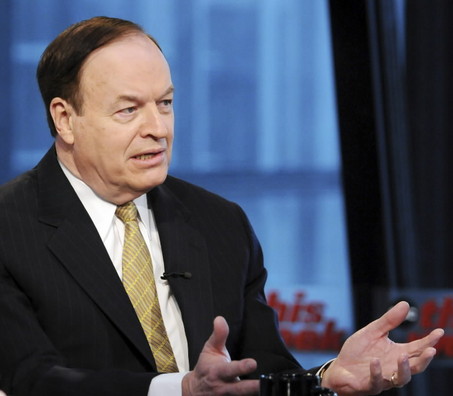
Sen. Richard Shelby, who placed holds on over 70 of President Obama’s nominees, has lifted all but three of them. Politico reports:

A spokesman for the senator said Monday that with attention brought to these two concerns, the political maneuver had “accomplished” its goal and was no longer necessary.

Translation: “We were getting too much bad publicity.”

The three holds that Sen. Shelby is keeping in place have directly to do with the Alabama-based pork projects that he believes will make him look good to the Alabama voters he will be facing in November. So, in a way, nothing has changed.

This brings up a legitimate question: can earmarking abuse sometimes be an agent for smaller government?

Few, if any, of President Obama’s appointees will work to decrease the size and scope of government. Now that their path is cleared, they will probably do net harm to taxpayers. This is the nature of government workers, whether Republican or Democratic.

Sen. Shelby’s motive for blocking them is despicable: stealing from taxpayers to improve his re-election prospects. But one wonders if those same taxpayers would have been better off if Sen. Shelby had stuck to his guns.

Sen. Richard Shelby, Thief

One reason Democrats were so upset about losing their 60th Senate seat was that it would make it easier for Republicans to obstruct legislation.

Fair enough. But the revived possibility of a filibuster may turn out to be the least of their worries.

Sen. Richard Shelby, an Alabama Republican, has placed a hold on more than 70 of President Obama’s nominees.

His motivations are not partisan. He wants money. A lot of it. If Democrats simply throw a few billion federal dollars at his home state, he promises to release his holds.

Basically, Sen. Shelby is requesting a wealth transfer from federal taxpayers – that’s you and me – to politically favored groups in Alabama. Presumably the earmarks would make him look good to Alabama voters. Sen. Shelby is up for re-election this November. Who doesn’t like free goodies? Vote for Shelby!

But they aren’t free. The money to pay for them has to come from somewhere – us. Let us mince no words, then. Sen. Shelby is a thief. What a shame that such stealing is perfectly legal.