Category Archives: Economics

Country of Origin Labels Are False Advertising

Don Boudreaux makes good sense on why country of origin labels only tell part of the story of where a product comes from:

Yes, Mr. Hoch’s socks say “Made in Swaziland,” but who developed the computer software to operate the loom that wove the cloth used to make his socks?  Who designed the loom itself?  Who figured out how to transform crude oil into the elastic in the socks?  Who devised the method for pooling risks so that the Swaziland factory is profitably insured against fire and that the cargo ship carrying his socks to America is profitably insured against sinking?

Don concludes:

In fact, Mr. Hoch’s socks – and nearly everything else that he consumes – should be labeled “Made on earth,” for they truly are global phenomena.

Read the whole thing. Keep it in mind the next time someone grouses —falsely — that America doesn’t make anything anymore, or that Americans buy too many goods from foreigners.

The Insanity of Ethanol Policy

My  colleague Brian McGraw skewers the ethanol lobby in this video he made. Warning: contains a bit of adult language.

A Bit of Smithian Wisdom

“[T]he law ought always to trust people with the care of their own interest, as in their local situations they must generally be able to judge better of it than the legislature can do.”

-Adam Smith, The Wealth of Nations, Book IV, Ch. 5.

This sentence must have had a tremendous influence on Hayek’s thought.

Printing Money Troubles

There is a lot of talk lately about the Fed’s quantitative easing policy. It is an indirect way of printing money, and also a huge mistake. It turns out the Fed can’t even print money the direct way without making mistakes. A new $100 bill that is harder to counterfeit has been rolling off the presses recently. 1.1 billion of them have been printed so far, at a cost of $120 million.

CNBC reports:

An official familiar with the situation told CNBC that 1.1 billion of the new bills have been printed, but they are unusable because of a creasing problem in which paper folds over during production, revealing a blank unlinked portion of the bill face.

A second person familiar with the situation said that at the height of the problem, as many as 30 percent of the bills rolling off the printing press included the flaw, leading to the production shut down.

The total face value of the unusable bills, $110 billion, represents more than ten percent of the entire supply of US currency on the planet, which a government source said is $930 billion in banknotes.

Coincidentally, these would be the first bills to feature Timothy Geithner’s signature.

Fuzzy Math on Foreign Aid Shows Why Spending Cuts Are Difficult

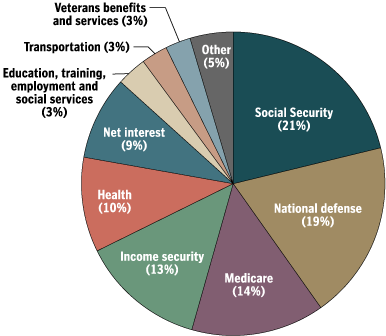
According to a new poll, the average American thinks that 25 percent of the federal budget is spent on foreign aid (or, more accurately, government-to-government transfers). They would like it cut to about 10 percent.

The actual figure is under 1 percent.

As Aid Watch’s Laura Freschi points out, that means most Americans want to increase government-to-government transfers ten-fold from current levels while also cutting them in half.

That most people think like this is a major reason why cutting the federal government’s $3.5 trillion budget is so difficult. The issues that people get worked up about tend to be small potatoes, in budgetary terms.

Besides transfer payments to other governments, earmarks are another lightning-rod issue. But even if earmarks were abolished entirely, that’s only about 2 percent of the budget. It would put the smallest of dents in spending.

Entitlement spending is the single largest driver of current and future deficits. That’s where the battle is. Aid spending and earmarks are not threatening to bankrupt the country. Social Security and Medicare are. And those programs are extremely popular. No politician with an eye on 2012 would be willing to cut them.

The government has made promises it can’t possibly keep. But most people refuse to believe that. So they don’t. As a guarding mechanism, they instead make grand assumptions about how much things like transfer payments to other governments and earmarks cost.

Quotation of the Week

“To err is human; to get paid for it, you have to be an economist.”

Larry Sabato, on unemployment projections being 100,000 off from what was released today.

From Poor and Sick to Healthy and Rich

Via Russ Roberts, this is an amazing video. I’m always impressed with creative, compelling ways to use data to tell a story. And this story is one of the most important in human history: how most of humanity went from being poor and sick to healthy and rich in just 200 years.

There is still a ways to go. But if past is prologue, I’m optimistic about the future.

Do You Want the IRS Doing Your Taxes?

The average American spends over 26 hours per year doing taxes. That’s too much. The obvious solution is to simplify the 70,000-page tax code. But that’s politically difficult. So Austan Goolsbee, among others, has an alternative idea: have the IRS do your taxes for you.

This return-free system is a bad idea for a lot of reasons. One of them is the obvious conflict of interest when your tax collector is also your tax preparer.

Another reason is that the IRS is not up to the task. As I explain in an op-ed being distributed by McClatchy News Services, the IRS rarely has all the information it needs to fill out an accurate return for any one individual, household, or business. People change jobs. They have kids. They get married, and sometimes divorced. They buy homes and cars. Who knows what kinds of deductions they qualify for? The IRS probably doesn’t.

And if the IRS makes a mistake on your return, you would be liable for it. If you want to stay on the right side of the law, you would have to calculate your own taxes anyway, to make sure the IRS got it right. So much for saving time.
Return-free systems have already been tried in California and the UK. Neither attempt can be called a success.
It is heartening that officials are looking for ways to reduce the burden of doing taxes. But a return-free system would treat only the symptom, and poorly at that. The root problem is an arcane, 70,000 page tax code. The solution is to simplify it.

Interesting Correlation

Via Business Insider.

According to this graph, the higher the percentage of a country’s males aged 25-34 live with their parents, the higher that country’s sovereign debt. Remember, though — correlation does not equal causation.

For one, this graph lists 11 Eurozone countries. But that’s out of a total of 25 Eurozone countries. Was there a reason the other 14 were left out? Maybe they fit the trend. Maybe they don’t. But since they aren’t there, we don’t know.

Even so, surely for some people, living with their parents for so long is caused by a lack of ambition and initiative. Those are two key ingredients for entrepreneurship and growth, which are important debt reducers. And a lack of them could be one cause of higher social spending, which increases debts.

The story this graph tells makes intuitive sense. But one wonders how much it matters compared to the many other factors in play.

Joe Biden vs. Adam Smith

Vice President Joe Biden recently said that every great idea of the last two-plus centuries came from government. My colleague Alex Schibuola and I rebut him over at The Daily Caller using Adam Smith’s book The Theory of Moral Sentiments as our weapon of choice. Biden, it turns out, is an almost perfect example of what Adam Smith described as the “man of system.” This is not a good thing.

As Smith put it:

The man of system … is often so enamored with the supposed beauty of his own ideal plan of government, that he cannot suffer the smallest deviation from any part of it … He seems to imagine that he can arrange the different members of a great society with as much ease as the hand arranges the different pieces upon a chess-board.

The problem, of course, is that human beings are not chess pieces. They have their own wants and desires. They move on their own. The man of system does not take this into account. This is why his plans fail time after time, even if he has the best of intentions.

Read our whole article here.

For those of you interested in learning more about Adam Smith, I couldn’t recommend him more highly. Don’t be scared off by his 18th-century prose style. Sit down with either of his books for less than an hour and you’ll develop an ear for it.

I don’t agree with everything Smith said; he invented the labor theory of value. But he was a keen observer of human nature. He was also a kindly soul, who wanted man to be free, happy, and prosperous. The overarching theme of his thought is mankind as social creature.  Our social instincts color how we form our notions of morality (the impartial spectator theory), and explain why economies function the way they do (peaceful exchange, as opposed to simple theft).

The Theory of Moral Sentiments is available for free at the Online Library of Economics and Liberty. You can also get a hard copy or a Kindle edition from Amazon.

For help wading through and digesting Smith’s arguments, I recommend Russ Roberts and Dan Klein’s six-part podcast series about the book, and D. D. Raphael’s short and readable The Impartial Spectator: Adam Smith’s Moral Philosophy.

Other quality secondary sources on Smith include E.G. West’s short-yet-thorough biography, and P.J. O’Rourke’s On the Wealth of Nations, which pairs Smith’s economic theories with O’Rourke’s mordant wit.