Tag Archives: Security Theater

How to Stand up to Terrorists

Fear of terrorism is literally irrational. You are 20 times more likely to be struck by lightning than fall victim to a terrorist attack. 200 times more Americans are killed by car wrecks than by terrorists. Yet people seem to be at least 200 times more scared of terrorists than of cars. This makes no logical sense.

In an article in the new issue of the CEI Planet (on page 7), I make the case that this is due to black swan bias, an inborn cognitive bias in the human brain that makes us pay undue attention to rare, catastrophic events and ignore everyday dangers.

Terrorism thrives on black swan bias. Terrorists are so few in number that fear is their only weapon. Every time people submit to new security theater measures, every time we trade away our freedom for the illusion of security, the terrorists win. The way to fight back is to not be scared. Fortunately, the facts give us plenty of reasons to drop our irrational fears.

In-Flight Wi-Fi: Security Threat?

An article in this month’s Infotech & Telecom News on a TSA proposal to ban in-flight wi-fi quotes me at length. Here’s what I had to say:

“Are such restrictions justified? No,” said Ryan Young, the Warren T. Brookes Journalism Fellow at the Competitive Enterprise Institute. “The only way to prevent terrorism is to make terrorism difficult.

“Banning in-flight entertainment would not do that,” he added. “Terrorism is a rare threat, and it should be treated accordingly. Every time you board a plane, your odds of being a victim of a terrorist attack are about 1 in 10.4 million. You are 20 times more likely to be struck by lightning,”

‘Chipping Away at Freedoms’

“Terrorists can’t win by killing people,” Young said. “There are too many of us and too few of them. They win by making us overreact in fear. And that is exactly what the TSA is doing.

“Chipping away at freedoms like in-flight wi-fi might make people feel safer. But it doesn’t actually make them safer,” he said. “The TSA should make sure that all cockpit doors are reinforced. It should diligently screen checked baggage. Passengers know that sometimes they have to take matters into their own hands. Anything beyond that isn’t security. It’s security theater.”

Dangerous Driving
Young adds TSA’s reaction to the Christmas Day bomber and other potential threats could not just stifle tech innovation but also harm the ability of the airline market to improve its services.

“Banning in-flight wi-fi would hurt both the airline industry and technology companies,” Young said. “Some airlines, such as JetBlue, compete by offering fringe benefits that competitors don’t, like in-air wi-fi. Taking that away would make the airline market more homogeneous and less competitive.

“Banning in-flight wi-fi also poses a safety risk,” he added. “When flying becomes more onerous, some people will opt to drive instead. Per mile traveled, driving is far more dangerous than flying. Car accidents kill at least 200 times as many Americans as terrorists do each year.”

New Reason Video on the TSA

Regulation of the Day 97: Full Body Scans and Child Protection Laws

Sometimes, when two regulations love each other very much, they get together and have little baby regulations. This is happening right now in Britain.

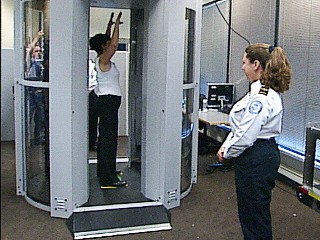
Full body scans are coming into use at many UK airport security checkpoints. Since screeners essentially see all passengers naked, the scans run afoul of child protection laws for passengers under 18.

The thought of pedophiles using the body scan images for their own sick ends is decidedly creepy. So the British government is taking steps to keep that from happening. Those steps include:

-Exempting everyone under 18 from being scanned. This defeats the security purpose of the scanners.

-Moving the scanner operators out of sight of passengers. That keeps the scanner images anonymous. But it doesn’t prevent perverts from seeing things they shouldn’t.

There is an easier way: don’t do full body scans. They do more to make people feel safe than to actually make them safe.

Reinforced cockpit doors, proactive passengers, and checked baggage screening are much more effective. And they’re already in place. Besides, terrorist attacks are rare. Full-body scans are an over-reaction. The resources spent on them have other, better uses.

Terrorism Is Rare

Radley Balko points to an article that shows exactly how rare terrorism is.

The figure that caught my eye was the last one. There were 647 deaths due to airborne terrorism over the last last ten years. There were 7,015,630,000 passengers over the same period. Yes, that figure is higher than current world population. That’s because each time someone flies, they count as one passenger. You take ten trips, you’re counted ten times. That represents each opportunity to become a terrorist victim, and is therefore the correct measure to use.

Each time you board a plane, your odds of being a victim of terrorism are about  1 in 10,408,947 (my own calculations yielded 1 in 10,843,323, but the point holds either way). Your odds of being struck by lighting are over twenty times higher!

Terrorists are so rare that they can’t win by killing people. There are too many of us and too few of them. Terrorists can only win by scaring people. Making them overreact. Making them trade away their freedom for for the illusion of security. The TSA, which is based on exactly that, represents the terrorists’ greatest victory yet.

That’s why people need to know just how safe we really are, even with all of the terrorists out there. The more we know, the less scary they become. And fear is their only effective weapon. If we take it away, the terrorists lose.

Regulation of the Day 73: Snow Globes as Terrorist Threat

snow-globe

Some of the TSA’s critics say the agency its own reductio ad absurdum. TSA’s latest action does nothing to improve security, but much to prove its critics correct. Snow globes are now banned from carry-on luggage (hat tip: Radley Balko).

This means one of two things: either grandmothers with snow globes in their carry-ons are the biggest terrorist threat facing the country, or the TSA is doing something wrong.

The way to prevent terrorism is to make terrorism difficult. Banning snow globes doesn’t make terrorism any more difficult.

Yes, larger snow globes probably violate the TSA’s three-ounce limit for liquids. But they are not bombs. They are, in fact, snow globes.

Obama Wants to Extend PATRIOT Act

People are often surprised to hear how similar President Obama’s policies are to President Bush’s. They shouldn’t be. One may be a Republican and the other a Democrat, but make no mistake. Bush and Obama are two peas in a pod.

-Bush signed a $700 billion bank bailout bill. Obama continued the policy. And he extended it to other sectors, such as the automobile industry.

-Bush tried fiscal stimulus twice while in power. With some help from the Bush team, Obama oversaw the largest fiscal stimulus bill in history. There is occasional talk of another.

-Bush started two land wars in Asia. Obama could end them. Instead, he is committing more troops to Afghanistan.

-Bush oversaw Medicare part D, the largest expansion of government’s role in health care since 1965. Obama also would like to expand government’s health care presence.

-And now, we have the PATRIOT Act. The bill was perhaps the largest expansion of executive power in seventy years, and the Bush administration’s signature legislation. Now that Obama has inherited all these cool powers, turns out he likes the PATRIOT Act, too. So he wants to extend some of its expiring provisions.

Predictable. Still disappointing.