

Ryan Young
Senior fellow at the Competitive Enterprise Institute. All opinions here are my own, and not necessarily CEI’s.
Questions? Comments? Send me an email.
Follow me on Twitter – @RegoftheDay
-
Join 218 other subscribers
Twitter Feed
Tweets by RegoftheDayArchives
Categories
- #NeverNeeded (48)
- Books (531)
- CEI Podcast (197)
- Correspondence (36)
- Economics (1,261)
- Antitrust (117)
- Bailouts (21)
- Business Cycles (42)
- Competition (35)
- Development Economics (13)
- Minimum Wage (37)
- Monetary Theory (50)
- Price and Wage Controls (22)
- Price Gouging (2)
- Public Choice (135)
- Spending (128)
- Stimulus (59)
- Taxation (72)
- The Market Process (40)
- Trade (271)
- education (19)
- Everybody Panic (14)
- Executive Power (12)
- Export-Import Bank (52)
- Financial Regulation (4)
- Free Speech (40)
- Fun with Statistics (10)
- General Foolishness (153)
- Great Thinkers (117)
- Health Care (43)
- History (183)
- Housekeeping (40)
- Immigration (51)
- Inequality (14)
- inflation (6)
- Innovation (44)
- institutions (3)
- International (155)
- labor (26)
- Law (89)
- Literature (58)
- Media (43)
- Media Appearances (174)
- modernity (6)
- Nanny State (118)
- nationalism (5)
- Philosophy (173)
- Argumentation (26)
- Certainty (20)
- Pith (48)
- Political Animals (358)
- Predicting the Future (9)
- prohibition (9)
- Psychology (5)
- Publications (165)
- Reform (25)
- regulation (858)
- Regulation of the Day (235)
- Science (94)
- Security Theater (93)
- Sports (150)
- Technology (89)
- The Arts (26)
- Music (15)
- The New Religion (108)
- Mankind's Doom (24)
- The Old Religion (14)
- The Partisan Mind (64)
- Transparency (2)
- Uncategorized (568)
Blogroll
Al's Ramblings (Brewers Blog)
Radley Balko (The Agitator)
Caleb Brown
Cafe Hayek
Cato Institute Blog
Coordination Problem (Peter Boettke, Pete Leeson, Steve Horwitz, et al)
William Easterly
EconLog (Bryan Caplan, David Henderson, Arnold Kling)
Jacob Grier
Gene Healy
Steven Landsburg
Jeremy Lott
Megan McArdle
Chris Moody
Carl Oberg
Open Market (CEI)
Tom Palmer
Reason Hit & Run
Jason Vines
They Aren’t Math Majors
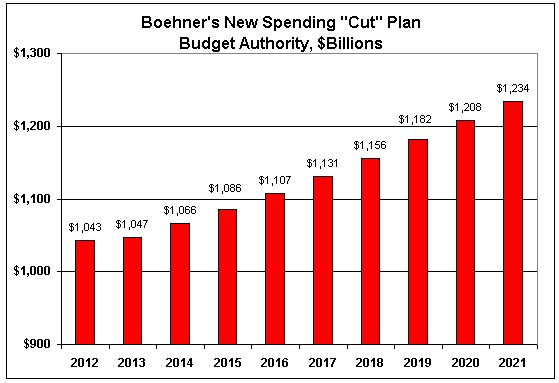
Eleven people were arrested for staging a sit-in today inside the U.S. Capitol. They were protesting budget cuts. They must not have known that spending is set to increase every year for at least the next decade, even under the Boehner plan.
Take a look at this handy discretionary spending chart that Cato’s Chris Edwards put together:
Comments Off on They Aren’t Math Majors
Tagged boehner, budget cut protests, budget cuts, capitol protests, Debt ceiling, spending, spending cut protests, spending cuts
A Common Mindset
 And not very rigorous, either. Click the image to enlarge. Original here.
Comments Off on A Common Mindset
Posted in Economics, regulation
Happy 99th Birthday, Milton Friedman
Reason.tv celebrates the occasion with a short video:
Comments Off on Happy 99th Birthday, Milton Friedman
Posted in Economics, Great Thinkers
CEI Podcast for July 28, 2011: Immigration Reform
President Obama made a speech on immigration reform this week. He is looking for a dance partner in Congress to ease restrictions on the immigrant-dependent high-tech sector. Policy Analyst Alex Nowrasteh points out that there are several bills already in Congress that would do just that, including the STAPLE Act and the DREAM Act.
Comments Off on CEI Podcast for July 28, 2011: Immigration Reform
Posted in CEI Podcast, Immigration
Tagged alex nowrasteh, dream act, e-verify, H-1B visas, Immigration, immigration reform, staple act, undocumented immigration
Regulation of the Day 189: Naming Your Baby

New Zealand’s Registrar of Births, Deaths and Marriages has a list of names that are verboten for newborn babies. Some of them make a good deal of sense. Lucifer and Adolf Hitler, for example, are specifically banned. Names like those say more about the parent than the child.
Other names, not so much. Names that sound like titles of nobility are also banned. Baseball all-star Prince Fielder must be glad he wasn’t born in New Zealand. Other likely naming casualties would include actor Judge Reinhold and NBA player Baron Davis.
In today’s post-feudal world, Prince, Judge, and Baron are unlikely to be confused with actual members of the nobility. Nor are noble names likely to have any adverse social consequences for the child. Unlike, say, these names that Bart Simpson used for prank calls to Moe’s Tavern.
Comments Off on Regulation of the Day 189: Naming Your Baby
Posted in Nanny State, Regulation of the Day
Tagged baby names, baron davis, judge reinhold, naming children, new zealand, Prince Fielder
The Believing Brain

Reason‘s Ronald Bailey reviewed Michael Shermer’s excellent The Believing Brain for The Wall Street Journal. If you don’t feel like reading all 340 pages, Bailey summarizes them well:
Superstitions arise as the result of the spurious identification of patterns. Even pigeons are superstitious. In an experiment where food is delivered randomly, pigeons will note what they were doing when the pellet arrived, such as twirling to the left and then pecking a button, and perform the maneuver over and over until the next pellet arrives. A pigeon rain dance. The behavior is not much different than in the case of a baseball player who forgets to shave one morning, hits a home run a few hours later and then makes it a policy never to shave on game days.
It’s surprising how much of human behavior can be explained by what Shermer calls patternicity and agenticity. Like pigeons, we seek patterns and therefore find them. But we also have the ingrained instinct to believe that some kind of agent has to be behind those patterns: god, a politician, somebody, anybody. Every design must have a designer.
No wonder Hayekian spontaneous order polls so poorly, despite having the benefit of being true. Lessons abound.
Comments Off on The Believing Brain
Posted in Books
Tagged michael shermer, ron bailey, ronald bailey, shermer, the believing brain, wall street journal, wsj
Regulation of the Day 188: Cat Licenses

San Diego, California’s city government is going through tough financial times. But legislators have found a lucrative possible revenue source: the city’s 373,000 cats. The city government could raise a lot of money by requiring cat owners to purchase a license for their little friends at $25 each.
Compliance rates for pet licenses tend to be low. Two thirds of Los Angeles’ dog owners don’t bother licensing their dogs, even though they’re required to by law. With cats, compliance would probably be even lower. Many cats are indoor-only, and are thus easy to hide from regulators. They don’t need to be walked in public daily like dogs do.
The city seems to be fine with that. It just wants some money, according to NBC’s San Diego affiliate in an article cleverly titled “Cat Owners Hiss at Licensing Proposal:”
If just 5 percent had been registered at $25 a head, the auditor’s office says the city could have saved $536,000 over the past three fiscal years.
Curiously worded. For the city government to save money, it would have to spend less. Here the city auditor is saying the city government would save money by taxing more. For that statement to be true, residents’ money couldn’t actually be theirs. It would be the government’s. They’re just nice enough to let the citizens have some of it. That ugly philosophical presumption alone is enough to discredit this proposal.
There’s more to it, though. Collection costs and establishing a licensing system would eat into the revenues.
Then there are the unintended consequences. Every city has stray cats. To keep their numbers in check, some kind souls will take them off the streets, have them spayed or neutered, then release them. Doing so would require a $25 license, even if the cat only stays with the person long enough to recover from the surgery. That means a lot of people wouldn’t bother with their good deeds, and San Diego would have even more stray cats.
Other cat owners would refuse to take their cats to the vet, where licenses would be issued. It can be expensive to get cats their shots and have them fixed. Making it even more expensive means fewer people will do the right thing. That’s bad for the animals’ health and life expectancy.
UPDATE: This is already happening in North St. Paul, Minnesota. Reader Maggie sends along this article:
Doug and Annette Edge thought they were doing the right thing for their community.
With feral cats roaming their North St. Paul neighborhood, the couple trapped the wild felines, took them to be sterilized and vaccinated, and then released them back into the city.
City officials, though, say the couple was breaking city animal laws.
In April, North St. Paul charged Doug Edge, 45, with two misdemeanors: failing to have a cat license and allowing domestic animals to run at large. Edge faces a fine and up to 90 days in jail.
Comments Off on Regulation of the Day 188: Cat Licenses
Posted in Regulation of the Day, Taxation
Tagged cat licenses, cats, san diego, san diego cat licenses
Regulation of the Day 187: Pedicabs

Pedicabs are the 21st century version of the rickshaw. A two-seat carriage is attached to a bicycle, and the driver will pick up customers and take them where they want to go. They’re especially popular around the National Mall in Washington, DC. Many of the drivers are cycling enthusiasts who get to make a little extra money and meet friendly people while getting some exercise.
The city has traditionally treated pedicabs with a light regulatory touch. At least until recently. The City Council now wants to require pedicab passengers to wear seatbelts.
That’s not all. Pedicabs will be required to have standardized braking system, no doubt to the delight of at least one lucky brake manufacturer. When cars are present, pedicabs will also be required to stick to the lane closest to the curb. This is legislating common sense.
The City Council is expected to pass the legislation this fall.
Comments Off on Regulation of the Day 187: Pedicabs
Posted in Nanny State, Regulation of the Day
Tagged dc city council, dc pedicab regulations, dc pedicabs, dcist, pedicab regulations, pedicab seatbelts, pedicabs, vincent gray
Man Arrested for Barking at Police Dog
In Mason, Ohio, being a jerk can be a crime. Police arrested a man for barking at a police dog that was sitting in a patrol car. At the subsequent trial, he defended himself on First Amendment grounds, and cited a similar case where the charges were dropped.
The judge didn’t buy it.
His next line of defense?
Stephens claimed “the dog started it,” police reports said.
Comments Off on Man Arrested for Barking at Police Dog
Posted in General Foolishness


