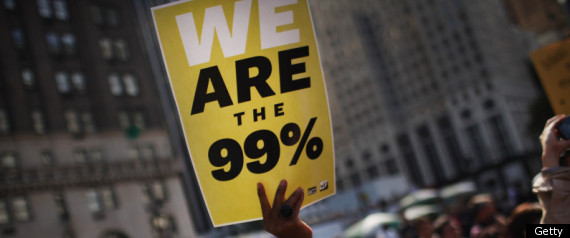
Until recently, I haven’t been paying much mind to the Occupy Wall Street protests. They’re a lot like tea party protesters. They’re upset with the status quo, and are being quite vocal about it. But – also like the tea partiers – they lack a unified voice. What do they want?
That incoherence was partially solved when one activist posted a list of thirteen demands on OccupyWallSt.com. It doesn’t stand for the whole movement, obviously. Some protesters are focused on different issues than the ones he chose. But it’s reasonable to assume that most of the protesters would agree with most of his demands.
From an economist’s perspective, the demands are both fascinating and disheartening. Fascinating because people who haven’t studied economics believe some really strange things; disheartening because many of the policies would hurt the very people they’re meant to help. Intentions are not results.
Let’s take a quick look at each of the demands. I have left his grammatical errors intact:
Demand one: Restoration of the living wage. This demand can only be met by ending “Freetrade” by re-imposing trade tariffs on all imported goods entering the American market to level the playing field for domestic family farming and domestic manufacturing as most nations that are dumping cheap products onto the American market have radical wage and environmental regulation advantages. Another policy that must be instituted is raise the minimum wage to twenty dollars an hr.
He’s being far too moderate here. Take as true that importing goods across international borders kills jobs. Well, as a matter of logic, importing goods across state borders is no different. Oregonians should be forbidden from importing goods from Californians. Inter-city free trade has the same harmful effects. Consistency demands banning that, too. Even inter-household trade kills jobs under this line of thought.
If the protesters arbitrarily draw the line at the national level, then there is an inconsistency in their thought. And economists from the left and the right have been openly poking fun at that inconsistency for over 200 years.
And why only a $20 minimum wage? Think big. If Congress can raise living standards simply by mandating higher wages, why not $200 per hour? Why not $2,000 per hour?
Demand two: Institute a universal single payer healthcare system. To do this all private insurers must be banned from the healthcare market as their only effect on the health of patients is to take money away from doctors, nurses and hospitals preventing them from doing their jobs and hand that money to wall st. investors.
Because monopolies work so well.
Demand three: Guaranteed living wage income regardless of employment.
This isn’t worded clearly. Does this mean a $20 minimum wage for all workers, as in Demand One? Or does it mean giving unemployment benefits equivalent to a living wage, however defined? If it’s the second case, it’s pretty easy to see that fewer people would choose to work if this demand was met. As any economist will tell you, incentives matter.
Demand four: Free college education.
This should be re-worded as “Demand Four: The poor and uneducated must give money to the rich and educated.” This just sounds like the protesters, many of them students, don’t want to pay their tuition and their student loans (see also Demand Eleven).
This demand is fundamentally unprogressive. Wealth redistribution from rich to poor is one thing. But asking the poor to subsidize the rich strikes this writer as morally wrong.
Demand five: Begin a fast track process to bring the fossil fuel economy to an end while at the same bringing the alternative energy economy up to energy demand.
This day will come. I look forward to it. Progress is a beautiful thing to behold. But these kinds of transitions can only happen from the bottom up. He is demanding that it be top-down, which is the same thing as demanding that it never happen at all. Top-down is how Solyndra happened. Top-down is how ethanol happened.
Top-down is also an open invitation to the exact kind of cronyism that the Occupy Wall Street crowd – and this writer – despise. Again, think results, not intentions. The best way to achieve this policy goal is to make entrepreneurship and innovation easier. It’s a bottom-up world. Policies must acknowledge that if they are to succeed.
Demand six: One trillion dollars in infrastructure (Water, Sewer, Rail, Roads and Bridges and Electrical Grid) spending now.
He must be unfamiliar with the data. Government infrastructure spending is about 2.5 percent of GDP right now. That’s the highest it’s been since the 1950s, when the interstate highway system was being built. And today’s 2.5 percent is sliced from a pie that’s nearly 7 times larger in real terms. That puts current spending on par with about 17 percent of 1950 GDP. That is hardly austere.
Demand seven: One trillion dollars in ecological restoration planting forests, reestablishing wetlands and the natural flow of river systems and decommissioning of all of America’s nuclear power plants.
More unfamiliarity with the data. The EPA’s budget is currently a little over $10 billion. He demands a century’s worth of EPA spending over what one assumes is a period of years, not decades. That’s a lot of money that we don’t have.
Meanwhile, forest acreage today is roughly what it was a hundred years ago, despite U.S. population growing four-fold. And getting rid of dams and nuclear power plants means using more coal and natural gas. That’s what economists call a tradeoff. And that tradeoff directly contradicts Demand Five.
Demand eight: Racial and gender equal rights amendment.
Just such an Amendment passed on July 9, 1868. The Fourteenth Amendment reads, in part, “nor shall any State deprive any person of life, liberty, or property, without due process of law; nor deny to any person within its jurisdiction the equal protection of the laws.” Emphasis added, though the egalitarian language is clear enough on its own. Perhaps he should press for more consistent enforcement of that language. That certainly has been lacking.
Demand nine: Open borders migration. anyone can travel anywhere to work and live.
Yes. I don’t have a problem with background checks to keep out recidivist criminals or terrorists who, while rare, would hurt other people. And screening people for communicable diseases is a reasonable public health measure. But, like the Occupy Wall Street crowd, I don’t think anyone should presume the moral authority to tell other people where they may live, work, or travel. Right on.
Demand ten: Bring American elections up to international standards of a paper ballot precinct counted and recounted in front of an independent and party observers system.
Mandatory recounts are a bit much; most Congressional elections are 60-40 or 70-30 affairs. But there’s not much to object to here. Though there will come a time when computerized voting machines will be harder to corrupt than paper ballots. He should instead demand honest vote counts, whatever the medium.
Demand eleven: Immediate across the board debt forgiveness for all. Debt forgiveness of sovereign debt, commercial loans, home mortgages, home equity loans, credit card debt, student loans and personal loans now! All debt must be stricken from the “Books.” World Bank Loans to all Nations, Bank to Bank Debt and all Bonds and Margin Call Debt in the stock market including all Derivatives or Credit Default Swaps, all 65 trillion dollars of them must also be stricken from the “Books.” And I don’t mean debt that is in default, I mean all debt on the entire planet period.
Do this and no one will ever lend again. This demand has so little understanding of basic human nature, let alone basic economics, that it frankly doesn’t deserve serious scrutiny. It just sounds like he wants all the trappings of a modern first-world lifestyle without paying for them. As the economist Deirdre McCloskey would say: no, dear.
Demand twelve: Outlaw all credit reporting agencies.
Moody’s and the other ratings agencies played a starring role in inflating the housing bubble. Oh, they deserve plenty of blame. But the solution isn’t to outlaw them. It’s to outlaw Congress from giving them special treatment. Congressional coddling allowed them to lie to their customers and not get punished by market mechanisms. Their legally protected oligopoly is an outsized example of crony capitalism. Don’t confuse it with the real thing.
Demand thirteen: Allow all workers to sign a ballot at any time during a union organizing campaign or at any time that represents their yeah or nay to having a union represent them in collective bargaining or to form a union.
Government policy should be neutral towards labor unions. Not hostile, not favorable. Neutral. Part of that neutrality means ensuring secret ballot elections when workers are deciding whether to unionize. If the ballots are open, it’s pretty easy to imagine both management and unions putting pressure on workers to sign with their side. Better to preserve anonymity. Let workers express their true feelings without fear of reprisal from either side.
This demand’s wording is unclear on neutrality, and unclear on secret ballots. Hard to tell what to make of it.
So there you have it.
Like almost any list of demands, there is good and bad here. Two common themes animate the list. One is that the writer clearly hasn’t studied economics. Free trade promotes wealth and peace, and has almost zero net effect on employment in the long-run. High minimum wages price the lowest-skilled employees out of work, and hurt them. There is no free lunch. Nobody will lend money if they aren’t going to be paid back.
None of those statements are controversial inside the profession, only out of it. Regardless of one’s political leanings.
The second theme is entitlement. Other people should pay for my health care. Other people should pay for my college education. I shouldn’t have to pay back my credit card balance. In short, gimme. How millennial.
The tea party movement’s uninformed populism is embarrassing to many on the right. No wonder Brendan O’Neill, seeing the same phenomenon on the left, wrote in The Telegraph that “The teenage moralism of the Occupy Wall Street hipsters almost makes me ashamed to be Left-wing.”
I agree with some of their demands, but it’s hard to see the Occupy Wall Street crowd being taken seriously. For that, they must first be able to be taken seriously. Given the movement’s lack of policy knowledge, its unseemly thirst for other people’s money, and the fact that some of them actually think that standing in the middle of a bridge invalidates their opponents’ arguments (!), they have a ways to go.