Funding Government by the Minute

Antony Davies has a creative way to explain the deficit in a new Learn Liberty video. Last year, the government took in $2.2 trillion. It spent about $3.8 trillion, or $434 million per hour. At that rate, $2.2 trillion is enough to fund the government from January to the end of July.

Abolishing NASA, the entire U.S. military, all federal funding for police and fire protection, courts, prisons, education, transportation, shuttering Congress and the White House, and a whole lot more besides only gets us to December 16.

In other words, if the only remaining federal spending was on Social Security, Medicare, Medicaid, and debt interest, we still wouldn’t have a balanced budget.

The lesson is that the government should stop making promises that the laws of mathematics won’t allow it to keep.

Click here if the embedded video doesn’t work.

Are Republicans Learning Tolerance?

Tolerance is a virtue. And many Republicans do not practice that virtue when it comes to gay people and foreigners. It’s a big reason why under-30 voters went 66 percent for Obama in 2008. Sensing political reality, it looks like the GOP is starting to come around. They’re not there yet — not even close — but maybe one day they will be. Baby steps.

A Politico article describes the GOP’s small, tentative about-face on same-sex marriage:

It’s not like the GOP has become a bastion of progressiveness on gay rights, but there has been an evolution in the political approach — and an acknowledgment of a cultural shift in the country. Same-sex relationships are more prominent and accepted. There are more gay public figures — including politicians — and it’s likely that many Washington Republicans have gay friends and coworkers. Just as important — there’s also a libertarian streak of acceptance on people’s sexuality coursing through the House Republican Conference.

I think it was Radley Balko who pointed out that in twenty years’ time, almost everyone who today opposes gay marriage will be for it, and will be embarrassed by their former hostility. It’s a long process. In the short run, I think politics are trumping any imaginary libertarian streak:

But there’s also a political strategy at work: The economy has displaced moral issues in today’s politics. Ask most House Republicans today if they have deep convictions about gay relationships, and it hardly registers.

This lighter approach is an international phenomenon. Over in the UK, the Conservative Party is actually outflanking Labour by proposing legalizing same-sex marriage nationwide.

Conservative hostility to immigration is another electoral loser, and the GOP seems to be discovering a little tolerance there, too. Sen. Marco Rubio, himself the son of Cuban immigrants, is on board with the DREAM Act, which would offer legal residency to undocumented immigrants who satisfy certain conditions (the bill is actually a mixed bag instead of an unmitigated good; more information in this podcast).

I don’t see the entire party coming around on either issue anytime soon, but it’s good that there glimmers of hope here and there. May they become more frequent.

CEI Podcast for March 29, 2012: The History of American Immigration in Six Minutes


Have a listen here.

America’s first immigration law passed in 1790. A more-or-less open borders policy lasted until the 1920s, when immigration was severely restricted. Since then, policies have become more open in some ways, and more closed in others. Immigration Policy Analyst Alex Nowrasteh talks about the reasons behind the major historical shifts, and suggests reforms that would make today’s immigration system fairer and less cumbersome.

TSA Trifecta

First, a TSA manager at Dulles airport has been arrested for running a prostitution ring.

Second, two Miami TSA employees were arrested for trashing a hotel room and firing a semiautomatic handgun six times out of a window.

Third, security expert Bruce Schneier has been debating former TSA head Kip Hawley over at The Economist. Schneier absolutely destroys him. Game, set match:

He wants us to trust that a 400-ml bottle of liquid is dangerous, but transferring it to four 100-ml bottles magically makes it safe. He wants us to trust that the butter knives given to first-class passengers are nevertheless too dangerous to be taken through a security checkpoint. He wants us to trust the no-fly list: 21,000 people so dangerous they’re not allowed to fly, yet so innocent they can’t be arrested. He wants us to trust that the deployment of expensive full-body scanners has nothing to do with the fact that the former secretary of homeland security, Michael Chertoff, lobbies for one of the companies that makes them. He wants us to trust that there’s a reason to confiscate a cupcake (Las Vegas), a 3-inch plastic toy gun (London Gatwick), a purse with an embroidered gun on it (Norfolk, VA), a T-shirt with a picture of a gun on it (London Heathrow) and a plastic lightsaber that’s really a flashlight with a long cone on top (Dallas/Fort Worth).


No to Broccoli Mandate, Yes to Health Insurance Mandate?


I was looking over the latest Reason-Rupe poll and found something strange: 87 percent of people think a federal broccoli mandate would be unconstitutional, while 62 percent think a health insurance mandate would be unconstitutional. That’s a 25 percent difference even though the basic principle is exactly the same. These two mandates were compared during this week’s Supreme Court oral arguments on the health care bill.

Over at the Daily Caller, I go over some possible explanations for the different results and conclude:

Public opinion has precisely nothing to do with whether a policy is a good idea or not; anyone who thinks otherwise would do well to read Shirley Jackson’s short story “The Lottery.” But since I think that government should not have the power to mandate that people buy certain products — think of the lobbying and rent-seeking by companies that stand to benefit! — it is heartening that the majority of Americans think the same way as I do about broccoli. And, to a lesser extent, health insurance.

More importantly, we’ll soon find out how the Supreme Court polls on the broccoli mandate issue. Er, health insurance mandate. Same principle.

Read the whole thing here.

Regulation of the Day 215: TacoCopter

Correction: According to Wired, TacoCopter turns out to have been a prank. It says a lot about the advancing state of technology that the concept was believable. So worry not, delivery drivers. Your jobs are safe. For now.

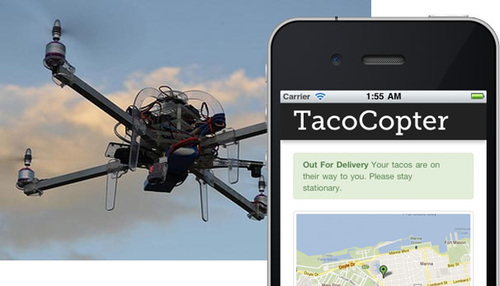
Whatever one’s feelings about unmanned attack drones, a group of Silicon Valley entrepreneurs have found a peaceful use for them that almost everyone can support: delivering food to hungry people.

It works like this: place an order from their taco shop using a smartphone with GPS. The restaurant cooks up your order, loads it into an unmanned drone, and the TacoCopter flies to your location and delivers it to you right where you stand.

It’s a pretty cool idea. But even though TacoCopter has been around for almost a year, they have yet to get off the ground – figuratively or literally. FAA regulations don’t allow unmanned drones to be used for commercial purposes. Maybe TacoCopter should re-charter as a non-profit?

TacoCopter co-founder Star Simpson told the Huffington Post, “Honestly I think it’s not totally unreasonable to regulate something as potentially dangerous as having flying robots slinging tacos over people’s heads … [O]n the other hand, it’s a little bit ironic that that’s the case in a country where you can be killed by drone with no judicial review.”

Non-FAA critics argue that TacoCopter-style automation would put delivery drivers out of work. If TacoCopter becomes a success, it almost certainly would eliminate some delivery jobs. But those critics haven’t proven that this would be a bad thing.

There was a time when about 90 percent of Americans were farmers. Automation has reduced that to about two percent today. Despite all those lost jobs, the main reason unemployment is over 8 percent isn’t new technology. It’s a recession. Something about anti-automation arguments doesn’t compute – they forget that economies are filled with change and dynamism. Technology marches on, yet most people still find work.

If a machine takes away a man’s job, that man is now free to pursue another opportunity. Remember, opportunity is not a zero-sum game. Economic prosperity requires creating more wealth with less labor. Reducing the amount of labor used on food delivery frees that labor for other, higher-valued uses.

The FAA should reconsider its ban-first-ask-questions-later approach. And latter-day Luddites need not fear for the deliveryman’s future.

Supreme Court Hears the Health Care Case


Over at CNN, law professor Ilya Somin explains why he believes the health care bill is unconstitutional, and the Supreme Court should strike it down. He argues on commerce clause grounds:

[E]very previous case expanding the commerce power involved some sort of “economic activity,” such as operating a business or consuming a product. Failure to purchase health insurance is neither commerce nor an interstate activity. Indeed, it is the absence of commerce.

If Congress could use that clause to regulate mere failure to buy a product on the grounds that such inaction has an economic effect, there would be no structural limits to its power.

In other words, the real question being decided is whether or not there are limits to Congress’ power. If Congress has unlimited power, the insurance mandate stands. If there are limits to Congress’ power, it has to be struck down. It’s pretty easy to see that this case will have consequences far beyond the piece of legislation that sparked the case.

It’s too early to tell how it will turn out. Today is the first of three days of oral arguments, and the Court probably won’t release its decision until June.

In the meantime, a bit of advice to court watchers of all ideological stripes: don’t confuse the Constitution with constitutional law. They are very different things. That’s why this case really could go either way.

The $400 Pizza

Baseball season is coming up. This time of year I’ll usually read a book about baseball to psyche myself up for the season. Some of the best ones I’ve come across in recent years are George Vecsey’s Baseball: A History of America’s Favorite Game and George Will’s Men at Work. This year I chose Ball Four by Jim Bouton.

Bouton was a pitcher who bounced around the league after having early success with the Yankees. Ball Four is a diary of his 1969 season with the expansion Seattle Pilots, who lasted only one year as a franchise; after the season ended they moved to Milwaukee and became the Brewers. Bouton ended the 1969 season with the Houston Astros after a late-season trade. Besides being wickedly funny, the book is something of a tell-all, and is surprisingly cynical for a book about a children’s game. It also made him persona non grata in the league.

What does all that have to do with the title of this post? Ten years after Ball Four came out, Bouton added an epilogue titled “Ball Five” for a new edition. In it he writes about his post-playing career as a sports reporter for New York-area tv stations, and he shares a story about friend-of-CEI John Stossel:

I also had a lot of respect for our intrepid consumer reporter John Stossel who exposed rip-offs in the marketplace. I particularly remember one of John’s rip-off stories that never got on the air. John was doing an exposé on the fast food industry and one Sunday he bought a pizza for $400. The reason it cost $400 was not because of restaurant business practices but because of television labor practices. John needed a pizza for a prop but he couldn’t get it himself. A set decorator had to get it. Then a prop man had to hold it. Then a stagehand had to give it to him. By the time they figured out the overtime and holiday pay, it came to something like $400. Of course, if John had tried to expose the cost of the television pizza he might have had to finish his story in a suddenly darkened newsroom.

Bouton doesn’t say in what year Stossel’s story didn’t air. So let’s assume it’s 1980, when he wrote the chapter. According to the Minneapolis Fed’s handy inflation calculator, that $400 pizza would cost $1,128.43 today.

CEI’s Battered Business Bureau: The Week in Regulation


Just another week in the world of regulation:

  •  75 new final rules were published last week, up from 72 the previous week. That’s the equivalent of a new regulation every 2 hours and 15 minutes, 24 hours a day, 7 days a week. All in all, exactly 800 final rules have been published in the Federal Register this year. If this keeps up, the total tally for 2012 will be 3,528 new rules.
  •  1,386 new pages were added to the 2012 Federal Register last week, for a total of 17,296 pages. At this pace, the 2012 Federal Register will run 75,860 pages.
  • Rules are called “economically significant” if they have costs of $100 million or more in a given year. The 13 such rules published so far in 2012 cost at least $15.2 billion. Two of the rules do not have cost estimates, and a third cost estimate does not give a total annual cost. We assume that rules lacking this basic transparency measure cost the bare minimum of $100 million per year. The true cost is almost certainly higher.
  •  There were 18 significant actions this week, as defined by Executive Order 12866. Three of them are economically significant. So far, 105 significant final rules have been published in 2012.
  •  So far this year, 150 final rules affect small businesses. 25 of them are significant rules.

Highlights from final rules published this week:

  • The biggest regulation of the week came out on Friday to implement part of the health care bill. A change in Medicaid eligibility requirements would increase federal spending by $164 billion over five years by OACT’s estimate. CBO estimates a $162 billion spending increase over 5 years. That’s an average of $32.4 to $32.8 billion per year. For Battered Business Bureau purposes, I am listing its cost as zero since its main cost is on-budget government spending, not off-budget compliance costs.
  •  A new rule governing living organisms inside ships’ ballast waters will cost $92 million per year, but it’s still classified as economically significant. As originally proposed, it would cost an estimated $167 million per year.
  • Another health care regulation covering “Standards related to Reinsurance, Risk Corridors, and Risk Adjustment” will cost nothing in 2012 or 2013. But it will cost $11 billion in 2014, and rise to $18 billion in 2015 and 2016. For Battered Business purposes, I have listed its cost as zero for 2012’s regulatory costs.

For more data, updated daily, go to TenThousandCommandments.com.

More than Meets the Eye

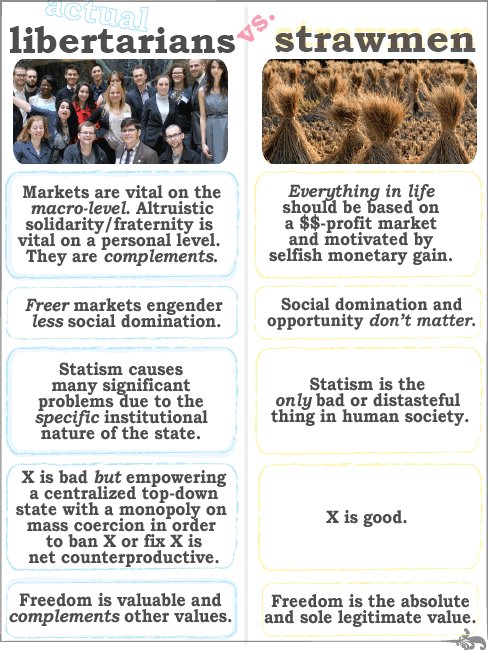
When people disagree with something, they are generally reluctant to ascribe depth or nuance to it. Its motives must also be checkered; how could anyone actually believe that?!

This picture, via St. Lawrence University economist Steve Horwitz, shows some examples that I encounter on practically a daily basis (click image to enlarge):