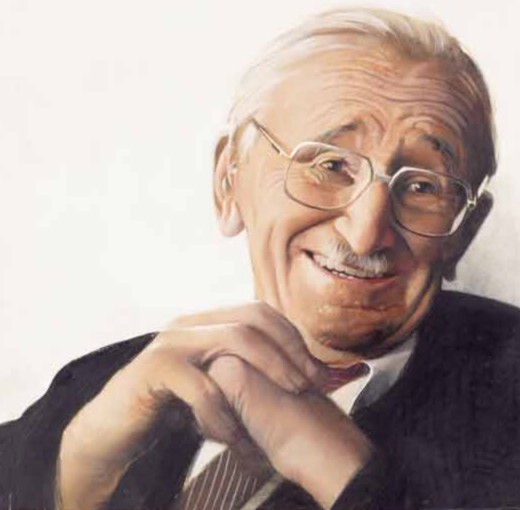
Twenty Years without Hayek


F.A. Hayek died twenty years ago today. In his long career – his first book was published in 1929, his last in 1988 – he made important contributions to economics, philosophy, and even psychology. He even won a Nobel Prize along the way.

If there is a unifying theme to Hayek’s diverse body of work, it is an emphasis on intellectual humility. He was a dogged opponent of capital-C Certainty, and was always quick to remind would-be social engineers that there are limits to their knowledge. The unintended consequences of their grand plans are somewhat less limited.

Hayek’s grandfather was a professor of natural science, and his father was a doctor who moonlighted in botany. As happens to many boys growing up in scientifically-minded households, the young Hayek was fascinated with evolution. This would profoundly influence his economic thought when he grew up, especially his concept of spontaneous order.

Human language, Wikipedia, and the economy are all examples of spontaneous order. Designs, even complicated ones, don’t always require a designer. Just as the process of natural selection allows species to adapt to their environment over time without someone planning it all, nobody invented the English language. Nobody directed its evolution from Shakespeare to text messages. Jimmy Wales, partially inspired by Hayek, created the Wikipedia website. But he certainly didn’t direct its army of contributors beyond a few basic ground rules, which themselves spontaneously evolved.

And as the 20th century showed, nobody can plan a national economy without severe unintended consequences.

That’s why one of Hayek’s most famous quotes is, “The curious task of economics is to demonstrate to men how little they really know about what they imagine they can design.” It’s a fancy of way of telling his fellow economists to please be humble.

Hayek first gained fame for his business cycle theories. He joined the London School of Economics in 1931, just as Keynes was rocketing to fame. The men became close friends, but their ideas were rather different. Keynes thought the way out of the Great Depression was investment. Since the private sector wasn’t investing enough to grow the economy, the solution was an expertly designed policy of inflation, lower interest rates, and public investment projects – stimulus.

Hayek counseled humility instead. Economies are so complicated, and so dynamic, that no expert on earth can accurately foresee unintended consequences. When experts tinker with interest rates, they change peoples’ behavior. They’ll invest in one thing instead of another, and nobody can quite predict how. When prices are distorted, peoples’ decision-making is distorted with it.

When people can’t accurately determine the highest-valued uses for their resources, the result is malinvestment. Too much investment in housing leads to too little investment in other areas that create more value. This does much to explain why the housing crisis is doing so much damage today.

Their friendly debate was the talk of the profession. Politicians almost universally sided with Keynes because he counseled them to do things they already wanted to do anyway; politics is not a humble profession. Most economists did, too. The discipline was becoming ever more quantitative, and economists were becoming more and more confident in their ability to precisely direct an economy. They were falling for the fatal conceit.

Hayek’s most popular book, The Road to Serfdom, was written in a barn in England during World War II. The London School of Economics temporarily moved out of London to avoid the blitz. Hayek’s new office was less than glamorous, but at least it was safe. The basic message is that economic intervention doesn’t work, and the usual political reaction to these failures is more intervention. Travel down this road long enough, and the result is a total state, or something close to it. The people will wake up one day to find that they have lost their freedom.

Hayek’s critics, and even many of his supporters, forget that Hayek thought that the road to serfdom is a two-way street. An intervention here and there does not, therefore, mean the end of civilization. But people must be eternally vigilant to make sure interventions don’t metastasize.

In the 1950s, Hayek turned his attention elsewhere. Seeing economists’ still-growing scientific pretensions, he published a book on methodology, The Counter-Revolution of Science, in 1952. In it, he calls this new science-fetish “scientism,” and once again counsels humility. Economics has scientific aspects, but it is not a pure science the way that physics or chemistry is. Economists forget this at our peril.

Economies, and the millions of humans who participate in them, are so complex, so fickle, and so unpredictable, that even the most rigorous multivariate regression analysis is unlikely to actually reflect real world conditions. Economists work with models, which are necessarily simplifications. They can’t account for every relevant factor. What’s more, economic plans based on flawed data are likely to be flawed themselves. There’s a knowledge problem here.

Hayek also published The Sensory Order in 1952, which remains widely cited in the psychological literature – an impressive feat, considering that psychology departments tend not to be bastions of free-market Hayekians. Drawing on his belief that human cognitive capabilities are less than perfect, the book outlines Hayek’s theory of how the mind processes and filters information that the senses send to it.

Whereas The Road to Serfdom was mainly negative in outlook, Hayek spent his later years writing more positive works. If Serfdom is about what should not be, 1960’s The Constitution of Liberty is about what should be. Think of it as Hayek’s answer to Plato’s Republic or Thomas More’s Utopia. It also contains his famous essay “Why I Am Not a Conservative,” which you can read online here.

In the 1970s, he would expand on this vision in the three-volume Law, Legislation, and Liberty. Hayek saw a world of difference between law and legislation. People often use the words interchangeably, but they are not the same. To avoid confusion, Hayek turned to Greek and borrowed the words metis and legis.

Metis is essentially social custom. It evolves as a spontaneous order, and adapts over time to changing circumstances; natural selection operates in the social sphere, not just in nature. Examples of metis include what is considered rude or polite, how one does business, and how a society is structured. The point is that they evolve bottom-up, and are deeply ingrained in society’s fabric.

Legis is where we get the English word legislation. These are top-down edicts from legislators. When they mesh well with already-existing metis – as with property rights protections – legis tends to work quite well, and can even enhance metis. But when it oversteps its bounds, as often happens in the hands of experts who believe they know better than the rest of us, the result is failure. Law is stronger than any piece of legislation.

Hayek capped his career with what is probably his most approachable book, The Fatal Conceit. It’s as good a summation of his life’s work as one will find. Given spontaneous order, the importance of metis over legis, and the knowledge problem, people who still arrogantly believe their grand plans will work without unintended consequences have fallen for the fatal conceit.

As always, the underlying theme is humility. Twenty years after Hayek’s death at age 92, that message is as important as ever.

CEI Podcast for March 22, 2012: Human Achievement Hour


Have a listen here.

From 8:30 to 9:30 pm on Saturday, March 31, buildings in major cities around the world will go dark in observance of Earth Hour. The point is to show that modernity and the environment are incompatible. At the same time as Earth Hour, millions of people will leave their lights on to celebrate Human Achievement Hour. Michelle Minton, CEI’s Fellow in Consumer Policy Studies and also the founder of Human Achievement Hour, explains.

On the Radio – Regulation

Tomorrow morning around 8:00, I’ll be on the Rob and Dave show on Atlanta’s WGST 92.3 FM to talk about regulation. Non-Georgians should be able to listen live at this link (look for a listen live button near the top of the page).

Regulation of the Day 214: Flipping the Bird


Steven Pogue, 64, was cited by police for flipping the bird while driving in Ballwin, Missouri. He was exonerated on free speech grounds, and the city is now moving to repeal the law.

Such impolite behavior is par for the course in New York City, among other places. Should such rude people find themselves in a certain part of eastern Missouri, they now have nothing to fear.

The ordinance in question prohibits motorists from extending body parts outside vehicle windows. It was intended more to prevent people from sticking their legs out of windows than to discourage profanity, though at least one officer thought the ordinance also applied to middle fingers.

Your mild-mannered correspondent has also, admittedly, been known to let loose now and then. Usually it’s while in pain, though the DC area’s spectacularly inept drivers do occasionally draw my ire. But should linguistic decorum be a matter of law? In this case, discretion should be the better part of valor.

A local ACLU spokeswoman comments that “Repealing the law fits within our nation’s finest traditions of allowing free expressions without fear of arrest.” Right on.

Similar cases have been successfully fought in Philadelphia, and with less success in Milwaukee.

Regulation of the Day 213: Dying


Falciano del Massico, a small town in Italy, has banned its 4,000 residents from dying because the local cemetery is completely full. Mayor Giulio Cesare Fava’s ordinance reads, in part, “It is forbidden for residents to go beyond the boundaries of earthly life, and go into the afterlife.”

An ongoing feud with a neighboring town has made it difficult to fix the problem.

Interviewed by the BBC, Mayor Fava pleaded with a straight face: “Citizens, while we await the construction of the new cemetery, I order you not to die, so we don’t have any problems.”

While this writer is often skeptical of the power of regulation, I sincerely hope that Mayor Fava’s death ban succeeds. If it does, Falciano del Massico might be just the place for my wife and I to spend our retirement years.

TSA Thwarts Wheelchair-Bound 3-Year Old Terrorist

Presented without comment. Click here if the embedded video doesn’t work.


CEI’s Battered Business Bureau: The Week in Regulation


Just another week in the world of regulation:

  •  72 new final rules were published last week, up from 64 the previous week. That’s the equivalent of a new regulation every 2 hours and 20 minutes, 24 hours a day, 7 days a week. All in all, 725 final rules have been published in the Federal Register this year. If this keeps up, the total tally for 2012 will be 3,492 new rules.
  •  1,459 new pages were added to the 2012 Federal Register last week, for a total of 15,910 pages. At this pace, the 2012 Federal Register will run 76,492 pages.
  • Rules are called “economically significant” if they have costs of $100 million or more in a given year. The 10 such rules published so far in 2012 cost at least $15.11 billion. Two of the rules do not have cost estimates, and a third cost estimate does not give a total annual cost. We assume that rules lacking this basic transparency measure cost the bare minimum of $100 million per year. The true cost is almost certainly higher.
  •  There were 13 significant actions this week, as defined by Executive Order 12866. One of them is economically significant. So far, 96 significant final rules have been published in 2012.
  •  So far this year, 127 final rules affect small businesses. 22 of them are significant rules.

Highlights from final rules published this week:

  • A rule doesn’t have to be economically significant to be expensive. A DEA rule on “Controlled Substances and List I Chemical Registration and Reregistration Fees” has an astoundingly precise estimated cost of $76,226,568.
  •  The Defense Department is still implementing parts of the Privacy Act of 1974.
  •  The Coast Guard sets the schedules for raising and lowering drawbridges across the country. Now, this isn’t rocket science – bridge up, bridge down. One would think local governments could handle such a complicated task on their own. But apparently they can’t. In fact, on Tuesday, the Coast Guard published a rule temporarily revising drawbridge schedules in Morgan City, Louisiana to accommodate some bridge maintenance. Again, this isn’t rocket science – the bridge will be in the down position during maintenance.

For more data, updated daily, go to TenThousandCommandments.com.

TSA Infographic

The creator of this great infographic sent me an email this morning asking if I’d post about it; happy to oblige. Original image here.

Worth noting: the link between body scanners and cancer is unclear. I’m personally skeptical that there’s a causal link, but we don’t know for sure yet. Either way, they’re easily defeated, and do not improve passenger safety.

TSA Waste
Created by: OnlineCriminalJusticeDegree.com

Popularization Matters

Academic scientists often look down on Carl Sagan because he spent so much time on popular-level projects, like the Cosmos television series. The man even wrote a novel. Heaven forbid.

Ask many of those same scientists who got them interested in the subject in the first place. What sparked their fascination? Who is ultimately responsible for giving them the gall to advance scientific frontiers? They’ll probably say it was Carl Sagan, or someone like him.

This tension between academics and popularizers goes back centuries. I’m on a Voltaire kick at the moment, so do indulge. Referring to Diderot’s massive, expensive Encyclopedie (to which Voltaire contributed), he wrote:

“Twenty folio volumes will never start a revolution; it’s the pocket books at thirty sous that represent the real threat. If the Gospels had cost 1,200 [Roman] sestertia, the Christian religion would never have established itself.”

Roger Pearson, Voltaire Almighty: A Life in Pursuit of Freedom, p. 298.

Not a bad point. Ideas originate with academics, and they’ll play with them for some time in the journals. But popularizers usually find a way to sneak ideas down to the masses eventually; Sagan and Bastiat and all that. Think of it as division of labor. Some create, others disperse.

The process works much faster in the Internet age. The primary obstacle now is IQ, not access. But it still holds. The point is that there is a role for both ivory tower academics and popularizers.

Given the disdain that each side holds for the other, it’s probably best that they be kept separate. But as someone who straddles the line between the two, I humbly propose that both sides find a way to get along. After all, when it comes to the pursuit of knowledge and a better life for all, we’re all friends. Let’s act like it.

CEI Podcast for March 15, 2012: T. Boone Pickens Amendment Fails


Have a listen here.

The Senate this week voted down a highway bill amendment that would massively financially benefit natural gas mogul T. Boone Pickens. Senior Fellow Marlo Lewis explains why the Senate did the right thing, and why Washington shouldn’t be in the business of picking winners and losers in the energy marketplace.