

CEI’s Battered Business Bureau: The Week in Regulation

fpka13
This week in the world of regulation:

  • Last week, 68 new final regulations were published in the Federal Register. This is down from 71 new final rules the previous week.
  • That’s the equivalent of a new regulation every 2 hours and 28 minutes — 24 hours a day, seven days a week.
  • All in all, 1,366 final rules have been published in the Federal Register this year.
  • If this keeps up, the total tally for 2013 will be 3,462 new final rules.
  • Last week, 2,598 new pages were added to the 2013 Federal Register, for a total of 31,766 pages. This is roughly double the average pace.
  • At its current pace, the 2013 Federal Register will run 78,629 pages.
  • Rules are called “economically significant” if they have costs of $100 million or more in a given year. One such rule was published last week (the first since April 18), for a total of 13 so far in 2013.
  • The total estimated compliance costs of this year’s economically significant regulations ranges from $5.58 billion to $10.19 billion.
  • So far, 94 final rules that meet the broader definition of “significant” have been published in 2013.
  • So far this year, 246 final rules affect small business; 21 of them are significant rules.

Highlights from final rules published last week:

For more data, go to TenThousandCommandments.com.
Regulation of the Day Update: Olive Oil Victory

I recently posted that new EU regulations would require restaurants to use factory packaged and sealed bottles of olive oil. This would put small artisanal producers out of business, and reduce consumer choice. Fortunately, the UK Telegraph is reporting that the EU is dropping the olive oil rules due to a public outcry (hat tip Walter Olson):

In a humiliating U-turn, Dacian Ciolos, the European commissioner for agriculture, admitted that the proposed ban on traditional olive oil jugs, had provoked popular loathing, or “misunderstanding”, from the people that he said wanted to protect for their own good.

This is why regulatory transparency is so important. The more people learn about regulation, the less they tend to like it. And when a whopper such as this one comes down the pike, it won’t get repealed unless people find out about it. Mr. Ciolos appears not to have learned his lesson, but results are what matter. He lost. More importantly, consumers and small olive oil producers won.

CEI Podcast for May 22, 2013: Twenty Years of Ten Thousand Commandments

10KC2013 cover-resize
Have a listen here.

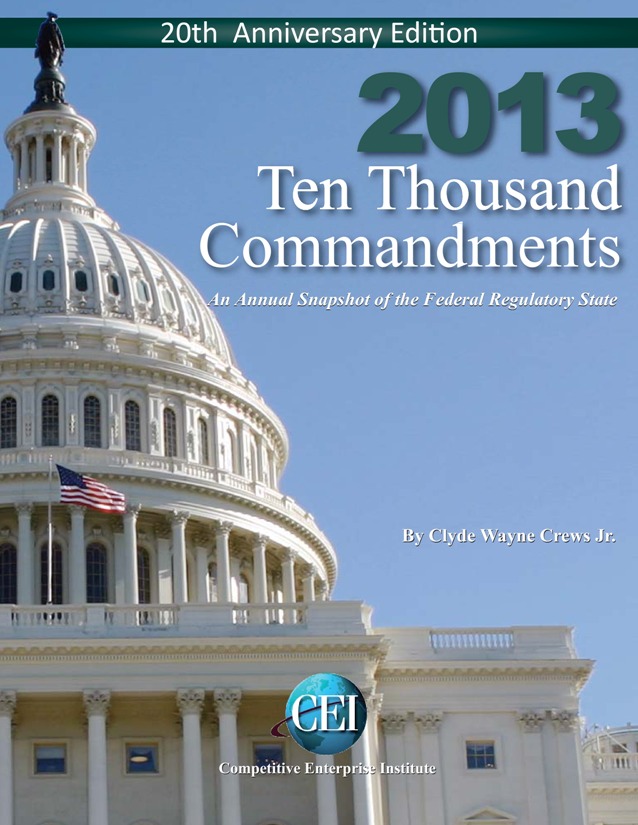
The twentieth anniversary edition of Ten Thousand Commandments was released this week. The annual report gives a big-picture overview of the federal regulatory state. Author Wayne Crews discusses his main findings, how he started Ten Thousand Commandments, how the regulatory state has evolved over the last twenty years, and what the future holds for regulation.

Possible Unintended Consequences in New Health Care Regulation

The Affordable Care Act bans health insurers from denying people coverage if they have certain pre-existing medical conditions. A regulation partially implementing that policy appeared in today’s Federal Register. It is the first “economically significant” regulation ($100 million or more in annual economic impact) to appear since April 18. This interim final rule extends the Pre-Existing Condition Insurance Plan (PCIP) program through 2014.

How much does it cost? The analysis accompanying the rule is vague. It does say that the Health and Human Services Department “is authorized to disperse $5 billion to pay claims and the administrative costs of the PCIP program that are in excess of premiums collected from enrollees.” Essentially, if insurers and providers are required to take losses on some of their patients, Washington has agreed to subsidize some of the difference with taxpayer dollars.

Since this is government spending, I won’t include this $5 billion in my running tally of compliance costs for this year’s economically significant rules (currently ranging from $5.58 billion to $10.19 billion, as of the most recent Battered Business Bureau post).

The rule acknowledges administrative costs, but claims they will be minimal since they build on existing systems. It gives no numbers.

The cost analysis also states, “With respect to other parties, we lack data with which to quantify costs associated with this regulation.” Since the bread and butter of this regulation is a series of price controls and subsidies, it can be hard to quantify how patients and providers might change their behavior.

Some providers, because of the price controls and paperwork involved with the PCIP, might opt to simply refuse to treat patients in the PCIP program. The rule acknowledges this:

While we understand that the decision to no longer treat PCIP enrollees is possible, we believe and are hopeful that most facilities and providers will accept the new payment rates established in this interim final rule given the serious health conditions many federally-administered PCIP enrollees have and the prospect that such reduced payment is temporary until 2014 when no one can generally be denied health coverage because of a pre-existing condition.

People change their behavior when their incentives change. The PCIP program gives health care providers an incentive to refuse treatment to people who desperately need it. And that unintended consequence, as opposed to paperwork, may be the true cost of today’s regulation.

Ten Thousand Commandments Released Today

Today marks the release of the twentieth anniversary edition of Ten Thousand Commandments, Wayne Crews’ annual overview of the regulatory state. Over at the Daily Caller, Wayne and I briefly summarize of few of the report’s findings. Here’s a taste:

Since the first edition of Ten Thousand Commandments was published in 1993, a touch less than 1.43 million Federal Register pages have been published. That’s an average of 71,470 pages per year. Considering that an average year has 250 workdays (the Federal Register is not published on weekends or holidays), that roughly averages out to 286 pages per day. It takes a very busy federal government to fill that many pages each and every workday.

We also ran a few numbers and found something very interesting:

A standard ream of 20-pound weight paper, standard for office use, is about two inches thick. From that, we can calculate that our 1.43 million-page stack would be 476 feet tall. It would also weigh more than seven tons. Fittingly, this regulatory tower would rival the Washington Monument’s 555 feet for supremacy of Washington’s skyline. In fact, if the tower were to keep growing at its 20-year average pace, it would surpass the Washington Monument in 2016.

Read the whole thing here. And read the new Ten Thousand Commandments here.

In Defense of Interest

The concept of lending money for interest hasn’t needed many defenders since roughly the Renaissance, when usury laws fell out of fashion. Even so, some people are still innocent of economics and the time value of money. They still attack the very notion of interest. Ludwig von Mises offers a pithy defense on p. 41 of 1940’s Interventionism: An Economic Analysis:

In order to do away with interest we would have to prevent people from valuing a house, which today is habitable, more highly than a house which will not be ready for use for ten years. Interest is not peculiar to the capitalistic system only. In a socialist community too the fact will have to be considered that a loaf of bread which will not be ready for consumption for another year does not satisfy present hunger.

Objections to interest then, must clear hurdles as high as human nature, hunger, and time itself. Good luck, I say.

Regulation of the Day 231: Serving Olive Oil

olive-oil
When you sit down at a Mediterranean restaurant, your server will typically set down some bread on the table, then pour some olive oil into a saucer or small bowl for dipping. Many restaurants also keep small jugs of olive oil as part of their table setting for general use. It’s a delicious way to begin a meal.

New European Union regulations are set to change this centuries-long practice. Starting January 1, 2014, any olive oil served at table “must be in pre-packaged, factory bottles with a tamper-proof dispensing nozzle and labelling in line with tight EU standards.” That means no more saucers of oil for dipping, and no more refillable jugs at the table.

Most complaints about the rule have been directed at the EU’s micromanagemerial tendencies, and there is certainly something to it. But there is also a public choice angle that’s worth looking at.

Many restaurants buy their olive oil from small family farms that aren’t able to comply with the new labeling and sealing standards. Restaurants buy from them because many diners prefer their olive oil to the more homogenous product put out by larger firms. These larger firms are also precisely the people who will benefit from the new rules. A public choice theorist would point out that the big producers very likely had something to do with pushing for their passage, and their added business comes at the expense of smaller farms – and consumers’ palettes.

This kind of rent-seeking behavior is all too common. And the more regulations there are, the more rent-seeking one sees. These olive oil rules are only the latest example. Most supporters of the rule might be motivated by health and safety, but certain other supporters are more concerned with securing an artificial competitive advantage for themselves.

10KC in WSJ

The Wall Street Journal editorial board weighed in this morning on the issue of regulation, citing a few numbers from the forthcoming 20th anniversary edition of Wayne Crews’ annual Ten Thousand Commandments report. Here’s a taste:

For two decades, Wayne Crews of the Competitive Enterprise Institute has tracked the growth of new federal regulations. In his 20th anniversary edition this week, he’ll report that pages in the Code of Federal Regulations hit an all-time high of 174,545 in 2012, an increase of more than 21% during the last decade.

Relying largely on government data, Mr. Crews estimates that in 2012 the cost of federal rules exceeded $1.8 trillion, roughly equal to the GDP of Canada. These costs are embedded in nearly everything Americans buy. Mr. Crews calculates these costs at $14,768 per household, meaning that red tape is now the second largest item in the typical family budget after housing.

Read the whole thing here.

CEI’s Battered Business Bureau: The Week in Regulation

american_lamb_board logo
This week in the world of regulation:

  • Last week, 71 new final regulations were published in the Federal Register. This is up from 64 new final rules the previous week.
  • That’s the equivalent of a new regulation every 2 hours and 22 minutes — 24 hours a day, seven days a week.
  • All in all, 1,298 final rules have been published in the Federal Register this year.
  • If this keeps up, the total tally for 2013 will be 3,458 new final rules.
  • Last week, 1,377 new pages were added to the 2013 Federal Register, for a total of 29,188 pages.
  • At its current pace, the 2013 Federal Register will run 76,011 pages.
  • Rules are called “economically significant” if they have costs of $100 million or more in a given year. For the fourth week in a row, no such rules were published last week, for a total of 12 so far in 2013.
  • The total estimated compliance costs of this year’s economically significant regulations ranges from $5.58 billion to $10.19 billion.
  • So far, 91 final rules that meet the broader definition of “significant” have been published in 2013.
  • So far this year, 237 final rules affect small business; 21 of them are significant rules.

Highlights from final rules published last week:

For more data, go to TenThousandCommandments.com.

Regulation Roundup

witch-on-broomstick