CEI Podcast for May 16, 2013: A Controversial EPA Nominee

gina mccarthy
Have a listen here.

The bitter fight over Gina McCarthy, President Obama’s nominee for EPA Administrator, is headed to the Senate floor under a potential filibuster threat. Myron Ebell, Director of CEI’s Center for Energy and Environment, explains that the deeper cause of this political fight is a startling lack of transparency at the EPA that McCarthy is unlikely to fix.

Now it’s Getting Serious

From Politico: “The IRS softball team in Washington canceled a game scheduled for Friday against a team from Texas Sen. John Cornyn’s office and wasn’t able to reschedule.”

The plot thickens.

New Cato Video on the IRS Scandal

Well worth five minutes of your time. Features the ACLU’s Michael MacLeod-Ball, David Keating from the Center for Competitive Politics, and Cato’s John Samples and Gene Healy (Gene’s column on the same subject is also worth reading). Click here if the video embedded below doesn’t work.

Vonnegut on Partisanship

kurt_vonnegut
The line of thought that Kurt Vonnegut describes on p. 27 of Breakfast of Champions isn’t true of all people, but it is still distressingly common.

Ideas on Earth were badges of friendship or enmity. Their content did not matter. Friends agreed with friends, in order to express friendliness. Enemies disagreed with enemies, in order to express enmity.

There is a good reason why Vonnegut’s depressing observation is true. Humans evolved as a tribal species, and we haven’t quite grown out of it yet. This is one reason an immigration debate still exists, even though economists decided the issue more than two centuries ago. More to the point, agreeing or disagreeing with people for merit-unrelated reasons is one way that people define their in-groups and out-groups.

Regulation of the Day 230: The Temperature of Beer

beer in ice
The state of Indiana regulates the temperature at which convenience stores may sell beer. Specifically, they must sell it at room temperature. Cold beer is forbidden. The law, unique to Indiana, is presumably motivated by temperance concerns. People can’t buy beer on the spur of the moment and it drink it cold right away. They have to take it home and refrigerate it first. Instead of instant gratification, people have to plan ahead. This promotes more responsible drinking habits, the thinking goes.

Then again, the law exempts wine sales. Any Indianan who wants to can buy a chilled bottle of wine from the local 7-11 and drink it immediately. Instead of keeping people sober, the law amounts in practice to discrimination against beer. Wine producers might not mind that so much, but nearly everyone else does.

Even so, a push to overturn the law in the legislature failed earlier this year. That’s why three convenience store chains are suing to overturn the law. The case is currently moving through federal court. An employee of one chain told WISH, a local television station:

“Thorton’s has not built a convenience store in Indiana since 2006,” said David Bridgers of Thorton’s convenience stores, “for the sole reason of its antiquated alcohol laws.”

So not only does Indiana’s warm beer law fail to promote temperance, it is directly hampering job creation in the state.

The plaintiffs also argue that Indiana’s room-temperature beer law is unconstitutional, violating the equal protection clause in two ways. One, the law only applies to convenience stores. Grocery stores and other types of retailers may sell cold beer. Different retailers shouldn’t be treated differently, they argue. Two, wine should not have an artificial competitive advantage over beer. Government’s job is to ensure that they compete as equals on level ground, not to tilt that ground unequally.

Scot Imus of the IPCA, a trade association for convenience stores, told a trade publication that “We are confident that the court will agree with us that it is not the job of government to pick winners and losers in the marketplace.”

Most Indianans are hoping he’s right.

CEI’s Battered Business Bureau: The Week in Regulation

PRC-RGB-twitter1This week in the world of regulation:

  • Last week, 64 new final regulations were published in the Federal Register. This is up from 62 new final rules the previous week.
  • That’s the equivalent of a new regulation every 2 hours and 38 minutes — 24 hours a day, seven days a week.
  • All in all, 1,227 final rules have been published in the Federal Register this year.
  • If this keeps up, the total tally for 2013 will be 3,445 new final rules.
  • Last week, 1,621 new pages were added to the 2013 Federal Register, for a total of 27,811 pages.
  • At its current pace, the 2013 Federal Register will run 76,404 pages.
  • Rules are called “economically significant” if they have costs of $100 million or more in a given year. For the third week in a row, no such rules were published last week, for a total of 12 so far in 2013.
  • The total estimated compliance costs of this year’s economically significant regulations ranges from $5.58 billion to $10.19 billion.
  • So far, 88 final rules that meet the broader definition of “significant” have been published in 2013.
  • So far this year, 228 final rules affect small business; 21 of them are significant rules.

Highlights from final rules published last week:

For more data, go to TenThousandCommandments.com.

IRS Apologizes for Targeting Conservative Groups

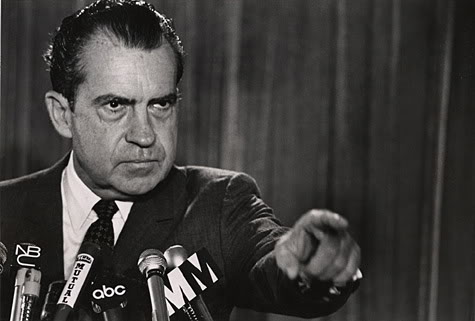
richard nixon pointing finger
The only surprising part of this story is that the IRS apologized. Whichever party is in power, its critics can expect more IRS attention than usual. Since  the executive branch is currently run by a Democrat, tax-exempt groups with phrases like “tea party” and “patriot” in their names were targeted. But the tables turn when a Republican is president. Charlotte Twight gives a historical example on p. 271 of her book Dependent on D.C.:

Republican President Richard Nixon in 1971 expressed his intention to select as IRS commissioner “a ruthless son of a bitch,” who “will do what he’s told,” will make sure that “every income tax return I want to see I see,” and “will go after our enemies and not go after our friends.”

President Bill Clinton, a Democrat, is also alleged to have abused his position to punish political enemies.

Conservatives are right to be outraged by today’s news. But they shouldn’t be surprised by it. Nor should they direct their ire at President Obama or the IRS staffers who initiated the unnecessary investigations. They should be outraged that politics has become such a high-stakes game in the first place that officeholders view this type of behavior as a legitimate political tactic. The problem is systemic, not partisan.

CEI Podcast for May 8, 2013: The Debate Over Undocumented Immigration

statue-of-liberty
Have a listen here.

CEI Immigration Policy Analyst David Bier is critical of a new Heritage Foundation study that estimates that giving legal status to America’s undocumented immigrants would cost $6.3 trillion over the next 50 years.

CEI’s Battered Business Bureau: The Week in Regulation

oliveThis week in the world of regulation:

  • Last week, 62 new final regulations were published in the Federal Register. This is down from 66 new final rules the previous week.
  • That’s the equivalent of a new regulation every 2 hours and 43 minutes — 24 hours a day, seven days a week.
  • All in all, 1,163 final rules have been published in the Federal Register this year.
  • If this keeps up, the total tally for 2013 will be 3,451 new final rules.
  • Last week, 1,250 new pages were added to the 2013 Federal Register, for a total of 26,190pages.
  • At its current pace, the 2013 Federal Register will run 76,134 pages.
  • Rules are called “economically significant” if they have costs of $100 million or more in a given year. No such rules were published last week, for a total of 12 so far in 2013.
  • The total estimated compliance costs of this year’s economically significant regulations ranges from $5.58 billion to $10.19 billion.
  • So far, 85 final rules that meet the broader definition of “significant” have been published in 2013.
  • So far this year, 216 final rules affect small business; 20 of them are significant rules.

Highlights from final rules published last week:

For more data, go to TenThousandCommandments.com.

CEI Podcast for May 2, 2013: Small Business Owners Sue Over IRS Obamacare Power Grab

gavel
Have a listen here.

Small business owners and individuals in six states, with help from CEI, are suing the IRS over what General Counsel Sam Kazman calls a flagrantly illegal expansion of the Affordable Care Act.