Category Archives: Uncategorized

TSA Pats Down Breast Cancer Survivor with Double Mastectomy

Lori Dorn is a breast cancer survivor. Her hair still hasn’t grown back after enduring chemotherapy. She must look very suspicious, because here’s what she went through on a recent trip:

The TSA pulled her aside for a breast patdown, even though she stated she had breast implants in place after her bilateral mastectomy. Of course, that didn’t stop them. They didn’t even let her take out the Device Identification Card that would could have explained where the implants came from and their medical purpose.

Cardinals 8, Brewers 4

The Cardinals earned a sweep. As I said not too long ago, they are no pushovers; point proven. The Brewers have had an amazing month. Two bad weeks knock them out of the playoffs. Nothing is settled.

From here, the Crew hit the road for 3 games against lowly Houston. Then it’s off to St. Louis for one last chance to dim the Cardinals’ postseason hopes.

The magic number remains 18.

Headline of the Day

Elizabeth Taylor, Michael Jackson and Marlon Brando ‘drove across the U.S. in a rental car after 9/11, eating KFC’

Should Banks be Tax Collectors?

Dan Mitchell thinks they shouldn’t. I agree.

This Is What Progress Looks Like

Click to enlarge. Or see the original image here.

(via Radley Balko)

Packer Fans Can Be Very Devoted

From today’s Milwaukee Journal Sentinel:

Raymond Raab of Menomonee Falls was watching the playoff game against Atlanta two weeks ago and was feeling ill. His concerned wife, Louise, wanted to call 911.

“He said, ‘No, no, no, I want to watch the Packer game,’ ” Louise said. “Finally, when they were ahead by so much, he said, ‘OK, you can call 911 now.’ ”

Ray Raab died nine days later.

The Insanity of Ethanol Policy

My  colleague Brian McGraw skewers the ethanol lobby in this video he made. Warning: contains a bit of adult language.

Fixing America’s Immigration Black Market

One of the problems with current immigration laws is that they raise the price of immigrating legally. Basic economics tells us that when something costs more, people consume less of it.

That’s why so many of America’s immigrants are turning to dangerous but cheap immigration black markets to enter the country. This is a problem with an obvious solution. In today’s American Spectator, Alex Nowrasteh and I make the case that lowering the cost of legal immigration through liberalization will reduce the amount of illegal immigration, and shrink cruel black markets.

Basic economics wins again.

Regulation of the Day 114: Unlicensed Fruit Candy

The Chicago Tribune has a jaw-dropping story of regulators gone wild:

Department of Health inspectors seized, slashed open and poured bleach over thousands of dollars of local peaches, pears, raspberry and plum purees owned by pastry chef Flora Lazar… Inspectors cited no health problems with any of the food.

And that’s just the beginning. Read the whole thing. This is a scandal. Ms. Lazar is out of business for six months and has lost about $6,000. There is no evidence of harm. This is no way to treat a small business. Especially during a recession.

(Hat tip: the ever-resourceful Brian McGraw)

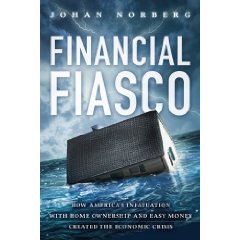
Financial Fiasco

I recently finished reading Swedish economist Johan Norberg‘s book about the financial crisis, aptly titled Financial Fiasco. It’s both short and informative. Six chapters and 155 pages, all of them worth reading.

The first two chapters are about the two big regulatory causes of the recession. One, monetary policy that was too easy for too long. The price system works. When the Fed messes with that price system, prices send out the wrong signals. People behave accordingly. Two, a decades-long drive to raise homeownership rates caused a lot of people to take out loans they couldn’t afford. It was only a matter of time before the consequences would come to bear.

Chapters 3 and 4 are about how the private sector reacted to the incentives regulators gave them. Let’s just say they acted badly. If people can game the system, they often will. Norberg’s criticism of overly-complicated securitized mortgage packages is both shocking and infuriating.

Chapter 5 is about how the government and private sector reacted to the crisis once the housing bubble popped. The $700 billion bailout program to reward bad behavior comes under fire.

Norberg is in top form in Chapter 6. Having looked at the causes and consequences of the crisis, now he offers a way out. One lesson is that politicians will always behave badly. “Politicians who distribute pork they cannot afford are reelected; butcher shops that sell pork they cannot afford go bankrupt. (p. 150)” Politicians are just like you and me. They go wherever their incentives lead them. We need to approach them accordingly.

The way to a full recovery is not bailouts. It is letting bad companies fail. And just as important, letting good ones prosper. “Government support for companies is thus not a way to save jobs, as politicians try to make us believe. It is a way to move jobs from good companies to bad companies.” (p. 151) In the long run, bailouts keep the economy down by keeping jobs and resources away from where they would do the most good.

Financial Fiasco has echoes of Tocqueville; a foreigner is trying to figure out how America works. Norberg, like Alexis de Tocqueville, is uncommonly perceptive. His experience living under an economy more thoroughly mixed than America’s allows him to see things that have escaped American commentators. This is extremely valuable. The fact that his book is concise, well written, and accessible to those of us who don’t have economics Ph.Ds makes it even moreso.