Category Archives: Philosophy

Who Says Economists Are Selfish?

And hence it is, that to feel much for others and little for ourselves, that to restrain our selfish, and to indulge our benevolent affections, constitutes the perfection of human nature; and can alone produce among mankind that harmony of sentiments and passions in which consists their whole grace and propriety.

-Adam Smith, Theory of Moral Sentiments, p. 25.

That sentence is more important to understanding how markets work than most people realize. The ability to feel empathy is part of what makes us human. It is also what makes market economies possible.

Without empathy, killing the customer would be at least as common as serving him. Mutual exchange — trade — is an act of peace. That wouldn’t be possible without the human ability to put ourselves in others’ shoes and feel for them. After all, it’s a lot easier to hit someone and take their stuff. And yet few people do. Empathy is a big reason why.

Adam Smith was one perceptive guy. Others have filled in gaps in his thought, and proven him wrong on some details. That does not take away from the fact that he was as perceptive as any thinker in history.

Political Pessimism, Human Optimism

Despite my pessimism (realism?) about politics, ever since reading Julian Simon, I have been an optimist when it comes to progress and the human condition. Since the industrial revolution, each generation has lived longer and better than the last. By that measure, the last decade was the best in human history.

This despite the last decade being an unmitigated political disaster, at least in America. President Bush grew government faster than any president since Lyndon Johnson. Between new health care entitlements, massive energy and farm bills, two wars, and more than 30,000 new regulations, the Bush administration was no friend of limited government.

President Obama has so far been no better. If anything, his policies are George W. Bush’s on steroids.

Fortunately, the institutional foundations of the market economy are stronger than any bumbling politician. Wherever there is peace, stability, tolerably low corruption, and secure property rights, people will make their lives better over time, despite meddlesome regulators getting in the way. The pattern is global.

Via Ronald Bailey, a brilliant article in Foreign Policy reinforces that point. Things really are getting better. The last decade was the best in human history. Read the whole thing. If you’re despairing over the state of the world, the data are a wonderful cure for pessimism. Here’s a taste:

Consider that in 1990, roughly half the global population lived on less than $1 a day; by 2007, the proportion had shrunk to 28 percent — and it will be lower still by the close of 2010. That’s because, though the financial crisis briefly stalled progress on income growth, it was just a hiccup in the decade’s relentless GDP climb.

Great Men (and Women)

“Great men have two lives; one which occurs while they work on this earth; a second which begins at the day of their death and continues as long as their ideas and conceptions remain powerful.”

-Adolph A. Berle

Berle wrote those words a bout FDR. I read them in a biography of Pericles. May they also apply to great thinkers from John Locke to Adam Smith Charles Darwin to F.A. Hayek, all the way on down to today’s bright lights of liberalism who are alive and well.

The World Is Not Perfect

We shall never prevent the abuse of power if we are not prepared to limit power in a way which occasionally may prevent its use for desirable purposes.

-F.A. Hayek

Serious thinkers need to keep that in mind more often. Human imperfection is exactly why human freedom is a good policy for the world in which we live. By its very definition, utopia — “no place” — is a poor goal for this place.

Responding to Media Matters

Apparently the folks at Media Matters didn’t care for my July 12 article in the Daily Caller debunking the cell phone cancer scare.

The trouble is, I’m not quite sure why. They never say. Jamison Foser’s blog post doesn’t touch a single argument I made in the article. Instead he attacks me personally, as well as CEI. For all I know, he agrees with everything I said. Or maybe he disagrees. I don’t know.

His main point is that corporate funding makes arguments untrustworthy. Since CEI receives some corporate funding, we are therefore suspicious. This is not a rigorous line of thought. Arguments are either right or wrong. The presence or absence of corporate funding has nothing to do with whether an argument is right or wrong.

There is also the matter of Media Matters’ own very generous corporate donors, which Foser does not address.

Media Matters’ fixation on corporate funding is an easy way for them to avoid genuine intellectual engagement. It is a diversion. If you are unable to attack the argument, then attack the person making it.

This ad hominem attack deserves a rebuttal. The Daily Caller was kind enough to run mine this morning. I hope you will take a few minutes to read it.

Will Durant on Human Achievement

I spent a good chunk of the long weekend engrossed in Will Durant’s autobiography, Transition. Durant and his wife Ariel were best known for their 11-volume The Story of Civilization series, which is a fine introduction not just to history, but to literature, philosophy, art, music, science, and all the other cantos in the poem of human life.

Transition is mainly the tale of Durant’s transition from seminarian to secularist, and from his youthful flirtations with socialist anarchism to a gentler, more tolerant and mature worldview that saw humanity as a good but flawed creature, set in his ways, yet capable of breathtaking progress and achievement. This passage, describing Durant’s first trip to Europe in 1912 aboard an oceanliner, captures that transition in microcosm:

One night there was no moon, nor any star; then our great ship, ghastly alight in the engulfing dark, seemed like a phosphorescent insect struggling in the sea. But as we neared the rocks of Britain’s ancient shore the mood of my thinking changed, and I marveled not at the vastness of the ocean but at the courage of man, who had ribbed it everywhere with the paths of his floating cities; who had dared to make great arks of heavy iron and fill them with thousands of tons of the products of human hands; who had built upon these frames luxurious homes for many hundred men; who had made engines capable, through the expansion of a little steam, of propelling this enormity of steel and flesh safely and quickly across the widest seas, making the rage of the ocean impotent. It was man that was marvelous, I said, as I stood secure and relieved on the solid soil of England.

(Transition, pp. 218-19)

The Two Americas

Maybe there is something to John Edwards’ “Two Americas” conceit after all. Except the warring factions aren’t the haves and have-nots. They are what Steven Malanga calls tax eaters and tax payers. And the two see the world very differently. See this revealing excerpt from today’s WSJ Political Diary (subscription required).

Pollster Scott Rasmussen uses several questions to break down voters demographically, but one of his most original tweaks is to differentiate between those voters he calls the “Political Class” and those he calls “Mainstream Americans.” The “Political Class,” representing about 14% of the electorate, tend to express “trust” in political leaders while rejecting suggestions that government is its own special interest and often works with big business against consumers. In contrast, “Mainstream Americans” represent about 75% of the voting public and identify with or lean toward a more populist skepticism about the intentions and actions of political leaders.

Striking is how the two groups divide on the question of repealing ObamaCare. “Mainstream Americans” support repeal by an overwhelming 73%, while the numbers are almost exactly reversed among the “Political Class,” 72% of whom oppose repeal.

Which Is More Dangerous: Government or Corporations?

Corporations are not saints, especially the bigger ones. They routinely seek subsidies, tax breaks, and other forms of corporate welfare. And contrary to popular belief, corporations usually favor burdensome new regulations. After all, a large, established company can afford the expense. But smaller upstarts can’t. Too often, regulations are simply a way of keeping competitors out of the market.

The common ingredient in all of that perfidy is government. Markets do not respect special interests; Washington exists to cater to them. Many anti-corporate activists have their heart in the right place. But their ire is misplaced.

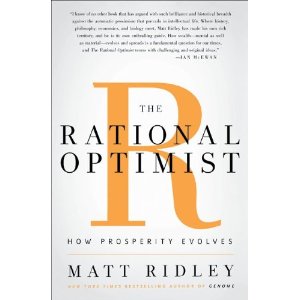
In that vein, here is a bit of wisdom from Matt Ridley’s excellent new book, The Rational Optimist:

Companies have a far shorter half-life than government agencies. Half of the biggest American companies of 1980 have now disappeared by takeover or bankruptcy; half of today’s biggest companies did not even exist in 1980. The same is not true of government monopolies… Yet most anti-corporate activists have faith in the good will of the leviathans that can force you to do business with them, but are suspicious of the behemoths that have to beg for your business. I find that odd.

(p. 111)

Happy 204th Birthday, John Stuart Mill

John Stuart Mill was born on this day in 1806. I wrote an appreciation of him last year, and told a bit of his unusual life story. This year, I’ll write a little bit on his philosophy of utilitarianism.

There are two kinds of utilitarianism: act utilitarianism, and rule utilitarianism. Act utilitarianism leads to absurd conclusions; rule utilitarianism, while more lenient, is one of the strongest philosophical underpinnings of liberalism (in the traditional European sense of the word). Many later liberals, including F.A. Hayek, were rule utilitarians.

Act utilitarians think that each individual act should be judged according to how much good it does. This leads to some problems, since most actions involve at least some small harm to others.

If I drive to work, I can save myself a lot of time. But by contributing to traffic congestion, I hurt each of my thousands of fellow drivers just a little bit. Maybe I cost them more total time than I save, so my driving causes a net loss in utility. So that’s not a good option. The subway, then? Same thing. Not only do I lose some time compared to driving, but I make the train more crowded, which causes disutility to every passenger on the train.

Better to just sit at home, then. But then I don’t get anything done. That’s bad for my career, not to mention my bank account. Act utilitarianism is a bit like Pareto optimality in economics: it leads to paralysis. It is an impossible standard.

That’s why I prefer rule utilitarianism. Instead of judging each act by its utility, put rules in place that give people incentives to act well. No law or institution is perfect. Even the best ones hurt somebody; a law against theft is bad for thieves. But good institutions beget good results, especially in the long run.

A property-rights-based system of government is an excellent example of rule utilitarianism. It will not be perfect. Laws against stealing obviously have not put end to stealing. Even within the law, people inevitably have honest disagreements about what belongs to who. Externalities such as pollution will hurt some peoples’ property. But the results are certainly better than a system without property rights. The whole of world history is proof. It’s also better than act utilitarianism, which lacks that overarching institutional-level standard.

Rule utilitarianism is one of the greatest gifts ever given to liberalism’s intellectual toolkit, and we have Mill to thank for it. Happy birthday to you, John Stuart Mill.

Advice to Tea Partiers

I have mixed feelings about the tea party movement. On one hand, it is wonderful that there is a large and vocal constituency agitating for lower taxes and lower spending. And while many tea partiers are appropriately wary of the Republican party, they certainly seem to skew conservative. And conservatives are no friends of limited government.

John Samples from Cato nails my sentiments exactly in the video below. Here is a list of his main points:

1. Republicans aren’t always your friends.
2. Some tea partiers like big government.
3. Democrats aren’t always your enemies.
4. Smaller government demands restraint abroad.
5. Leave social issues to the states.