
“I have decided to repeat George Bush’s mistakes.”

“I have decided to repeat George Bush’s mistakes.”
Posted in International
Tagged foreign policy, libya, libya speech, middle east, obama, president obama
Tragedy struck Japan this morning. It will be some time before we know just how many lives the tsunami took, and how much damage was done. But pundits are already saying dumb things.
Larry Summers, who should know better, committed the economists’ cardinal sin this morning: he fell for the broken window fallacy. The sunny side of the destruction is that it will boost the economy. Just think of all the jobs that will be created by the rebuilding process!
Over at the Daily Caller, I gently correct Summers. Natural disasters are bad for the economy. All the rebuilding activity in the next few years will only get Japan back to where it was. If the tsunami had never happened, all that energy could be put to creating new wealth. Disasters are just that: disasters.
Comments Off on Tsunamis Are Not Stimulus
Posted in Economics, International, Publications, Stimulus
Tagged bastiat, bastiat broken window fallacy, broken window fallacy, cnbc, daily caller, earthquake, economic growth, japan, japan earthquake, japan tsunami, larry summers, lawrence summers, natural disaster, Stimulus, tsunami
It all but disappeared when President Obama was elected. Apparently it was mostly a partisan phenomenon.
I predict the same thing will happen to the tea party movement if a Republican wins in 2012.
Comments Off on What Happened to the Anti-War Movement?
Posted in International, The Partisan Mind

Don Boudreaux makes good sense on why country of origin labels only tell part of the story of where a product comes from:
Yes, Mr. Hoch’s socks say “Made in Swaziland,” but who developed the computer software to operate the loom that wove the cloth used to make his socks? Who designed the loom itself? Who figured out how to transform crude oil into the elastic in the socks? Who devised the method for pooling risks so that the Swaziland factory is profitably insured against fire and that the cargo ship carrying his socks to America is profitably insured against sinking?
Don concludes:
In fact, Mr. Hoch’s socks – and nearly everything else that he consumes – should be labeled “Made on earth,” for they truly are global phenomena.
Read the whole thing. Keep it in mind the next time someone grouses —falsely — that America doesn’t make anything anymore, or that Americans buy too many goods from foreigners.
Comments Off on Country of Origin Labels Are False Advertising
Posted in Economics, International, Trade
Tagged america, basic economics, cafe hayek, country of origin labels, dan ikenson, Don Boudreaux, international trade, no labels, swaziland, Trade

Richard Holbrooke passed away on Monday from heart surgery complications. He was a high-ranking diplomat who advised four presidents through three wars. He also had his private doubts about Afghanistan, but he never expressed them publicly.
According to The Washington Post, Holbrooke’s final words were “You’ve got to stop this war in Afghanistan.” May Congress and President Obama make that wish come true.
Armies can fight wars. But they cannot build nations. Defense-unrelated missions such as Afghanistan that put U.S. troops in harm’s way are not worth the human cost.
Comments Off on Richard Holbrooke’s Last Words
Posted in International
Comments Off on Wow. Just Wow.
Posted in General Foolishness, International
According to a new poll, the average American thinks that 25 percent of the federal budget is spent on foreign aid (or, more accurately, government-to-government transfers). They would like it cut to about 10 percent.
The actual figure is under 1 percent.
As Aid Watch’s Laura Freschi points out, that means most Americans want to increase government-to-government transfers ten-fold from current levels while also cutting them in half.
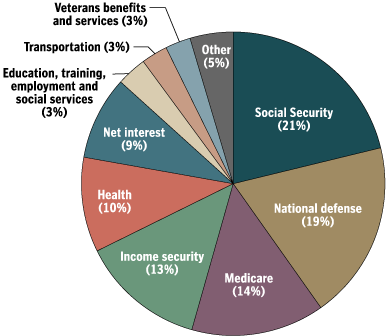
That most people think like this is a major reason why cutting the federal government’s $3.5 trillion budget is so difficult. The issues that people get worked up about tend to be small potatoes, in budgetary terms.
Besides transfer payments to other governments, earmarks are another lightning-rod issue. But even if earmarks were abolished entirely, that’s only about 2 percent of the budget. It would put the smallest of dents in spending.
Entitlement spending is the single largest driver of current and future deficits. That’s where the battle is. Aid spending and earmarks are not threatening to bankrupt the country. Social Security and Medicare are. And those programs are extremely popular. No politician with an eye on 2012 would be willing to cut them.
The government has made promises it can’t possibly keep. But most people refuse to believe that. So they don’t. As a guarding mechanism, they instead make grand assumptions about how much things like transfer payments to other governments and earmarks cost.
There is a reason it’s called the Department of Defense. But the same mission creep that haunts other agencies has gotten hold of the military. There are 50,000 troops still in Iraq, which never attacked us. Afghanistan began as a defensive campaign, but has since become an exercise in nation-building.
The U.S. still has troops in Germany and Japan; World War II ended in 1945. America has a military presence in dozens of other nations. We have become the world’s policeman.
Few people are willing to consider returning the Defense Department’s role to what its name says. So it goes; there are still ways to substantially cut defense spending without even touching all those defense-unrelated missions. Cato’s Christopher Preble identifies $441 billion in cuts over ten years — an average of $44.1 billion per year — in three minutes.
These are cuts that can be made right now, with no loss of mission capability, a minimum of political fuss, and without a rethinking of the status quo.
Which says a lot about that $800 billion per year status quo. Maybe Congress will work up the courage tackle that someday.
More details in this study.
Comments Off on Cutting Military Spending: A Good Start
Posted in International

Over at the AmSpec blog, I describe a kerfuffle in Germany over schnitzel taxes:
Gerhard Kaltscheuer owns a restaurant in a working-class neighborhood in Hammerbruecke, Germany. His schnitzels are especially popular — except with German tax authorities.
Comments Off on This Tax Is Full of Schnitzel
Posted in Economics, International, Taxation
Tagged food, Gerhard Kaltscheuer, Germany, saxony, schnitzel, tax policy, taxes
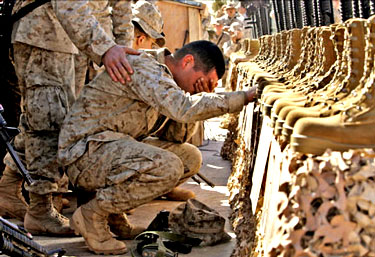
Invading Iraq was one of the Bush administration’s worst mistakes. It is a waste of blood and treasure to send troops to a country that never attacked us and poses no security threat. I’ve been looking forward to the day when President Obama would announce that misguided war’s end.
Today is that day. He has declared an official end to combat operations. But the announcement rings hollow. There are still 50,000 troops in Iraq. They are still being fired upon. They are still firing back. Their lives are still at risk every day. That sounds an awful lot like “combat operations.”
Iraq will be a free country some day. But that requires massive institutional reform. That kind of sea-level change will take a generation or more. And it has to come from within. It cannot be imposed from without by a foreign army.
Armies can fight wars. They cannot build nations. Freedom is not a top-down construction. It is a bottom-up process. It is well past time to withdraw all troops from Iraq and put a real end to combat operations.
America does have a role in Iraq’s future. Engaging in trade and commerce with Iraqis will help build the economy there, while benefiting consumers in both countries. Tourism and cultural exchange can build up good will for a nation currently viewed by many Iraqis as an occupier.
Most importantly, intellectual exchange can give Iraq’s future leaders an understanding of liberalism that they can make their own and adapt to Iraq’s unique circumstances.
It’s a long and messy road. But nobody can take the first step until combat operations actually end. We are still 50,000 troops away from that noble goal.
Posted in International
Tagged bush, combat operations, end of combat operations, iraq, iraq war, liberalism, nation-building, obama


 Inertia Wins!