Category Archives: Great Thinkers

Mises on Political Parties

With a fiercely partisan election just over a month away, the concluding paragraph of Ludwig von Mises’ Liberalism is a refreshing rejection of party politics. Mises, of course, uses liberalism in the original sense of the word:

No sect and no political party has believed that it could afford to forgo advancing its cause by appealing to men’s senses. Rhetorical bombast, music and song resound, banners wave, flowers and colors serve as symbols, and the leaders seek to attach their followers to their own person. Liberalism has nothing to do with all this. It has no party flower and no party color, no party song and no party idols, no symbols and no slogans. It has the substance and the arguments. These must lead it to victory.

-Ludwig von Mises, Liberalism: The Classical Tradtion, p. 151.

Who Says Economists Are Selfish?

And hence it is, that to feel much for others and little for ourselves, that to restrain our selfish, and to indulge our benevolent affections, constitutes the perfection of human nature; and can alone produce among mankind that harmony of sentiments and passions in which consists their whole grace and propriety.

-Adam Smith, Theory of Moral Sentiments, p. 25.

That sentence is more important to understanding how markets work than most people realize. The ability to feel empathy is part of what makes us human. It is also what makes market economies possible.

Without empathy, killing the customer would be at least as common as serving him. Mutual exchange — trade — is an act of peace. That wouldn’t be possible without the human ability to put ourselves in others’ shoes and feel for them. After all, it’s a lot easier to hit someone and take their stuff. And yet few people do. Empathy is a big reason why.

Adam Smith was one perceptive guy. Others have filled in gaps in his thought, and proven him wrong on some details. That does not take away from the fact that he was as perceptive as any thinker in history.

Shifting the Burden of Explanation

A lot of people get angry when somebody suggests privatizing some or other government service. For example, someone who opposes government-run schools is accused of opposing all education, period. Not a rigorous line of thought. But it’s common.

Why do some people propose privatization? It’s not because they’re against the service. It’s because they think the private sector will do a better job providing that service.

If anything, because theory and data usually side with privatizers, the burden of explanation actually lies on those who favor government provision of many services. Why support more expensive and less effective schools, or mail service, or health care, or rail travel?

Mises briefly touches on that disconnect in his short 1927 book Liberalism (that is, liberalism as the word originally meant):

If I am of the opinion that it is inexpedient to assign to the government the task of operating railroads, hotels, or mines, I am not an “enemy of the state” any more than I can be called an enemy of sulphuric acid because I am of the opinion that, useful though it may be for many purposes, it is not suitable either for drinking or for washing one’s hands.

-Ludwig von Mises, Liberalism: The Classical Tradition, p. 18.

Why Freedom of Speech Matters

“Freedom of thought, in any valuable sense, includes freedom of speech.”

-J.B. Bury, A History of Freedom of Thought

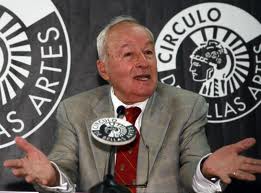
Rest in Peace, Manuel Ayau

Sad news from Guatemala. Manuel “Muso” Ayau died this morning at 85 from cancer. He founded Universidad Francisco Marroquin, one of the top schools in all of Central America. UFM is also one of the region’s few bastions of liberalism, and has done much to promote human freedom in a part of the world that has far too little of it.

Don Boudreaux, who knew him well, remembers him over at Cafe Hayek. He also links to a profile he wrote about Ayau to celebrate his 80th birthday. Well worth the few minutes it takes to read it.

Ayau was a remarkable man, and I regret never getting the chance to meet him. Condolences to his family, friends, and admirers.

Hayek on History

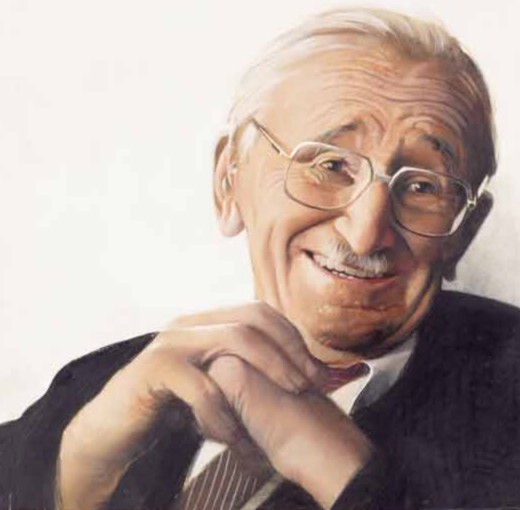
“[I]f it is too pessimistic a view that man learns nothing from history, it may well be questioned whether he always learns the truth.”

Capitalism and the Historians, (F.A. Hayek, ed.), p.3

The World Is Not Perfect

We shall never prevent the abuse of power if we are not prepared to limit power in a way which occasionally may prevent its use for desirable purposes.

-F.A. Hayek

Serious thinkers need to keep that in mind more often. Human imperfection is exactly why human freedom is a good policy for the world in which we live. By its very definition, utopia — “no place” — is a poor goal for this place.

Crony Capitalism shouldn’t Be Confused with the Real Thing

Russ Roberts has a short appreciation of F.A. Hayek in today’s Wall Street Journal (subscription required). Worth reading, especially if you are new to Hayek.

Will Durant on Human Achievement

I spent a good chunk of the long weekend engrossed in Will Durant’s autobiography, Transition. Durant and his wife Ariel were best known for their 11-volume The Story of Civilization series, which is a fine introduction not just to history, but to literature, philosophy, art, music, science, and all the other cantos in the poem of human life.

Transition is mainly the tale of Durant’s transition from seminarian to secularist, and from his youthful flirtations with socialist anarchism to a gentler, more tolerant and mature worldview that saw humanity as a good but flawed creature, set in his ways, yet capable of breathtaking progress and achievement. This passage, describing Durant’s first trip to Europe in 1912 aboard an oceanliner, captures that transition in microcosm:

One night there was no moon, nor any star; then our great ship, ghastly alight in the engulfing dark, seemed like a phosphorescent insect struggling in the sea. But as we neared the rocks of Britain’s ancient shore the mood of my thinking changed, and I marveled not at the vastness of the ocean but at the courage of man, who had ribbed it everywhere with the paths of his floating cities; who had dared to make great arks of heavy iron and fill them with thousands of tons of the products of human hands; who had built upon these frames luxurious homes for many hundred men; who had made engines capable, through the expansion of a little steam, of propelling this enormity of steel and flesh safely and quickly across the widest seas, making the rage of the ocean impotent. It was man that was marvelous, I said, as I stood secure and relieved on the solid soil of England.

(Transition, pp. 218-19)

Happy 204th Birthday, John Stuart Mill

John Stuart Mill was born on this day in 1806. I wrote an appreciation of him last year, and told a bit of his unusual life story. This year, I’ll write a little bit on his philosophy of utilitarianism.

There are two kinds of utilitarianism: act utilitarianism, and rule utilitarianism. Act utilitarianism leads to absurd conclusions; rule utilitarianism, while more lenient, is one of the strongest philosophical underpinnings of liberalism (in the traditional European sense of the word). Many later liberals, including F.A. Hayek, were rule utilitarians.

Act utilitarians think that each individual act should be judged according to how much good it does. This leads to some problems, since most actions involve at least some small harm to others.

If I drive to work, I can save myself a lot of time. But by contributing to traffic congestion, I hurt each of my thousands of fellow drivers just a little bit. Maybe I cost them more total time than I save, so my driving causes a net loss in utility. So that’s not a good option. The subway, then? Same thing. Not only do I lose some time compared to driving, but I make the train more crowded, which causes disutility to every passenger on the train.

Better to just sit at home, then. But then I don’t get anything done. That’s bad for my career, not to mention my bank account. Act utilitarianism is a bit like Pareto optimality in economics: it leads to paralysis. It is an impossible standard.

That’s why I prefer rule utilitarianism. Instead of judging each act by its utility, put rules in place that give people incentives to act well. No law or institution is perfect. Even the best ones hurt somebody; a law against theft is bad for thieves. But good institutions beget good results, especially in the long run.

A property-rights-based system of government is an excellent example of rule utilitarianism. It will not be perfect. Laws against stealing obviously have not put end to stealing. Even within the law, people inevitably have honest disagreements about what belongs to who. Externalities such as pollution will hurt some peoples’ property. But the results are certainly better than a system without property rights. The whole of world history is proof. It’s also better than act utilitarianism, which lacks that overarching institutional-level standard.

Rule utilitarianism is one of the greatest gifts ever given to liberalism’s intellectual toolkit, and we have Mill to thank for it. Happy birthday to you, John Stuart Mill.