Category Archives: Public Choice

Why Government Layoffs Tripled in June

This graph from just-released Federal Reserve data caught my eye. It shows government layoffs and discharges from late 2000 through June of this year (raw data set downloadable here). Government jobs are remarkably stable. According to this BLS chart,government workers enjoy roughly three times the job security of private sector jobs. Government workers also compensated more than twice as well as the people who pay their salaries.

For most of the last decade, government workers had as small as a 1-in-200 chance of getting fired or laid off in a given month. This stability mostly held up even during recessions, which are marked as the shaded areas in the graph.

But notice the big spike that happened this June. The economy is out of recession. But times are still tough. And government deficits are at record highs. Is the sudden jump in layoffs and discharges due to government cutting spending to avoid fiscal disaster?

I’d guess not. June was when large numbers of temporary census workers finished their jobs. Still, for one shining second, I thought that Washington had come to its senses.

Justice Kagan, Please Be a Judicial Activist

Over at the Daily Caller, I explain why newly-minted Justice Kagan should be a judicial activist — but not in the way most people use the term. True judicial activism doesn’t mean legislating from the bench. It means standing up to the executive and legislature and striking down unconstitutional laws. Unfortunately, Justice Kagan seems like she would rather defer to the branches that gave her her new job:

There is a reason why the Supreme Court is filled with Justices eager to defer to the political branches. It’s because the political branches get to pick who sits on the bench. No president would nominate a judge who might nullify his administration’s signature achievements. No Senator would vote to confirm a judge who might strike down an important bill that she wrote. There is a selection bias favoring judicial passivists.

But there is light at the end of the tunnel:

Justice Kagan was nominated and confirmed because of her judicial passivism. But now that she’s in, she’s in for life. She can stand up for the judicial branch if she wants to. If a case comes before her involving a law that is clearly unconstitutional, her rightful duty is to strike it down.

In many cases, it’s as easy as just saying no.

The Two Americas

Maybe there is something to John Edwards’ “Two Americas” conceit after all. Except the warring factions aren’t the haves and have-nots. They are what Steven Malanga calls tax eaters and tax payers. And the two see the world very differently. See this revealing excerpt from today’s WSJ Political Diary (subscription required).

Pollster Scott Rasmussen uses several questions to break down voters demographically, but one of his most original tweaks is to differentiate between those voters he calls the “Political Class” and those he calls “Mainstream Americans.” The “Political Class,” representing about 14% of the electorate, tend to express “trust” in political leaders while rejecting suggestions that government is its own special interest and often works with big business against consumers. In contrast, “Mainstream Americans” represent about 75% of the voting public and identify with or lean toward a more populist skepticism about the intentions and actions of political leaders.

Striking is how the two groups divide on the question of repealing ObamaCare. “Mainstream Americans” support repeal by an overwhelming 73%, while the numbers are almost exactly reversed among the “Political Class,” 72% of whom oppose repeal.

Get Spit On, Take Three Months Off

New Yorkers have a reputation for being rude. But they are also a sensitive lot. Especially bus drivers. Last year, angry customers literally spit on bus drivers 51 times. The experience was so harrowing for one unidentified driver that he or she needed 191 days of paid leave to recover. The average driver took 64 days of paid leave after being spat upon.

Seems a bit much. But union leaders think it’s justified.

“Being spat upon — having a passenger spit in your face, spit in your mouth, spit in your eye — is a physically and psychologically traumatic experience,” said John Samuelsen, the union’s president. “If transit workers are assaulted, they are going to take off whatever amount of time they are going to take off to recuperate.”

Getting spit on is not fun. And it can certainly ruin one’s day. But the recovery time for most people is measured in minutes, not months.

Raul Morales, 52, has been driving city buses for five years, but his first encounter with spit came early.

“A guy wanted to get on the bus; I told him the fare; he didn’t want to pay it,” Mr. Morales said. “So, he spat at me.”

The spittle landed on his shirt and glasses. He stopped at a nearby McDonald’s to clean himself off, then finished his shift. “I just kept on going.” (An ice slushie was once thrown at him for the same reason.)

Mr. Morales said it did not occur to him to take an extended absence to recover.

Good to see that common sense isn’t completely dead.

It is sad that so many transit employees have no problem taking months-long vacations at taxpayer expense, using the flimsiest of excuses. That kind of behavior wouldn’t fly in the productive sector.

New York City Transit is running a $400 million deficit this year. Saliva-induced vacations alone account for nearly a million dollars of that, based on average salaries. That money could have gone towards softening looming service cuts. It could have gone to repairing aging infrastructure. It could have gone to employees who actually work.

But when labor rules are as generous as they are for many public-sector union workers, it should come as no surprise that some people will game the system.

Solving America’s Problems

The days of trillion-dollar deficits, multiple land wars in Asia, and other catastrophes may soon be coming to an end. Congress continues to work long and hard to solve America’s most important problems. Take a look at some of the legislation that passed on May 18:

H. Res. 1256: congratulating Phil Mickelson on winning the 2010 Masters golf tournament

H. Res. 792: honoring Robert Kelly Slater for his outstanding and unprecedented achievements in the world of surfing and for being an ambassador of the sport and excellent role model

H. Res. 1297: supporting the goals and ideals of American Craft Beer Week.

H.R. 4491: to authorize the Secretary of the Interior to conduct a study of alternatives for commemorating and interpreting the role of the Buffalo Soldiers in the early years of the National Parks, and for other purposes

I applaud each and every one of these bills, frivolous though they are. Each one took a good deal of time to write and to put through committee. Each one was given 40 minutes of floor debate, though less than that was typically used. All of that time and effort was not spent further destroying the economy with more substantive legislation.

Most states get by with part-time legislatures. Congress would do well to follow suit. In the meantime, as long as Congress is full-time, it should devote as much time as possible to trivial bills like the ones listed above.

Regulation of the Day 134: Not Voting

The lede to this Denver Post article says it all:

RIDGWAY — Residents of this Old West- meets-New Age town can be fined if their fences are too high, they have too many chickens, their dogs aren’t on leashes or their weeds are out of control.

Tom Hennessy would like to add not voting to that list.

There are three things wrong with Mr. Hennessy’s proposed regulation. One is that mandatory voting is a violation of personal freedom. To vote or not is an important choice that people make for themselves. It is not Mr. Hennessy’s place to make that decision for others. Many countries have tried mandatory voting over the years, most notably the Soviet Union.

The second thing wrong with mandatory voting is that it violates freedom of speech. Mr. Hennessy is aware that compelled speech is just as unconstitutional as censored speech. That’s why he proposes a “none of the above” option on ballots. But some people are sending a deliberate message when they choose not to vote. Mr. Hennessy would fine them for sending that message.

The third point is that, maybe, some people shouldn’t vote. If I step into a voting booth not knowing a thing about the candidates or the issues, I am essentially choosing at random. And choosing wrong means voting against everything I stand for.

Even worse, human beings have built-in cognitive biases that affect their voting habits. Economist Bryan Caplan’s book The Myth of the Rational Voter identifies anti-foreign bias, anti-market bias, make-work bias, and pessimistic bias, for starters.

Even relatively informed voters fall prey to these biases. They vote accordingly. The difference of opinion between economists and the general public on economic issues is startling. Nobody argues relativity with a physicist thinking they’ll win. But voters from both parties argue against the laws of economics every election, often in error but never in doubt.

Despite its flaws, democracy has worked tolerably well in this country for a long time. Perhaps the best part of our particular democracy is that people are free to choose their level of engagement with it. That should be your choice. Not Tom Hennessy’s.

(Full disclosure: CEI takes no stance on whether to vote, or for whom. Neither do I. I personally have not voted since 2002, but seriously consider it every year.)

Politics 101: Machiavelli and Public Choice

When Niccolo Machiavelli died in 1527, Washington, DC was still more than two and a half centuries away from being founded. But he understood perfectly how that dismal city would work, as Bertrand Russell reminds:

“In the absence of any guiding principle, politics becomes a naked struggle for power; The Prince give shrewd advice as to how to play this game successfully.”

-Bertrand Russell, History of Western Philosophy, xxii-xxiii.

Machiavelli was, in many ways, the first modern public choice theorist. Had he lived in a post-Adam Smith world, he would have made a fine economist. A politician’s guiding principle is usually not ideology. It is to remain in power. So they behave accordingly. The first lesson of economics is that people respond to incentives. If someone’s incentive is to get re-elected, they will behave in a way conducive to achieving that goal. Morality and the greater good compete for a distant second.

Sen. Shelby Lifts Holds

Sen. Richard Shelby, who placed holds on over 70 of President Obama’s nominees, has lifted all but three of them. Politico reports:

A spokesman for the senator said Monday that with attention brought to these two concerns, the political maneuver had “accomplished” its goal and was no longer necessary.

Translation: “We were getting too much bad publicity.”

The three holds that Sen. Shelby is keeping in place have directly to do with the Alabama-based pork projects that he believes will make him look good to the Alabama voters he will be facing in November. So, in a way, nothing has changed.

This brings up a legitimate question: can earmarking abuse sometimes be an agent for smaller government?

Few, if any, of President Obama’s appointees will work to decrease the size and scope of government. Now that their path is cleared, they will probably do net harm to taxpayers. This is the nature of government workers, whether Republican or Democratic.

Sen. Shelby’s motive for blocking them is despicable: stealing from taxpayers to improve his re-election prospects. But one wonders if those same taxpayers would have been better off if Sen. Shelby had stuck to his guns.

Regulation of the Day 111: Buying Wine in New York

It is illegal for grocery stores to sell wine in the state of New York. Only liquor stores are allowed to sell the stuff.

This regulation, a relic of Prohibition, lives on because of one of the central concepts in public choice theory: diffused costs and concentrated benefits.

The benefits are concentrated in one constituency: liquor stores. Regulations give them get millions of dollars in free business. That means they have millions of reasons to lobby to keep the status quo.

Consumers, on the other hand, are hurt by the ban by the exact amount that liquor stores benefit. But that hurt is spread far and wide. No one consumer feels enough pain to hire a high-priced lobbyist to open up the market.

That means New York’s misguided restrictions on competition are likely to continue for some time. It’s hard to imagine an aggrieved shopper suing New York’s wine cartel because she has to make an extra trip to get the wine on her grocery list. Or because she pays a bit more than if she lived in a different state.

(Hat tip: Jonathan Moore)

Health Insurance and Campaign Contributions


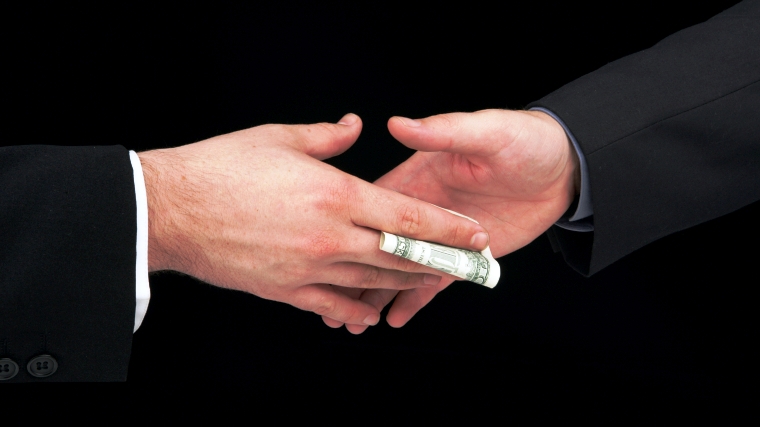
Congressional Democrats are thinking of revoking the health insurance industry’s antitrust exemption; some insurers have spent as much as $20,000,000 opposing the current legislation.

Of course, insurers also gave $20,175,303 to President Obama’s 2008 campaign, roughly triple what McCain netted.

On one hand, this might look like the dog biting the hand that feeds. But really, it isn’t.

If the health care legislation passes, there is a good chance that every American would be required to purchase health insurance.

Suppose that happens. $40 million and change plus some antitrust troubles is a really small price to pay for a legal guarantee of vastly increased business, forever, plus looking like you didn’t want the favor.

As my friend Jeremy Lott is so quick to remind, it’s a wonder that politicians can be bought off so cheaply, given what they could charge for their services.

It is just as surprising that insurers would spend $20 million opposing legislation that would yield many times that in profit. As economist Bruce Yandle notes, “industry support of regulation is not rare at all; indeed, it is the norm. And in the United States it is as American as apple pie.”