Category Archives: Economics

New Bastiat Book

Frederic Bastiat, despite having died in 1850, just came out with a new book. The Man and the Statesman: The Correspondence and Articles on Politics, was just published by Liberty Fund. It’s available in hard copy for Liberty Fund’s typical low price, or for free in PDF format.

A majority of the letters and articles in the book have never before been translated into English.

Bastiat has five more books on the way; Liberty Fund is in the process of publishing his collected works in 6 volumes.

Bipartisan Regulatory Reform

Usually, “bipartisan” means “twice as stupid.” But for real regulatory reform to happen, both parties need to be involved. President Obama’s recent executive orders requiring agencies to comb their books and repeal unneeded regulations should save a few billion dollars. But that’s just a drop in a $1.7 trillion bucket. Over at Fox Forum, I explain one bipartisan idea that could potentially save much more:

Agencies cannot be trusted to clean out their own books because they have no incentive to. Agency administrators want to maximize their
missions and budgets. Having them police themselves will not yield real savings.

There is a relatively easy fix: get independent outsiders with no stake in the outcome go through the Code of Federal Regulations make the
repeal recommendations. President Obama should appoint a bipartisan repeal commission to do just that and then send its package of repeal
proposals to Congress.

Congress, worried about backlash from interest groups with vested interests in existing rules, would have every incentive to water down
the package. To avoid that, Congress should impose on itself a requirement to have a straight up-or-down vote on the package within a
short time-say, 10 legislative days-with no amendments allowed.

Read the whole thing here.

They Aren’t Math Majors

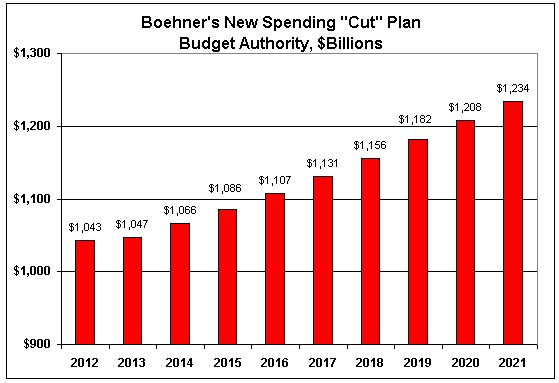
Eleven people were arrested for staging a sit-in today inside the U.S. Capitol. They were protesting budget cuts. They must not have known that spending is set to increase every year for at least the next decade, even under the Boehner plan.

Take a look at this handy discretionary spending chart that Cato’s Chris Edwards put together:

A Common Mindset

And not very rigorous, either. Click the image to enlarge. Original here.

Happy 99th Birthday, Milton Friedman

Reason.tv celebrates the occasion with a short video:

Regulation of the Day 188: Cat Licenses

San Diego, California’s city government is going through tough financial times. But legislators have found a lucrative possible revenue source: the city’s 373,000 cats. The city government could raise a lot of money by requiring cat owners to purchase a license for their little friends at $25 each.

Compliance rates for pet licenses tend to be low. Two thirds of Los Angeles’ dog owners don’t bother licensing their dogs, even though they’re required to by law. With cats, compliance would probably be even lower. Many cats are indoor-only, and are thus easy to hide from regulators. They don’t need to be walked in public daily like dogs do.

The city seems to be fine with that. It just wants some money, according to NBC’s San Diego affiliate in an article cleverly titled “Cat Owners Hiss at Licensing Proposal:”

If just 5 percent had been registered at $25 a head, the auditor’s office says the city could have saved $536,000 over the past three fiscal years.

Curiously worded. For the city government to save money, it would have to spend less. Here the city auditor is saying the city government would save money by taxing more. For that statement to be true, residents’ money couldn’t actually be theirs. It would be the government’s. They’re just nice enough to let the citizens have some of it. That ugly philosophical presumption alone is enough to discredit this proposal.

There’s more to it, though. Collection costs and establishing a licensing system would eat into the revenues.

Then there are the unintended consequences. Every city has stray cats. To keep their numbers in check, some kind souls will take them off the streets, have them spayed or neutered, then release them. Doing so would require a $25 license, even if the cat only stays with the person long enough to recover from the surgery. That means a lot of people wouldn’t bother with their good deeds, and San Diego would have even more stray cats.

Other cat owners would refuse to take their cats to the vet, where licenses would be issued. It can be expensive to get cats their shots and have them fixed. Making it even more expensive means fewer people will do the right thing. That’s bad for the animals’ health and life expectancy.

UPDATE: This is already happening in North St. Paul, Minnesota. Reader Maggie sends along this article:

Doug and Annette Edge thought they were doing the right thing for their community.

With feral cats roaming their North St. Paul neighborhood, the couple trapped the wild felines, took them to be sterilized and vaccinated, and then released them back into the city.

City officials, though, say the couple was breaking city animal laws.

In April, North St. Paul charged Doug Edge, 45, with two misdemeanors: failing to have a cat license and allowing domestic animals to run at large. Edge faces a fine and up to 90 days in jail.


Competitors: Stop That Merger!

The proposed AT&T/T-Mobile merger is drawing the usual antitrust scrutiny. Fearful competitors say the $39 billion deal will make the market less competitive. Or so they say. Over at the Daily Caller, I point out that actions speak louder than words:

[I]f Sprint is willing to devote resources to fighting the AT&T/T-Mobile merger, then it probably thinks the new post-merger company will be more competitive, not less. That cuts directly against their main argument – that the merger reduces competition.

Put yourself in Sprint’s shoes for a minute. If your competitors are making what you think is a foolish business decision, you’re not going to try to stop them. If anything, you’ll actively encourage them.

Instead, Sprint’s opposition is proof positive that it thinks the competition is about to get more formidable, not less.

Antitrust authorities, blind to that obvious fact, stand a real risk of stunting the competitive process. They should ignore competitors’ pleas for special government favors and let the merger succeed — or fail — on its own terms. Real competition happens in the market. Not in Washington.

Read the whole article here.

Federal Job Security

Back in the old days, government jobs didn’t pay very well compared to private sector jobs. But they’ve always offered better job security. For people who value not having to worry about being laid off, it can be a fair tradeoff.

Today, federal jobs tend to pay much better than comparable private sector jobs. There are other perks such as early retirement, and exceedingly generous pension and health benefits. And job security? That remains as high as ever. USA Today reports:

Death — rather than poor performance, misconduct or layoffs — is the primary threat to job security at the Environmental Protection Agency, the Small Business Administration, the Department of Housing and Urban Development, the Office of Management and Budget and a dozen other federal operations.

The federal government fired 0.55% of its workers in the budget year that ended Sept. 30 — 11,668 employees in its 2.1 million workforce. Research shows that the private sector fires about 3% of workers annually for poor performance, says John Palguta, former research chief at the federal Merit Systems Protection Board, which handles federal firing disputes.

For those interested in learning more, I recommend my colleague Iain Murray’s new book, Stealing You Blind.

Worth a Thousand Words

From today’s Washington Post:

Via David Boaz, who adds,

Does this look like the record of policymakers making sensible decisions, running surpluses in good year and deficits when they have to “address national security and economic emergencies”? Of course not. Once Keynesianism gave policymakers permission to run deficits, they spent with abandon year after year.

The Debt Limit Debate

Cato’s Chris Edwards and Dan Mitchell with some wise words about the debt limit debate, how we got where we are, and why neither party can be trusted with the public fisc.