Category Archives: Economics

CEI Podcast for September 29, 2011: The End of Free Debit Cards

Have a listen here.

Every time you use your debit card, the merchant has to pay a fee to the company that issued your card, usually about 1 percent of the purchase price. On October 1, that price will be capped by law to 21 cents. John Berlau, Director of CEI’s Center for Investors and Entrepreneurs, explains the unintended consequences that will hurt consumers, merchants, and banks alike. John has written on interchange fees for The Wall Street Journal, Investor’s Business Daily, The American Spectator, and other outlets.

DC’s Capital Bikeshare Program

If you walk around DC, you’ll see bright red bike racks here and there, along with matching bicycles. They were installed about a year ago, and anyone can use them. It’s the city’s way of encouraging people to use bicycles instead of cars.

It hasn’t worked as planned. According to my colleague Marc Scribner, before the Bikeshare program, about 1.6 percent of person-trips in the city were on bikes. Now it’s 1.9 percent.

That 0.3 percent gain comes at a steep price:

The Capital Bikeshare bikes cost around $1,000 a piece and have a life cycle of six years. Annual operating costs are somewhere closer to $2,000 per bike. In the past two years, I have spent approximately $500 on my personal bike that I commute to work on daily — $250 a year. Capital Bikeshare’s costs given the benefits are simply absurd.

$16 Muffins a Hoax?

The Justice Department’s auditors have been getting a lot of press lately. They found that the department paid $16 each for muffins at a recent event in Washington. At another event in San Francisco, the department spent $76 per person on lunch.

According to the Hilton hotel chain, which hosted the DC muffin event, the auditors didn’t read the invoice very carefully:

Hilton Worldwide, which manages and franchises hotels including the Capital Hilton where the conference took place, says the price included not only breakfast baked goods but also fresh fruit, coffee, tea, soft drinks, tax and tips. It says the report misinterpreted its invoices, which often use shorthand and don’t reflect the full menu provided.

So it appears that part of the story has been exaggerated. The $76-per-person lunch in San Francisco, also held at a Hilton, included “slow-cooked Berkshire pork carnitas, hearts-of-romaine salad — and coffee at $8.24 a cup.” That one still looks dodgy. A bit fancy for a government conference. But the muffins do seem to have been blown out of proportion.

In related news, after an assistant told Federal Reserve Chairman Ben Bernanke that the muffins didn’t actually cost $16, he was reportedly overheard muttering to himself, “soon…”

It Gets Better: Sears Catalog Edition

I forget who I’m paraphrasing here, but the two iron laws of modernity are 1) things are getting better, and 2) people think they’re getting worse. The short video at the bottom of this post is one way to prove the first law to victims of the second law. It’s a rough cut adapted from a recent talk Don Boudreaux gave; I eagerly await the full version.

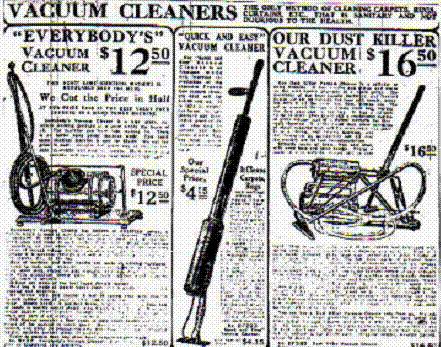
When I took macroeconomics in graduate school, the professor circulated a Sears catalog from 1900 or so around the classroom. Most of the prices were given in cents, not dollars. Now imagine that you could buy anything you wanted from that catalog today at those low prices. They’re still too expensive. Take these vacuum cleaners pictured below:

$12.50 for a vacuum cleaner? What a deal! And yet, given the choice, I would not buy it. Too expensive. I wouldn’t even be willing to pay $5.00 for it. Heck, I wouldn’t even want it for free.

Why is even a price of zero too expensive for that vacuum? Because it doesn’t even use electricity. It’s manually powered. No thanks. I’m better off with the $90 vacuum I bought a few years ago.

Of course, I’ve been ignoring inflation. As a useful public service, the Minneapolis Fed has an inflation calculator right on its homepage. It only goes back to 1913, and our vacuum is a 1909. But that’s close enough for the point I’m making.

If that vacuum cost $12.50 in 1913, it would cost $285.17 in 2011. This manually powered vacuum, that I wouldn’t pay a dime for, is three times as expensive in real terms as my electric vacuum.

Things are better now. Modernity is a blessing. The first law holds. Hopefully the second law won’t prove quite so rigid.

Click here if the embedded video below doesn’t work. It’s well worth 1:26 of your time to watch.

Google’s Antitrust Troubles

Holman Jenkins sums it up:

Google will be accused of having a “monopoly” on search, though its market share is only 65%, and it charges consumers nothing for its services.

An Economic Lesson in Comic Strip Form

Prices aren’t just dollars and cents. Time, effort, hassle, standing in line, and driving across town also count. Click the image to enlarge. Original here.

CEI Podcast for September 15, 2011: Solyndra


Have a listen here.

Myron Ebell, Director of CEI’s Center for Energy and Environment, takes a look at the brewing Solyndra scandal. Solyndra is a company that makes solar panels and recently declared bankruptcy. In 2009, the federal government gave Solyndra a $535 million loan even though its own analysts predicted the company would go bankrupt in 2011. The company’s cozy relationship with political figures, including a major political donor with an investment stake, make the loan — and its low interest rate — look rather suspicious.

On the Radio – Job Creation

Just wrapped up a 20-minute interview on Jim Kearney’s Financial Spectrum show on WKXL 1450 in Concord, New Hampshire. We talked about job creation — more specifically, CEI’s 10-point job creation plan. I’ll post or link to an mp3 if I can get one.

New Math: Lobbying Edition

State and local governments across the country are looking for fat to trim from their budgets. One place many are considering cutting is lobbying the federal government. That particular expense has gone up sharply over the last decade:

The trend is clear: Spending on federal lobbying by municipalities and other nonfederal governments soared from $37.2 million in 1999 to $93.3 million in 2009, according to data compiled by the Center for Responsive Politics. But that figure dipped slightly in 2010, and this year, it’s seems it will barely crack the $80 million mark.

One lobbying firm that gets a lot of its business from state and local governments would like to get that spending back up. That’s why it is running an ad claiming that “Lobbying is no 4-letter word.”

Correct. “Lobbying” is an 8-letter word.

There Is Nothing Left to Cut

Politico: CDC to Fight HIV with Comic Books