Category Archives: Economics

Financial Fiasco

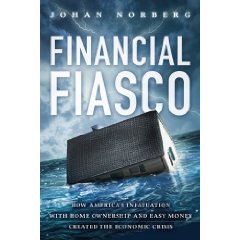
I recently finished reading Swedish economist Johan Norberg‘s book about the financial crisis, aptly titled Financial Fiasco. It’s both short and informative. Six chapters and 155 pages, all of them worth reading.

The first two chapters are about the two big regulatory causes of the recession. One, monetary policy that was too easy for too long. The price system works. When the Fed messes with that price system, prices send out the wrong signals. People behave accordingly. Two, a decades-long drive to raise homeownership rates caused a lot of people to take out loans they couldn’t afford. It was only a matter of time before the consequences would come to bear.

Chapters 3 and 4 are about how the private sector reacted to the incentives regulators gave them. Let’s just say they acted badly. If people can game the system, they often will. Norberg’s criticism of overly-complicated securitized mortgage packages is both shocking and infuriating.

Chapter 5 is about how the government and private sector reacted to the crisis once the housing bubble popped. The $700 billion bailout program to reward bad behavior comes under fire.

Norberg is in top form in Chapter 6. Having looked at the causes and consequences of the crisis, now he offers a way out. One lesson is that politicians will always behave badly. “Politicians who distribute pork they cannot afford are reelected; butcher shops that sell pork they cannot afford go bankrupt. (p. 150)” Politicians are just like you and me. They go wherever their incentives lead them. We need to approach them accordingly.

The way to a full recovery is not bailouts. It is letting bad companies fail. And just as important, letting good ones prosper. “Government support for companies is thus not a way to save jobs, as politicians try to make us believe. It is a way to move jobs from good companies to bad companies.” (p. 151) In the long run, bailouts keep the economy down by keeping jobs and resources away from where they would do the most good.

Financial Fiasco has echoes of Tocqueville; a foreigner is trying to figure out how America works. Norberg, like Alexis de Tocqueville, is uncommonly perceptive. His experience living under an economy more thoroughly mixed than America’s allows him to see things that have escaped American commentators. This is extremely valuable. The fact that his book is concise, well written, and accessible to those of us who don’t have economics Ph.Ds makes it even moreso.
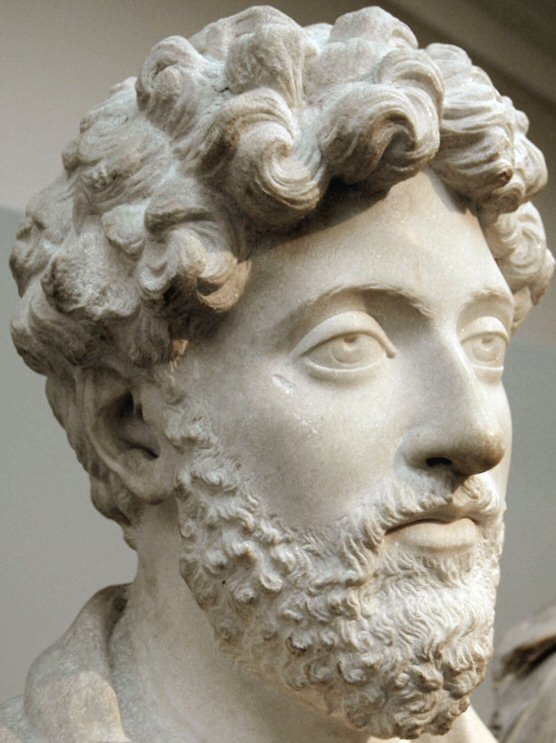
Marcus Aurelius: Emperor, Philosopher, Economist

Gibbon’s Decline and Fall begins with the death of Marcus Aurelius in 180 AD. It was all downhill from there.

Besides being a well-regarded emperor who was succeeded by an ill-regarded son, Marcus was a philosopher. Reading the works of Epictetus turned him into a devoted stoic as a young man. Marcus’ book Meditations remains the sterling example of the stoic mindset: civility, moderation in all things, and above all, taking triumph and tragedy with the same quiet dignity.

Marcus also had a bit of the economist in him. Despite predating Adam Smith by sixteen centuries, Meditations contains an excellent example of opportunity costs. Only the law of demand is more important in the economist’s toolkit. As a way of saying “mind your own business,” he writes:

Do not waste what remains of your life in speculating about your neighbours, unless with a view to some mutual benefit. To wonder what so-and-so is doing and why… means a loss of opportunity for some other task.*

*Meditations, III.4; trans. Maxwell Staniforth.

Antitrust as Corporate Welfare for Aggrieved Competitors

Wayne Crews and I have an article in today’s American Spectator about the antitrust crusade against Intel. Our key points:

-An FTC picking winners and losers is not capitalism. It is crony capitalism.

-Chips in “Wintel” desktop computers increasingly constitute just one subset of a vast semiconductor market. Only a small fraction of the chips in non-PC devices are Intel’s — and these devices are where the future lies.

-Regulators’ charges against Intel have changed over the years, but their verdict always remains the same: guilty. Suspicious.

-We’d be better off prosecuting the DOJ and the FTC for colluding against free enterprise.

In-Flight Rent-Seeking

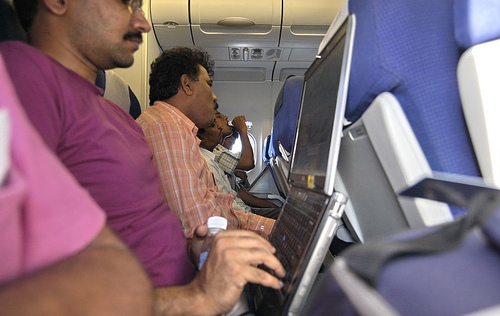
An article in this month’s Info Tech & Telecom News quotes me about proposed stimulus funding for an in-flight broadband provider.

My take: it’s corporate welfare.

Did Deregulation Cause the Great Recession?

Over at RealClearMarkets, I explain why the answer is a resounding no:

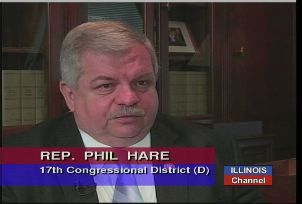
Rep. Phil Hare argues that “reckless deregulation” is one of the causes of the current economic crisis. That isn’t actually true. This year’s edition of the Competitive Enterprise Institute’s Ten Thousand Commandments report found that 3,830 new regulations came into effect in 2008 alone.

Over 30,000 total new rules passed during the Bush years. Hardly any were repealed. Businesses currently dole out the equivalent of Canada’s entire 2006 GDP – about $1.2 trillion – just to comply with federal regulations.

Where is the deregulation?

263,989 people make their living working for federal regulatory agencies, according to research from the Mercatus Center. That’s an all-time high.

12,190 of them regulate financial markets from Washington. More are based in New York and other financial centers. None of these figures include state and local rules and regulators. Those cost extra.

Regulation of the Day 79: Auctioneers in Alabama

It is illegal to conduct an auction without a license in Alabama. Unlicensed auctioneers can be punished with fines of up to $500.

Applicants must pay nearly a thousand dollars for 85 hours of coursework. 8 additional hours are required every two years to keep the license.

It’s worth asking: Does this benefit anyone besides the people teaching the courses and the auctioneers who get to limit the amount of competition they have to face?

Don’t Worry about Trade Deficits

Here’s a letter I sent recently to the New York Daily News:

December 3, 2009

Editor, New York Daily News
450 W. 33rd Street
New York, NY 10001

Washington, D.C.: In his December 3 column, “On jobs front, President Obama needs to show a little audacity,” Errol Louis worries about America’s trade deficit. He shouldn’t.

I run an ongoing trade deficit with my local grocery store. I import food from them every week. They have never purchased a thing from me in return. Even so, we both benefit. I’d rather have their food than my money, and they’d rather have my money than the food on their shelves. This is true even if an international border separates us.

If Mr. Louis is as worried about trade deficits as he says he is, he would never again set foot in a grocery store, start growing his own food, and engage only in barter transactions. If he doesn’t, he is either misinformed, or else he doesn’t really believe what he writes.

Ryan Young
Warren T. Brookes Journalism Fellow
Competitive Enterprise Institute
Washington, D.C.

Regulation of the Day 78: Green Energy Subsidies

Today’s New York Times has a classic dog-bites-man story. The green energy sector is shedding jobs, despite being given billions of taxpayers’ dollars by Presidents Bush and Obama.

As so often happens, regulators’ efforts to change people’s behaviors aren’t working as hoped.

To paraphrase Jerry Taylor and Peter Van Doren’s work on ethanol subsidies: if it’s commercially viable, then it doesn’t need any subsidies. If it isn’t, no amount of subsidy will make it so.

Time to Leave Afghanistan

Bill Easterly’s surprisingly Hayekian take on Afghanistan is worth a read:

News sources say that President Obama will choose “escalate” with additional troops for Afghanistan in his speech at West Point tonight. I and many like-minded individuals find this disastrous.

“Like-minded” means that critics of top-down state plans for economic development are also not fans of top-down state plans for military development. If the Left likes the first, and the Right likes the second, that just shows you how incoherent Left and Right are.

The Economics of Black Friday

This year’s Black Friday was much more peaceful than last year’s. No tramplings were reported. There was a fight at a Wal-Mart in the wee hours, unfortunately. The store was temporarily closed, which led to this lovely scene:

[P]eople began “yelling and screaming,” pounding on the glass doors and trying to sneak into the store through the lawn and garden section. Store managers had to be sent outside to try to calm the crowd, workers said.

Which brings us to Black Friday’s most important economics lesson: not all costs are measured in money. Yes, the discounts to be had can be great. But you pay a price for them. The price can be waiting outside in the cold. It could be the crowds, the parking, or the long checkout lines. In rare cases like today’s Wal-Mart near-riot, safety becomes an issue.

Here’s an example of what I mean. Suppose the people who camp out all night end up saving $40 on their purchases. If they spend eight hours suffering in the cold, that’s a savings of only $5 per hour. Less than minimum wage. Some people don’t place much value on their time, it seems.

Or, for some people, Black Friday’s pomp, circumstance, and sales are a cultural experience. They’re worth all the trouble. For other people, they’re not. Wherever you stand, non-price costs should be factored into your shopping habits. Otherwise you just might be getting ripped off.