Category Archives: Economics

Health Insurance and Campaign Contributions


Congressional Democrats are thinking of revoking the health insurance industry’s antitrust exemption; some insurers have spent as much as $20,000,000 opposing the current legislation.

Of course, insurers also gave $20,175,303 to President Obama’s 2008 campaign, roughly triple what McCain netted.

On one hand, this might look like the dog biting the hand that feeds. But really, it isn’t.

If the health care legislation passes, there is a good chance that every American would be required to purchase health insurance.

Suppose that happens. $40 million and change plus some antitrust troubles is a really small price to pay for a legal guarantee of vastly increased business, forever, plus looking like you didn’t want the favor.

As my friend Jeremy Lott is so quick to remind, it’s a wonder that politicians can be bought off so cheaply, given what they could charge for their services.

It is just as surprising that insurers would spend $20 million opposing legislation that would yield many times that in profit. As economist Bruce Yandle notes, “industry support of regulation is not rare at all; indeed, it is the norm. And in the United States it is as American as apple pie.”

Are Economists Cheap?

According to an amusing article in today’s Wall Street Journal, some are:

Children of economists recall how tightfisted their parents were. Lauren Weber, author of a recent book titled, “In Cheap We Trust,” says her economist father kept the thermostat so low that her mother threatened at one point to take the family to a motel. “My father gave in because it would have been more expensive,” she says.

and some aren’t:

[T]he principles that can make economists seem cheap sometimes lead them to hire help, because they are taught to value their own time.

Ms. Stevenson and Justin Wolfers, also of the Wharton School, gave a friend $150 to hire movers instead of helping him themselves. Harvard University economist David Laibson pays to have a driver pick up his sister from the airport rather than driving himself.

So are economists just cheap, or does their fixation on tradeoffs make them act in ways that only make them appear cheap? You be the judge.

Hayek on the Constitution of Liberty

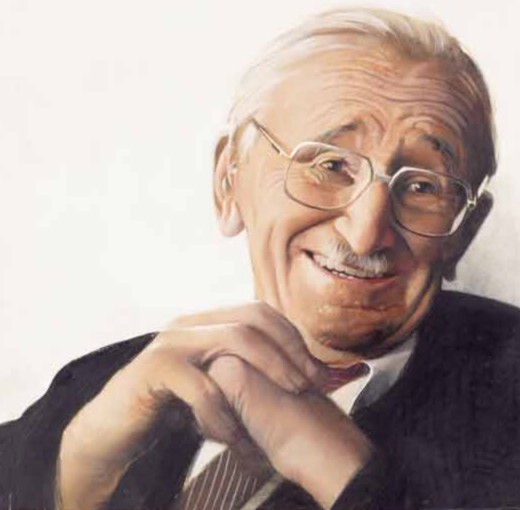
The Foundation for Economic Education has just posted an audio file from its archives of Nobel-winning economist F.A. Hayek talking about his masterwork, 1960’s The Constitution of Liberty.

Have a listen here.

Hayek on Freedom

Think for a minute about how progress is made. It doesn’t follow a constant, linear path. It is unpredictable. It comes in violent fits and starts. It happens at the whim and fancy of genius.

Everyday life is much the same. Life is what you make of it. You have to be free to find what’s best for you. That means making wrong choices sometimes. It means not just trial, but error. Or, as Hayek put it:

“If we knew how freedom would be used, the case for it would largely disappear… It is therefore no argument against individual freedom that it is frequently abused.”

-F.A. Hayek, The Constitution of Liberty, p. 31.

Regulation of the Day 93: Predatory Lending

Congress has used the financial crisis as an excuse to regulate what it calls “predatory lending.” As so often happens, its new regulations have had unintended consequences.

A bank in South Dakota, in order to comply with the new rules, is charging 79.9 percent interest for one of its low-limit credit cards. The pre-regulation rate was 9.9 percent.

The Credit Card Accountability, Responsibility and Disclosure Act of 2009 makes it illegal to charge annual fees greater than a quarter of a card’s limit. For small-balance cards, the allowable fees are tiny now. That leaves banks with three options:

-1. Lose money. The Wall Street Journal correctly notes that “Banks can’t be expected to give money away, even if Congress is in the habit of doing just that.” So this option is unlikely.

-2. Stop offering low-limit cards. This will hurt people who need them, such as people with low incomes, people with bad credit records, and young people who are trying to establish a credit record.

-3. Charge higher interest rates to make up for the money lost in fees. This is exactly what is happening here with the 79.9 percent rate for a $250-limit card.

If the bank calculated correctly, the 79.9 percent rate will be roughly a wash compared to the earlier high-fee, low-rate policy. But different customers will be paying. The people who incur a lot of  interest-rate charges are usually the people who can’t afford them. And they’ll be paying a lot more than they were before the CCARD Act.

People who can afford to pay their balances on time often don’t pay little or no interest interest anyway. The 79.9 percent rate doesn’t really affect them. And now their annual fees have gone way down. The CCARD Act is, completely unintentionally,  a wealth transfer from poor people to richer people. Congress is actively hurting the very people it intended to help.

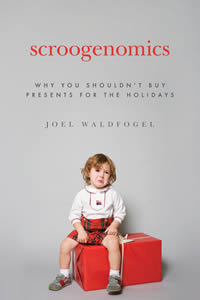
Scroogenomics

Today’s Washington Times contains my review of Joel Waldfogel’s book Scroogenomics: Why You shouldn’t Buy Presents for the Holidays.

Here’s a taste:

“‘A cribbage board? You shouldn’t have,’ we tell our mothers-in-law. Indeed.” In those three short sentences, Joel Waldfogel describes the origin of what retailers call “return season” and what consumers call “the week after Christmas.”

Mr. Waldfogel has a point here. By his calculations, such gifts cost the U.S. economy about $85 billion in waste. That’s more than 124 countries’ entire gross domestic product, by the way.

Regulation of the Day 91: Horse Floaters

As horses age, their teeth often wear down into points. This can cause the animals great pain if they bite into their tongue or cheeks. Chewing can also become problematic. A horse floater’s job is to keep that from happening. They are a kind of equine dental specialist. Floaters anesthetize the animal then grind its teeth into smoother shapes.

But regulators are clamping down on horse floaters. Many states want to require them to be licensed veterinarians. This would throw a lot of floaters out of business. Most of them specialize in horse teeth and have no need for full veterinary training. That’s why few have bothered to get it, since it takes years of school and thousands of dollars.

Horse floater Carl Mitz told a reporter, ‘Saying only veterinarians can do this profession … if they’re successful, it eliminates me. After 25 years, I’ll no longer have a job.’

Mr. Mitz is fighting back in court. But he shouldn’t have to. He has a right to make an honest living. And he has been for at least 25 years. Regulators should respect that right.

Regulation of the Day 89: Purple Dye

Ancient Roman consuls – equivalent to our presidents – wore togas edged in purple to mark their high status. As Republic became Empire, new emperors were said to “ascend to the purple.”

Purple clothing was a status symbol for most of human history. It was the ancient equivalent of the Mercedes-Benz. Originally discovered in the glands of shellfish (reputedly by Heracles’s dog!), it took 12,000 of the creatures to get just 1.5 grams of dye. Purple garments could be as rare and costly as gold in some places.

Modern innovations such as inexpensive synthetic dyes, the Minnesota Vikings, and purple M&Ms have taken away the color’s exotic reputation. But no worry. Federal regulators are doing what they can to bring it back.

Alpinil Industries, a dye manufacturer in India, sells its carbazole violet pigment 23 cheaply. Too cheaply, it seems. Even commoners can afford to buy products colored with their purple hues!

Irate American competitors convinced the government in 2004 to put an anti-dumping duty on Alpinil’s purple dye. That raised the price to match pricey American-made dyes. Purple would once again be reserved for the rich.

Now that the tax has been in place for five years, the Department of Commerce is wrapping up an investigation to see if it has been working as intended. A repeal would be best for consumers. Don’t expect to see it happen, though.

The benefits are concentrated to a few dye manufacturers, who have a strong incentive to lobby to keep the status quo. Meanwhile, the costs are diffused onto millions of consumers, none of whom have much incentive to spend thousands of dollars in an effort to save themselves a few pennies.

Explaining the Government Option in 41 Seconds

Watch this video by Caleb Brown, Austin Bragg, and Lester Romero. It’s part of a video contest; take a look at the other entries and vote if you like.

Regulation of the Day 83: Citations

The Code of Federal Regulations contains a regulation on how to cite the Code of Federal Regulations. It reads as follows:

The Code of Federal Regulations may be cited by title and section, and the short form “CFR” may be used for “Code of Federal Regulations.” For example, “1 CFR 10.2” refers to title 1, Code of Federal Regulations, part 10, section 2.

See for yourself at 1 CFR 8.9.

Standard citation formats are extremely useful. That would be why, even without regulation’s guiding hand, the private sector evolved the Chicago and MLA styles, among others.

Yet another example of spontaneous order at its finest.