
Category Archives: Business Cycles

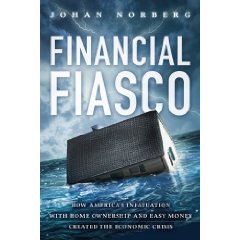
Financial Fiasco

I recently finished reading Swedish economist Johan Norberg‘s book about the financial crisis, aptly titled Financial Fiasco. It’s both short and informative. Six chapters and 155 pages, all of them worth reading.

The first two chapters are about the two big regulatory causes of the recession. One, monetary policy that was too easy for too long. The price system works. When the Fed messes with that price system, prices send out the wrong signals. People behave accordingly. Two, a decades-long drive to raise homeownership rates caused a lot of people to take out loans they couldn’t afford. It was only a matter of time before the consequences would come to bear.

Chapters 3 and 4 are about how the private sector reacted to the incentives regulators gave them. Let’s just say they acted badly. If people can game the system, they often will. Norberg’s criticism of overly-complicated securitized mortgage packages is both shocking and infuriating.

Chapter 5 is about how the government and private sector reacted to the crisis once the housing bubble popped. The $700 billion bailout program to reward bad behavior comes under fire.

Norberg is in top form in Chapter 6. Having looked at the causes and consequences of the crisis, now he offers a way out. One lesson is that politicians will always behave badly. “Politicians who distribute pork they cannot afford are reelected; butcher shops that sell pork they cannot afford go bankrupt. (p. 150)” Politicians are just like you and me. They go wherever their incentives lead them. We need to approach them accordingly.

The way to a full recovery is not bailouts. It is letting bad companies fail. And just as important, letting good ones prosper. “Government support for companies is thus not a way to save jobs, as politicians try to make us believe. It is a way to move jobs from good companies to bad companies.” (p. 151) In the long run, bailouts keep the economy down by keeping jobs and resources away from where they would do the most good.

Financial Fiasco has echoes of Tocqueville; a foreigner is trying to figure out how America works. Norberg, like Alexis de Tocqueville, is uncommonly perceptive. His experience living under an economy more thoroughly mixed than America’s allows him to see things that have escaped American commentators. This is extremely valuable. The fact that his book is concise, well written, and accessible to those of us who don’t have economics Ph.Ds makes it even moreso.

Did Deregulation Cause the Great Recession?

Over at RealClearMarkets, I explain why the answer is a resounding no:

Rep. Phil Hare argues that “reckless deregulation” is one of the causes of the current economic crisis. That isn’t actually true. This year’s edition of the Competitive Enterprise Institute’s Ten Thousand Commandments report found that 3,830 new regulations came into effect in 2008 alone.

Over 30,000 total new rules passed during the Bush years. Hardly any were repealed. Businesses currently dole out the equivalent of Canada’s entire 2006 GDP – about $1.2 trillion – just to comply with federal regulations.

Where is the deregulation?

263,989 people make their living working for federal regulatory agencies, according to research from the Mercatus Center. That’s an all-time high.

12,190 of them regulate financial markets from Washington. More are based in New York and other financial centers. None of these figures include state and local rules and regulators. Those cost extra.

Bernanke Says Recession Likely Over

Wonderful news if he’s right. We won’t know for sure until the GDP figures come out for the third quarter. Or the fourth quarter, depending on when the growth started and how fast it is. But leading indicators have been looking good for some time, so Bernanke’s guess seems reasonable.

Just beware of any declarative statements that come out before the data do.

Hoover and the Great Depression

One of the oddities of U.S. history is that Herbert Hoover is regarded as a free-market president. He grew federal spending by 52% in just four years. Engaged in massive deficit spending. Created the Federal Home Loan Bank. And the Reconstruction Finance Corporation. Signed the Smoot-Hawley tariffs into law. And the Agricultural Marketing Act. And so on. Free-market, he was not.

The Hoover myth is showing some cracks, fortunately. Where most civics textbooks would blame Hoover’s laissez-faire policies for the Great Depression, a new paper by UCLA’s Lee Ohanian fingers Hoover’s labor market interventions.

I’m personally convinced the Depression was more of a monetary phenomenon than a fiscal one. But Ohanian is surely right that Hoover’s dictating to companies what wages shall pay their workers was a net negative for the economy.

It’s certainly possible to blame Hoover’s policies for the Great Depression. Just not on the grounds that those policies were free-market. People shouldn’t have to read obscure academic journals to find that out.

New Schumpeter Book

In the tradition of the Reader’s Digest condensation of F.A. Hayek’s The Road to Serfdom, Joseph Schumpeter’s Can Capitalism Survive? Creative Destruction and the Future of the Global Economy is coming out on September 1.

Can Capitalism Survive? is a condensation of Schumpeter’s 431-page masterwork of 1942, Capitalism, Socialism, and Democracy. The timing couldn’t be better. With economic crisis and recession dominating the news, people are as interested in the topic as ever. The trouble is, they don’t understand it very well. This book should help.

In this age of bailouts and cash-for-clunkers, Schumpeter’s theory of creative destruction is crucial for understanding why some policies will work and others will fail.

Putting Schumpeter’s ideas in a more accessible format does not dilute them, as some ivory tower types will no doubt allege. It increases their impact. Economic literacy is a good thing. The economic way of thinking badly needs to be popularized. May many more distillations of major economic works follow this one.

Keynes Remains Popular with Politicians

“We’re going to go bankrupt as a nation. People, when I say that, look at me and say, ‘What are you talking about, Joe? You’re telling me we have to go spend money to keep from going bankrupt?’ The answer is yes.”

-Vice President Joe Biden

Recession: A Bit of Context

The Bureau of Economic Analysis recently revised its third quarter growth estimate to -0.5%. They will release the fourth quarter figures on January 30. If they are negative, as is widely expected, GDP growth for the whole year may well go negative, too.

By my calculations from BEA data, all it will take (for real GDP, not nominal) is -0.79% growth. Well within the realm of possibility.

What would this mean? Even in these hard times, the American economy will still record the second-highest real GDP in human history. For any country. In any time period. Ever. And this in a recession! Remarkable.

Times are tough, to be sure. But they’re not nearly as bad as most people believe.

In Which Basic Irony Goes Undetected

L. Glenn Hubbard used to be the chief of President Bush’s Council of Economic Advisers. In today’s Wall Street Journal, he and co-author Christopher Mayer worry that “without policy action house prices are likely to continue falling.”

As someone who would like to own a home someday, I might argue that low housing prices are not necessarily a bad thing. Is there any compelling reason why it’s ok for housing prices to go up, but not down?

This of course, is only the beginning of the article.

They go on to encourage lenders to offer sweetheart mortgage rates to people who may not purchase homes under normal market conditions.

Think about what happened the last time the industry did this. This is terrible advice!

Our economic troubles were caused in part from borrowing too much. The Hubbard and Mayer solution is to borrow even more. They say this without any trace of irony.

It is becoming easier to understand why so many of President Bush’s economic policies were so misguided. With advisers like Hubbard, who needs enemies?

Pesimistic Bias

Last quarter’s economic growth was revised upward to 3.3%. This is fifty percent faster than the hundred-year moving average of 2.2%. What wonderful news.

Or is it? “[T]he outlook for the remainder of the year remained grim,” warns the second sentence of a New York Times article.

Bad reporting is one reason why polling data shows that the public systematically thinks the economy is in worse shape than it actually is. But is it right to blame the Times for simply giving the people what they already want — a cloud to go with their silver lining?

Pessimistic bias is wired into the human brain, it seems. Which makes this writer pessimistic about the state of economic reporting.

The Economy Is Still Growing

The first revision for the first quarter’s GDP is in. Originally figured at 0.6% growth, it is now pegged at a slightly better 0.9%.

That’s not exactly record-setting growth. But the consensus seemed to be that the revision would be downward, perhaps even negative. So good news.