Two great quotes from “Economists and Public Policy,” from Coase’s collection Essays on Economics and Economists:
If we took seriously the argument used by those who advocate price controls and similar measures, we would expect much more extreme, and less sensible, proposals than are actually put forward. Thus, some senators belive that lower prices for gasoline would benefit consumers, so they introduce a measure which would make the gasoline prices of last December [1973] mandatory, not the still lower prices that prevailed in the 1930s.
Which implies that even senators tacitly acknowledge the laws of economics. The quotation below is self-explanatory, and has rightly become famous:
An economist who, by his efforts, is able to postpone by a week a government program which wastes $100 million a year (what I would consider a modest success) has, by his action, earned his salary for the whole of his life.
It has always been fashionable to lament the decline of morals and decency. Every generation has had some variation of the “kids these days” trope. Applying this folk wisdom to modern century politics, the rise of special-interest groups during the 20th century must certainly have been a disturbing development to witness. Even today, it seems like pressure groups grow more powerful with every election cycle. What is happening to our democracy?
Whatever is going on, moral decay has little to do with it. On pp. 285-6 of their classic Calculus of Consent, James Buchanan and Gordon Tullock offer a much more realistic theory on why K Street is what it is:
A hypothesis explaining the increasing importance of the pressure group over the last half century need not rest on the presumption of a decline in the public morality. A far simpler and much more acceptable hypothesis is that interest-group activity, measured in terms of organizational costs, is a direct function of the “profits” expected from the political process by functional groups.
In other words, if the amount of money in politics disturbs you, then you should advocate for less politics. Just as bank robbers go where the money is, so do rent-seekers.
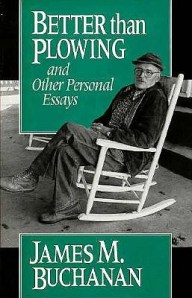
Sometimes offhand comments are the most revealing of all about someone’s character. Many Nobel laureates are defined by their vanity at least as much as their accomplishments. Not Buchanan. In an aside near the end of an autobiographical essay — written, at least in part, so he could shoo away pesky journalists asking about his life story, telling them to read this instead — he remarks that he doesn’t even feel like a part of the discipline whose highest honor he had recently won:
I am not, and never have been, an economist in an narrowly defined meaning. My interests in understanding how the economic interaction process works have always been instrumental to the more inclusive purpose of understanding how we can learn to live one with another without engaging in Hobbesian war and without subjecting ourselves to the dictates of the state. The “wealth of nations,” as such, has never commanded my attention save as a valued by-product of an effectively free society.
-James Buchanan, Better than Plowing and Other Personal Essays, p. 17
Right in line with the subtitle of Buchanan’s favorite book of his, The Limits of Liberty: Between Anarchy and Leviathan. The Buchananite approach is so much more relevant to the real world than the discipline’s conventional approach of inapplicable, if pretty, mathematical gymnastics.
The only significant difference between the Republican and Democratic parties is their rhetoric. When it comes to policies actually enacted, a much better metric, they are remarkably similar. Despite their similarities, the parties will still reliably oppose whatever the other team is proposing.
A case in point is how tax cuts affect total revenues. Reagan-era supply-side economists argued that tax cuts, by sparking economic growth and aggregate spending, could actually increase tax revenues under certain conditions. Their basic insight that tax revenue has dynamic economic effects was, and is, correct. But the dynamic effects were too small to counteract the lower marginal rates, let alone Reagan’s spending hikes in defense and other areas; the deficit grew. Democrats have sneered at supply-side tax ideas ever since.
Of course, twenty years before that, Democrats were proposing exactly the same policy, and for the same reason. In chapter 16 of Passage of Power, the fourth volume of Robert Caro’s Lyndon Johnson biography, Johnson has just assumed the presidency, and is figuring out how to pass as much of the late John F. Kennedy’s legislative program as possible, beginning with the FY 1965 budget. His thinking was this would improve his chances of winning the 1964 election. Caro explains how progressives (he misuses the word “liberal”) and conservatives butted heads in that year’s budget battle:
Liberals wanted a larger role for government, wanted bigger, and new, government social welfare programs and therefore a larger budget. They believed the $11 billion tax cut [proposed by Kennedy] would, by putting more money into people’s pockets, stimulate the economy and thereby increase tax revenues, and the money the government would have available for these programs. Conservatives, uneasy about an expansion in government’s role and about the proposed new programs, were opposed to the higher spending, and believed the deficits would be increased by the tax budgets.
Somewhere, Art Laffer is either smiling or scowling. Not sure which.
When one country puts up a barrier to foreign trade, its partners tend to return the favor. This is, to put it politely, a poor recipe for economic health. On page 360 of Lawrence White’s excellent book The Clash of Economic Ideas, he quotes Joan Robinson explaining why in one pithy sentence:
The logic of embracing free trade unilaterally, that is, no matter what policy any other national government adopts, is well expressed in an adage attributed to the economist Joan Robinson: Even if your trading partner dumps rocks into his harbor to obstruct arriving cargo ships, you do not make yourself better off by dumping rocks into your own harbor.
National governments tend to ask for a quid pro quo from their citizens’ trading partners before lowering tariffs and quotas and other nonsense. One understands the impulse; that is why it takes internationally negotiated agreements such as NAFTA to get anyone to dredge up said rocks. The point is that those rocks are a bad thing in and of themselves. Get rid of them, then. Even if you have to do it alone.
Comes from the New York Times, circa 1945 in the aftermath of the Labour Party’s trouncing of Winston Churchill:
After winning the election by a wide margin, Prime Minister Atlee informed reporters that he, not Professor Laski, would be in charge of policy making. The New York Times duly ran a story with the droll headline: “Britain Not Run by Intellectuals.”
-Lawrence White, The Clash of Economic Ideas, p. 174.
On page 140 of Douglas Arnold’s book The Logic of Congressional Action, while discussing why Congressmen are so reluctant to close unneeded military bases in their home districts, he states the first law of congressional behavior:
[N]ever impose costs on one’s constituents that might be directly traced to one’s own individual actions.
This is both true and important. Reforms that ignore this law are doomed to failure.
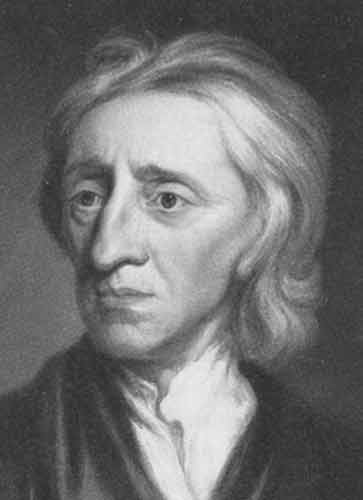
While James Buchanan’s simple insight that politicians are just as self-interested as the rest of us may have shocked the economic discipline, it strikes the rest of humanity as simple common sense. John Locke, writing well before the rise of Samuelson and Nordhaus, shows such common sense towards the beginning of chapter 12 of his Second Treatise:
And because it may be too great a temptation to human frailty, apt to rasp at power, for the same persons, who have the power of making laws, to have also in their hands the power to execute them, whereby they may exempt themselves from obedience to the laws they make, and suit the law, both in its making, and execution, to their own private advantage, and thereby come to have a distinct interest from the rest of community, contrary to the end of society and government: therefore in well-ordered commonwealths, where the good of the whole is so considered, as it ought, the legislative power is put into the hands of divers persons, who duly assembled, have by themselves, or jointly with others, a power to make laws, which when they have done, being separated again, they are themselves sunject to the laws they have made; which is a new and near tie upon them, to take care, that they make them for the public good.
That incredibly long sentence says two things, and both of them are true: legislators act in their own interest, and we should design our political institutions with that in mind to minimize the harm they can do. Buchanan would agree on both fronts.

It isn’t just crazy Internet people who use all-caps to emphasize their points, apparently. John Locke, writing well before the Internet age in 1690, writes early in his Second Treatise of Government (at the end of section 8):
EVERY MAN HATH A RIGHT TO PUNISH THE OFFENDER, AND BE EXECUTIONER OF THE LAW OF NATURE.
At least it’s all-caps in my Kindle edition. The Cambridge edition uses mere italics. Either way, do not mess with this man.

I wish.
As is now tradition on this blog (2009, 2010, 2011), here are capsule reviews of all the books I read this year. The usual rules apply: only books I actually finished made the list, and I recommend them unless stated otherwise in the review. My approach is less extreme than Tyler Cowen‘s, but I still tend not to finish a book unless I feel it’s worth the time and effort; hence the mostly favorable reviews. If you see any that interest you, I hope you’ll check them out. A good book is one of life’s genuine joys, and one well worth sharing.
- Daron Acemoglu and James A. Robinson – Why Nations Fail: The Origins of Power, Prosperity, and Poverty
Why are some countries rich while others are poor? According to this book, institutions are the answer. Countries with extractive political and economic institutions are poor and despotic. Countries with more inclusive institutions prosper.
- Tom Bethell – Eric Hoffer: The Longshoreman Philosopher
Hoffer was a dockworker and philosopher who wrote the massively influential The True Believer. This biography does a good job of blending Hoffer’s personal and intellectual lives, and reveals that he may have been an illegal immigrant from Germany. Which, of course, only reinforces my pro-immigration views.
- Peter Boettke – Living Economics: Yesterday, Today, and Tomorrow
An insightful collection of 22 articles about teaching economics, and what economics can teach us — and what it can’t. The economist should see himself as a student of society, not its savior. Humility, not certainty.
- Daniel J. Boorstin – The Creators: A History of Heroes of the Imagination
A lengthy history of the arts spanning 3,000 years, told mainly through biography. Almost all of its 70 chapters tell the life story of one or more great artist, and describes their works. Poetry, prose, painting, sculpture, architecture, theater, photography, and more all get their moments.
- Donald J. Boudreaux – Hypocrites & Half-Wits: A Daily Dose of Sanity from Cafe Hayek
I sometimes give a lunch seminar to CEI’s interns about writing, and assign them to write letters to the editor. Don taught me much of what I know in that department. This excellent book, which collects 100 or so of his best letters, shows why I learned from the best. My personal favorite is the final one.
- Jim Bouton – Ball Four
A baseball classic. A tell-all diary/memoir/autobiography of Bouton’s 1969 season pitching for the Seattle Pilots. It’s as funny as it is cynical.
- Michael Breen – Kim Jong-il: North Korea’s Dear Leader, Revised and Updated Edition
Unimpressive, but still valuable. Breen’s use of bad pop psychology to analyze Kim Jong-il’s character wastes valuable pages, and he is an awkward prose stylist. But he has gathered a lot of valuable inside information from his years as a journalist covering North Korea, and shares it eagerly.
- Robert Caro – The Path to Power: The Years of Lyndon Johnson, Volume 1
The first of four lengthy volumes published so far. The series is a study of power as much as it is of LBJ himself. Caro, while ideologically sympathetic to Johnson’s Great Society, is unafraid to paint him — accurately — as power-obsessed, manipulative, and often just plain mean.
- Robert Caro – Means of Ascent: The Years of Lyndon Johnson, Volume 2
Glad I read this during an election year. The heart of the book is the story of Johnson’s 1948 Senate race against Coke Stevenson. The two men could not be more different, which alone makes it interesting. But the lengths to which Johnson went during the campaign reveal much about the politician’s mindset. Johnson stole the election all but openly; the rest is history.
- Kenneth Clark – Civilisation: A Personal View
The companion book to Clark’s masterful BBC art history documentary, which I also recommend. Clark never does define “civilization,” but he shows 280 examples of it in this lavishly illustrated book.
- Bill Clinton – Back to Work: Why We Need Smart Government for a Strong Economy
Quick-hit book of progressive policy ideas. Recommended for young economists learning about opportunity costs, comparative advantage, and other Econ 101 concepts. Lots of places to apply them here. I also reviewed it for RealClearBooks.
- Benjamin Constant – Principles of Politics Applicable to All Governments
Published in 1815, the same year as Waterloo. Constant was a French political philosopher heavily influenced by Enlightenment ideals. But this is a world-weary work; Constant lived through the French Revolution, the Terror, and Napoleon’s wars. Above all else except for human freedom, he yearned for peace and quiet. I can get behind that.
- Martha Derthick and Paul J. Quick – The Politics of Deregulation
Dry as dust, but informative. Tells the story of how a perfect storm led to airline, trucking, and telecom deregulation under Ford, Carter, and Reagan. In a bit of disciplinary squabbling, The political scientist authors repeatedly go out of their way to disparage by name economists such as Anthony Downs, Bill Niskanen, and Mancur Olson. But their Homo economicus-based criticisms reveal that they probably haven’t read them, and certainly don’t understand them.
- Pierre Desrochers and Hiroko Shimizu – The Locavore’s Dilemma: In Praise of the 10,000-Mile Diet
This ad hominem-free deluge of data and arguments made me feel embarrassed for buy-local activists such as Michael Pollan. Like watching a cat play with a mouse.
- Peter K. Diamandis and Steven Kotler – Abundance: The Future Is Better Than You Think
Diamandis founded the X Prize Foundation. He has excellent insights into our biological predilection towards pessimism, and gives a tour of innovations that could change the world and end poverty over the next few decades.
- Paul Dickson: Bill Veeck: Baseball’s Greatest Maverick
Veeck was a baseball innovator and showman who also had a healthy sense of humor. He put the ivy in Wrigley Field, last names on players’ jerseys, set off fireworks after home runs, and once sent 3′ 7″ Eddie Gaedel to bat during a regular season game. He also played a major role in baseball’s racial integration.
- Brian Doherty – Ron Paul’s rEVOLution: The Man and the Movement He Inspired
This book is more about Ron Paul supporters, warts and all, than it is about Paul himself. A fun read, if not terribly edifying. Could stand to be a little more critical.
- Susan Dudley and Jerry Brito – Regulation: A Primer, Second Edition
Highly recommended. Excellent overview of the different types of regulation, their rationales, and the regulatory process. The link goes to a free PDF version.
- William Easterly – The White Man’s Burden: Why the West’s Efforts to Aid the Rest Have Done So Much Ill and So Little Good
The title, drawn from Kipling, refers to the West’s haughty condescension towards the Rest. Easterly draws a dichotomy between Planners — top-down, grandiose, and bureaucratic — and Searchers, who take a more bottom-up, humble, and effective approach to aid.
- Robert Heinlein – The Man Who Sold the Moon
A collection of sci-fi stories and a novella. As dated as some Heinlein stories are, the better ones have a simple joie de vivre that both leavens and complements his usual anti-authoritarianism.
- Johann Wolfgang Von Goethe – The Sufferings of Young Werther
A work of much passion and emotion, and little sense. Reminds me of what it was like to be 19 years old. From an aesthetic standpoint, though, it is simply beautiful.
- Rob Goodman and Jimmy Soni – Rome’s Last Citizen: The Life and Legacy of Cato, Mortal Enemy of Caesar
This book weaves together three themes. The first two, tightly intertwined, are Cato’s life story and the end of the Roman Republic, in which he believed strongly enough to die for. The third is his legacy, which endured all the way from St. Augustine to Dante to Addison to Trenchard and Gordon to today’s Cato Institute.
- Blaine Harden – Escape from Camp 14: One Man’s Remarkable Odyssey from North Korea to Freedom in the West
The story of Shin Dong-Hyuk, who is believed to be the only person born in a North Korean prison camp to ever escape alive. Besides describing the unimaginable hardships he endured, it tells of his new life as a human rights activist, and the difficulties he has faced adjusting to life on the outside. Shin also receives 50 percent of this book’s royalties, if you need further incentive to buy it.
- F.A. Hayek (Stephen Kresge and Leif Wenar, eds.) – Hayek on Hayek: An Autobiographical Dialogue
Hayek’s easiest read. He spoke much more clearly than he wrote. Still, it’s not a good introduction. A basic prior knowledge of his major works is essential to get much out of it. A valuable read, but Hayek neophytes are better served by the relevant parts of Brian Doherty’s Radicals for Capitalism.
- Gene Healy – False Idol: Barack Obama and the Continuing Cult of the Presidency
An update to 2008’s superb Cult of the Presidency, this short e-book looks at the abuses and expansion of executive power over the last four years. Obama doesn’t deserve the blame, though. The public’s unrealistic expectations for the office are what drive its constant expansion. I wrote more about the book here.
- Christopher Hitchens – Why Orwell Matters
Hitchens waxes eloquent on why Orwell was a principled opponent of all kinds of totalitarianism, whether from the right or the left. He is not afraid to criticize Orwell’s regrettable prejudices (women, gays, Jews), but he paints an overall picture of a an archenemy of arbitrary power, and a master of language.
- Christopher Hitchens – Mortality
Hitchens’ account of dying of esophageal cancer. Difficult to read.
- Mike Kim – Escaping North Korea: Defiance and Hope in the World’s Most Repressive Country
Kim, a Korean-American, gave up a career in finance to move to the Chinese-North Korean border and help refugees. The stories he tells about the people he met and helped are harrowing, yet ennobling.
- Mark Kurlansky – Birdseye: The Adventures of a Curious Man
Clarence Birdseye was the fellow who invented frozen food. He was also a colorful character. An enjoyable look at how innovation happens, and filled with random facts about food, Labrador, the physics and chemistry of freezing, and much else.
- Robert E. Litan and William D. Nordhaus – Reforming Federal Regulation
Published in 1983, so some parts are dated. But it contains useful discussions of numerous reform ideas, including an entire chapter on the regulatory budget, a personal favorite. If there’s a budget for how much government can spend, there should be one for how much it can regulate, too.
- Steven Malanga – Shakedown: The Continuing Conspiracy Against the American Taxpayer
A public choice-influenced book that examines rent-seeking from public sector unions, community organizers, and allied politicians at the state and local levels. The picture Malanga paints is not a pretty one for taxpayers, especially in California and New Jersey.
- David Maraniss – When Pride Still Mattered: A Life of Vince Lombardi
Lombardi is something of a god in the football world. Maraniss brings him down to earth while confirming his legendary stature. Lombardi’s drive and personality never allowed him to achieve Machiavelli’s preferred balance of fear and love, though he did try.
- Michael L. Marlow – The Myth of Fair and Efficient Government: Why the Government You Want Is Not the One You Get
Hayek wrote that “Nobody can be a great economist who is only an economist.” Marlow, at least in this book, is only an economist. Still, this would make a decent free-market policy primer for an undergraduate. The trouble is that Marlow’s monomaniacal focus on efficiency leaves out all the other reasons markets are preferable to their alternatives.
- Allan Massie – The Royal Stuarts: A History of the Family That Shaped Britain
Follows Scotland’s royal family from its murky origins as stewards (hence Stewart, or Stuart) to earlier Scottish monarchs, to the family capturing the crown for itself, on through James VI and I’s unifying the Scottish and English crowns, Charles I’s 1649 “shortening,” the Glorious Revolution that made Parliament supreme, to the line’s extinction after Bonnie Prince Charlie’s failed plot to reclaim the crown. Good stuff.
- Dierdre McCloskey – Crossing: A Memoir
Deirdre, one of my favorite economists, was once Donald. This is the story of her transition. It makes one appreciate just how hard it can be to feel comfortable in one’s own skin. As with all of her books, it is superbly written.
- Ludwig von Mises – Socialism: An Economic and Sociological Analysis
Originally published in 1922, and very prescient. The prevailing thought at the time was that a planned economy would be wealthier than an unplanned market economy; Mises showed this not to be true. People thought socialism would free people; Mises showed why the total state would enslave them.
- David Nasaw – The Patriarch: The Remarkable Life and Turbulent Times of Joseph P. Kennedy
The Kennedy patriarch was a remarkable man, if not always a pleasant one. Nasaw’s biography is Caro-esque in its level of detail. This is mostly for the good, though it spends entirely too much time on his ambassadorship in London and his alliance with Neville Chamberlain.
- Bruce Nash and Alan Zullo – The Football Hall of Shame
Not the most intellectually stimulating book, but it is laugh-out-loud funny. The literary equivalent of a blooper film.
- Tom Palmer (ed.) – After the Welfare State
A collection of essays about the welfare state and its alternatives. The historical essays about mutual aid by David Green and David Beito are especially valuable. You can download a free copy at the link.
- Roger Pearson – Voltaire Almighty: A Life in Pursuit of Freedom
The author needs a remedial lesson in comma usage, but this is still a wonderful book. One can’t help laughing along with Voltaire as he crushes l’infame.
- Martin Redfern – The Earth: A Very Short Introduction
Part of Oxford’s Very Short Introductions series. A densely packed geology primer written in an engaging and occasionally humorous style. Good for anyone from a high school student to an interested layman like this writer.
- Jean-Jacques Rousseau – Discourse on the Origin and Basis of Inequality Among Men
Nature is good and civilization is bad, according to this early work of Rousseau’s. His later works reached the same conclusion, but fortunately with more nuance. Voltaire wrote to Rousseau about this book, “Reading your book fills one with the desire to walk on all fours.” Like Voltaire and unlike Rousseau, I would rather be man than animal.
- Steven Saylor – Roma: The Novel of Ancient Rome
Historical fiction that does justice to both words. Follows the ebbs and flows of a single line of descendants over 1,000 years. Different personalities and common themes both shine through. Pre-Romulus and Remus mythical times, the Age of Kings, the entire life of the Republic, and the rise of Caesar and Augustus are all covered in vivid detail.
- Peter Schweizer: Throw Them All Out
No one will be surprised by this book’s thesis: most politicians are corrupt, and it is a thoroughly bipartisan problem. Most people would be surprised by the many details that Schweizer reveals.
- William L. Shirer – The Rise and Fall of the Third Reich
Long, but very good. The hardback edition I have is a two-volume set. The definitive history of Nazi Germany. A weakness is that it focuses on diplomacy, political maneuvering, and military strategy at the near-total expense of social history.
- Thomas Sowell – A Conflict of Visions: Ideological Origins of Political Struggles
Very insightful. Sowell compares the constrained and unconstrained visions of the world, and shows why they tend to talk past, instead of to each other. The unconstrained vision believes in the unconstrained power of intellectuals to achieve desired social results. The constrained vision believes the world is too complicated for such plans to work, and prefers ever-evolving, bottom-up processes.
- George J. Stigler – The Intellectual and the Marketplace: Enlarged Edition
Stigler, a Nobel-winning economist, was as well known for his wit and his sharp sense of humor as he was for his technical excellence. This surprisingly funny book shows that wit in full flower.
- John Stossel – No They Can’t: Why Government Fails – But Individuals Succeed
I don’t care for the unsubtle title, but Stossel is one of today’s better popularizers of libertarian ideas. Not much original material here, but well-suited for people interested in classical liberal ideas but unwilling to slog through the primary sources.
- Sean Trende – The Lost Majority: Why the Future of Government Is Up for Grabs – and Who Will Take It
I’m not much on the political horse race, but this was a good read. Trende persuasively argues that there are no permanent majorities, and that most pundits are pattern-seeking, hyperbolic windbags. I’ve long thought the same thing myself.
- Bob Uecker – Catcher in the Wry: Outrageous but True Stories of Baseball
In true Uecker fashion, I bought this book for one cent. Better, I paid nearly 400 times that — $3.99 — for shipping. It was well worth it. Uecker’s self-deprecating brand of humor is always good for a smile.
- Bryan Ward-Perkins – The Fall of Rome: And the End of Civilization
A darker counterpoint to Peter Wells’ sunnier take on post-classical Europe. Not as pessimistic as Gibbon’s Decline and Fall, but he emphasizes across-the-board declines in living standards, population, trade, literacy, architecture, and the quantity and quality of consumer goods.
- Peter S. Wells – Barbarians to Angels: Reconsidering the Dark Ages
A mostly successful attempt to improve the Dark Ages’ dismal rehabilitation. Surviving texts are mostly from the declining Romans’ pessimistic perspective; hence the dominant view. Wells prefers a different historiographical perspective: archaeology. In his enthusiasm he oversells his case, but he makes an excellent point. I blogged about the book here.
- Roy Wenzl, Tim Potter, Jurst Laviana, and L. Kelly – Bind, Torture, Kill: The Inside Story of BTK, the Serial Killer Next Door
Not a biography. This is the story of how Wichita detectives caught Dennis Rader, the BTK killer. It took them 31 years. Kudos to them for their patience and persistence in tracking down a particularly elusive monster.
- David Wessel – Red Ink: Inside the High-Stakes Politics of the Federal Budget
Very little here in the way of original thought. But it’s a good primer for the layman on the ticking fiscal time bomb. Wessel is studiously non-partisan, a huge plus in my book. Though he does favor fiscal stimulus, which makes me question his economic acumen; broken window fallacy and all that.
- Richard Wrangham – Catching Fire: How Cooking Made Us Human
Absolutely fascinating, and highly recommended. Cooking food makes it easier to digest, and allows otherwise indigestible nutrients to be absorbed. This is what made the large, energy-intensive human brain possible. We are literally evolved to cook.
Posted in Books
Tagged a conflict of visions, abundance, abundance: the future is better than you think, Addison, Addison cato, after the welfare state, allan massie, allan zullo, back to work, ball four, barbarians to angels, baseball’s greatest maverick, benjamin constant, bill clinton, bill easterly, bill veeck, bind torture kill, birdseye, blaine harden, bob litan, bob uecker, Books, brian Doherty, bruce nash, bryan ward-perkins, btk, catcher in the wry, catching fire, cato, christopher hitchens, civilisation, civilization, Clarence birdseye, conflict of visions, creators, crossing, cult of the presidency, Daniel boorstin, dante, daron acemoglu, david beito, david green, david maraniss, david nasaw, david wessel, deirdre mccloskey, discourse on the origin and basis of inequality among men, discourse on the origin of inequality, Don Boudreaux, eric hoffer, escape from camp 14, escaping north korea, fa hayek, fall of rome, false idol, football hall of shame, gene healy, george stigler, Goethe, hayek, hayek on hayek, hiroko shimizu, hitchens, how cooking made us human, hypocrites and half-wits, inside story of btk, james robinson, jean-jacques rousseau, jerry brito, jim bouton, jimmy soni, john stossel, joseph p. kennedy, jurst lavania, Kenneth clark, Kenneth clark civilisation, Kenneth clark civilization, kim jong-il, l. Kelly, leif wenar, living economics, locavore’s dilemma, lombardi, longshoreman philosopher, ludwig von mises, lyndon johnson, mark kurlansky, Martha derthick, martin redfern, means of ascent, Michael breen, Michael marlow, mike kim, mises, mises socialism, mortality, myth of fair and efficient government, nasaw patriarch, no they can’t, north korea’s dear leader, ombardi when pride still mattered, orwell, path to power, paul Dickson, paul quick, peter boettke, peter diamandis, peter s. wells, peter schweizer, peter wells, pierre desrochers, politics of deregulation, principles of politics, reading list, red ink, reforming federal regulation, regulation a primer, Richard wrangham, rise and fall of the third reich, rob goodman, robert caro, robert heinlein, Robert litan, roger pearson, roma, rome’s last citizen, ron paul’s revolution, rousseau, rousseau discourse, roy wenzl, sean trende, shakedown, shin dong-hyuk, socialism, sorrows of young werther, st. Augustine, Stephen kresge, steven kotler, steven malanga, steven saylor, stigler, story of btk, stossel, students for liberty, sufferings of young werther, susan dudley, the creators, the earth: a very short introduction, the fall of rome, the intellectual and he marketplace, the locavore’s dilemma, the lost majority, the man who sold the moon, the patriarch, the rise and fall of the third reich, the royal stuarts, thomas sowell, throw them all out, tim potter, tom bethel, tom palmer, trenchard and Gordon, trende lost majority, true believer, tyler cowen, uecker, vince Lombardi, voltaire, Voltaire almighty, when pride still mattered, white man’s burden, why nations fail, why orwell matters, william easterly, william l. shirer, William nordhaus, william shirer, years of Lyndon Johnson



 Inertia Wins!