It’s year-end list season. Thought I’d join the fun with a list of books I read this year, along with a few words about each. Books that I started and didn’t finish are not listed. Hopefully you’ll find a few you’ll want to pick up yourself. I enjoyed each and every one; I wouldn’t have bothered reading all the way through if I didn’t.
I read a lot about economics because it’s my job to. And I read a lot of history because I love history. But I’m a bit weak on literature and science. Any suggestions for good books in those areas are most welcome.
1. Dante Alighieri – Inferno
Dante was the last great gasp of the medieval mind, and arguably started Europe’s transition into the early Renaissance. You probably read this in high school. I did. And I hated it. But re-reading it this year, I loved every word. Since this work is very much a creature of its time and place, some historical background into late medieval Florence is essential. Fortunately, the abundant footnotes in the edition linked to above are extremely helpful, though they do slow things down. I’m 4 cantos away from finishing Purgatorio, and hope to eventually finish the trilogy.
2. Joel Best – Damned Lies and Statistics: Untangling Numbers from the Media, Politicians, and Activists
A guide to the more common statistical fallacies that newspapers and politicians use. Some of those fallacies are due to ignorance. Some are intentionally misleading. This book seeks to prevent people from being misled in the first place.
3. Fernand Braudel – The Structures of Everyday Life: Civilization and Capitalism, 15th-18th Century, Volume 1
This book was a landmark event in the historiographical shift from kings-and-battles to everyday social history. It is also, unintentionally, the best case for modernity ever put to paper. The first hundred pages are a litany of disease, famine, early death, loneliness, cold, and drudgery. And that’s how life was for most people before the Industrial Revolution.
4. Marcus Tullius Cicero – De Oratore
Cicero was the best, most persuasive public speaker of his day. He was also one of the best prose stylists. De Oratore is his how-to guide for aspiring orators. This book made me a better speaker, a better writer, and was a revelation in how to keep my thoughts organized.
5. Hernando De Soto – The Other Path: The Economic Answer to Terrorism
A classic in the field of development economics, which focuses on how to make poor countries rich. De Soto’s answer is rooted in property rights. He wrote this book in the 1980s at great personal risk. Sendero Luminoso, a Maoist terrorist group in De Soto’s native Peru, bombed his offices and made several attempts on his life because this book was such a convincing refutation of their ideas.
6. Will and Ariel Durant – The Story of Civilization, Volume XI: The Age of Napoleon
The last of their masterly eleven-volume survey of human history. Eleven of the best books I have ever read. Oh, how they could write. And their integral historiographical approach was revolutionary in bringing history alive for the layman.
7. Anthony Everitt – Hadrian and the Triumph of Rome
The third and last of Everitt’s biographies of great Romans. His books on Cicero and Augustus are the best of this generation; this one falls a bit short due to the poor historical record. As a result, it is about Hadrian’s predecessor Trajan as much as it is about Hadrian himself. Still a good book.
8. Bob Garfield – The Chaos Scenario
An opinionated take on the decline of old media and the rise of new media.
9. Phil Hanrahan – Life After Favre: A Season of Change with the Green Bay Packers and Their Fans
The author moved from LA back to Wisconsin to follow the Packers in their first season without Favre. Part travel memoir, part sports journalism, it’s about the fans as much as it is the players.
10. Peter Heather – The Fall of the Roman Empire: A New History of Rome and the Barbarians
A new take on Rome’s fall. He thinks it was external, not internal. The Empire was doing just fine in the 5th century, but population pressures in Asia forced mass migrations to the West at a faster pace than the West could assimilate. It’s often paired with Adrian Goldsworthy’s very different book on the same subject, which I haven’t read.
11. Christopher Hitchens – Thomas Paine’s Rights of Man: A Biography
Short primer on Paine, with all the panache and hyper-erudition one would expect from a Hitchens book.
12. Darrell Huff – How to Lie with Statistics
A classic of its genre from the 1950s. A quick, easy read that taxonomizes the most common tricks used in charts, graphs, and statistics.
13. Steven E. Landsburg – The Big Questions: Tackling the Problems of Philosophy with Ideas from Mathematics, Economics, and Physics
The economist as philosopher. Very different, and very good.
14. Steven E. Landsburg – More Sex Is Safer Sex: The Unconventional Wisdom of Economics
Another book along the lines of his The Armchair Economist and Fair Play. Landsburg’s absolutely relentless use of logic and economic reasoning is inspiring. He’s one of my favorites.
15. Peter T. Leeson – The Invisible Hook: The Hidden Economics of Pirates
Pirates and economics, together at last. Leeson was pretty entertaining (not to mention radical) as a professor. So is his book.
16. Steven D. Levitt and Stephen J. Dubner – Superfreakonomics: Global Cooling, Patriotic Prostitutes, and Why Suicide Bombers should Buy Life Insurance
Better than the first one. Borders on being contrarian for its own sake at times. And a climatologist I know says that the physics behind one of the geoengineering schemes they describe in chapter 5 are flawed. But this book will make you think.
17. Niccoló Machiavelli – The Prince
Machiavelli was the original public choice theorist. He describes how Florence worked in his day, which is also how Washington works in our day. I keep a leather-bound edition in my office, and a paperback edition at home. I make sure to re-read this every few years.
18. Thomas K. McCraw – Prophet of Innovation: Joseph Schumpeter and Creative Destrtuction
Schumpeter had quite the life story, and McCraw tells it well. His explanation of Schumpeter’s intellectual work is top-notch.
19. Thomas K. McCraw – Prophets of Regulation: Charles Francis Adams; Louis D. Brandeis; James M. Landis; Alfred E. Kahn
If Plutarch wrote about regulation, he would have written something like this.
20. Ludwig von Mises – Human Action: A Treatise on Economics
Didn’t read it in college. Didn’t read it in grad school. Finally read it this year. And I see the world a little differently now. It’s not easy going, but this is the most definitive — and thorough — economic work since Adam Smith.
21. Charles Murray – Real Education: Four Simple Truths for Bringing America’s Schools Back to Reality
Takes a sledgehammer to the Lake Wobegon school of thought. His pedagogy is a little traditionalist for my taste, but his policy recommendations are a breath of fresh air.
22. Johan Norberg – Financial Fiasco: How America ’s Infatuation with Homeownership and Easy Money Created the Economic Crisis
The sanest breakdown of the financial crisis that I’ve seen. Echoes of Tocqueville. I had more to say in an earlier post.
23. Edwin S. Rockefeller – The Antitrust Religion
Strident in tone, but a valuable introduction to the basics of antitrust policy.
24. Joseph A. Schumpeter – Can Capitalism Survive? Creative Destruction and the Future of the Global Economy
An excerpt from Schumpeter’s masterwork, Capitalism, Socialism, and Democracy. Contains his explanation of his theory of creative destruction.
25. William Caruthers Sellar and Robert Julian Yeatman – 1066 and All That: A Memorable History of England
Easily the funniest book I’ve read in years. It came out during the Great Depression, and is still just as funny today.
26. Thomas Sowell – Applied Economics: Thinking beyond Stage One
From the content to the delivery, Sowell is one of the best economics writers there is. He’s in fine form for this book. His politics are to the right of mine, but this book is about economics, so there’s very little politicking.
27. Nassim Nicholas Taleb – Fooled by Randomness: The Hidden Role of Chance in Life and in the Markets
The tone is haughty, but it contains valuable lessons about probability, certainty, and humility. Though the third seems to have escaped the author.
28. Nassim Nicholas Taleb – The Black Swan: The Impact of the Highly Improbable
More of the same from Taleb. This is a good thing.
29. Arnold J. Toynbee – Civilization on Trial
Toynbee was one of the best of the big-picture historians. Though his obsession with world government is a bit odd to an early 21st century reader. He thought history was unstoppably progressing in that direction.
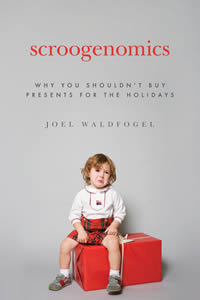
30. Joel Waldfogel – Scroogenomics: Why You shouldn’t Buy Presents for the Holidays
I liked it. My review will run tomorrow in the Washington Times.
31. Fiona Watson – Scotland: From Prehistory to the Present
A 300-page survey history that reads quickly. Found it in a gift shop in Scotland while there on vacation. It was exactly what I was looking for: a short introduction to the land I was visiting so I could better appreciate where I was.
32. Derek Wilson – Charlemagne: A Biography
This one was a little disappointing. Only half of this short book is about Charlemagne’s life. The rest is about Europe. Charlemagne was one of the great unifiers of the continent. He was the first post-classical European to reign over a territory as large as a modern nation-state. He set in motion a trend that continues today with the EU. That’s important. But I would have preferred more on his life and times, and less on all that.





 Inertia Wins!