Tag Archives: Public Choice

Regulation of the Day 89: Purple Dye

Ancient Roman consuls – equivalent to our presidents – wore togas edged in purple to mark their high status. As Republic became Empire, new emperors were said to “ascend to the purple.”

Purple clothing was a status symbol for most of human history. It was the ancient equivalent of the Mercedes-Benz. Originally discovered in the glands of shellfish (reputedly by Heracles’s dog!), it took 12,000 of the creatures to get just 1.5 grams of dye. Purple garments could be as rare and costly as gold in some places.

Modern innovations such as inexpensive synthetic dyes, the Minnesota Vikings, and purple M&Ms have taken away the color’s exotic reputation. But no worry. Federal regulators are doing what they can to bring it back.

Alpinil Industries, a dye manufacturer in India, sells its carbazole violet pigment 23 cheaply. Too cheaply, it seems. Even commoners can afford to buy products colored with their purple hues!

Irate American competitors convinced the government in 2004 to put an anti-dumping duty on Alpinil’s purple dye. That raised the price to match pricey American-made dyes. Purple would once again be reserved for the rich.

Now that the tax has been in place for five years, the Department of Commerce is wrapping up an investigation to see if it has been working as intended. A repeal would be best for consumers. Don’t expect to see it happen, though.

The benefits are concentrated to a few dye manufacturers, who have a strong incentive to lobby to keep the status quo. Meanwhile, the costs are diffused onto millions of consumers, none of whom have much incentive to spend thousands of dollars in an effort to save themselves a few pennies.
Financial Fiasco

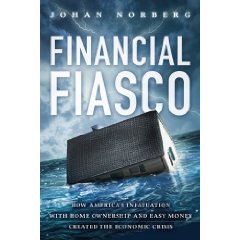
I recently finished reading Swedish economist Johan Norberg‘s book about the financial crisis, aptly titled Financial Fiasco. It’s both short and informative. Six chapters and 155 pages, all of them worth reading.

The first two chapters are about the two big regulatory causes of the recession. One, monetary policy that was too easy for too long. The price system works. When the Fed messes with that price system, prices send out the wrong signals. People behave accordingly. Two, a decades-long drive to raise homeownership rates caused a lot of people to take out loans they couldn’t afford. It was only a matter of time before the consequences would come to bear.

Chapters 3 and 4 are about how the private sector reacted to the incentives regulators gave them. Let’s just say they acted badly. If people can game the system, they often will. Norberg’s criticism of overly-complicated securitized mortgage packages is both shocking and infuriating.

Chapter 5 is about how the government and private sector reacted to the crisis once the housing bubble popped. The $700 billion bailout program to reward bad behavior comes under fire.

Norberg is in top form in Chapter 6. Having looked at the causes and consequences of the crisis, now he offers a way out. One lesson is that politicians will always behave badly. “Politicians who distribute pork they cannot afford are reelected; butcher shops that sell pork they cannot afford go bankrupt. (p. 150)” Politicians are just like you and me. They go wherever their incentives lead them. We need to approach them accordingly.

The way to a full recovery is not bailouts. It is letting bad companies fail. And just as important, letting good ones prosper. “Government support for companies is thus not a way to save jobs, as politicians try to make us believe. It is a way to move jobs from good companies to bad companies.” (p. 151) In the long run, bailouts keep the economy down by keeping jobs and resources away from where they would do the most good.

Financial Fiasco has echoes of Tocqueville; a foreigner is trying to figure out how America works. Norberg, like Alexis de Tocqueville, is uncommonly perceptive. His experience living under an economy more thoroughly mixed than America’s allows him to see things that have escaped American commentators. This is extremely valuable. The fact that his book is concise, well written, and accessible to those of us who don’t have economics Ph.Ds makes it even moreso.

Antitrust as Corporate Welfare for Aggrieved Competitors

Wayne Crews and I have an article in today’s American Spectator about the antitrust crusade against Intel. Our key points:

-An FTC picking winners and losers is not capitalism. It is crony capitalism.

-Chips in “Wintel” desktop computers increasingly constitute just one subset of a vast semiconductor market. Only a small fraction of the chips in non-PC devices are Intel’s — and these devices are where the future lies.

-Regulators’ charges against Intel have changed over the years, but their verdict always remains the same: guilty. Suspicious.

-We’d be better off prosecuting the DOJ and the FTC for colluding against free enterprise.

Regulation of the Day 79: Auctioneers in Alabama

It is illegal to conduct an auction without a license in Alabama. Unlicensed auctioneers can be punished with fines of up to $500.

Applicants must pay nearly a thousand dollars for 85 hours of coursework. 8 additional hours are required every two years to keep the license.

It’s worth asking: Does this benefit anyone besides the people teaching the courses and the auctioneers who get to limit the amount of competition they have to face?

Happy 90th Birthday to Nobel Laureate James Buchanan

buchanan

James Buchanan was one of the founding fathers of public choice theory, along with Gordon Tullock and some others (Bill Niskanen, Mancur Olson, et al). Public choice, despite the obscure name, is quite simple. It says that market behavior does not end where government begins. Politicians and other government actors are not angels. They are just as self-interested as you or I. Public choices are subject to the same incentives as private choices.

Buchanan’s simple, powerful insight won him the economics Nobel in 1986. Don Boudreaux made some brief remarks at Buchanan’s recent 90th birthday celebration. They’re worth reading, especially if you aren’t familiar with Buchanan and his very distinguished place in the history of economic thought. Also worth reading is his Nobel lecture.

Net Neutrality and Rent-Seeking

Here is a letter I sent recently to The Wall Street Journal:

September 22, 2009

Editor, The Wall Street Journal
200 Liberty Street
New York, NY 10281

To the Editor:

Your article “Bad News for Broadband” (editorial, Sept. 22) hints at, but does not make, a key point: net neutrality proposals are driving a wedge between service providers like AT&T and content providers like Google.

Strange, is it not? Their interests are actually closely aligned. If AT&T upgrades its network, Google benefits from the increased bandwidth. If Google improves its products, AT&T benefits from increased demand for broadband.

Net neutrality proposals give companies the incentive to seek rents at each other’s expense when they could be benefiting from each other’s innovations instead. This must be music to the ears of lobbyists, but how sad for consumers.

Ryan Young
Fellow in Regulatory Studies
Competitive Enterprise Institute
Washington, D.C.