Megan McArdle on DC Drivers

Well worth a read:

I could not have imagined, before I moved to DC, that I would find driving through New York City traffic soothing. But this is exactly how I do feel, when I drive back to New York. New York City drivers are extremely aggressive and numerous, but they are rational and predictable. I never feel like I don’t know what a cab driver is about to do; of course, he’s about to try to cut me off at around 35 miles per hour. But he isn’t about to pull over into the left lane of a major thoroughfare at 35 miles per hour, slam on the brakes, and back up traffic for fifteen minutes while he waits for an opening in opposing traffic so that he can pull into the hotel driveway across the street. Because even a New York City cab driver can recognize that that would be insane.

CEI Podcast: Alex Nowrasteh on Birthright Citizenship

In the latest CEI Podcast, I interview my colleague Alex Nowrasteh. He thinks the recent push to repeal birthright citizenship for undocumented immigrants is misguided.

Have a listen here. Length: 4:49.

Alex recently wrote an article on the issue for Fox News.

Regulation of the Day Update: Ladies’ Night Bar Specials

As noted previously, ladies’ night bar specials are illegal in Minnesota. The state’s Department of Human Rights says they are unfair gender discrimination. But they’re still legal in New York.

That upsets attorney Roy Den Hollander. He thinks ladies’ nights are unconstitutional. So he sued several New York bars. The Second Circuit Court of Appeals wisely threw out his case. Even more wisely, they chose not to take him seriously:

The court, with evident amusement, said it must rule against Den Hollander even though “without action on our part, (he) paints a picture of a bleak future, where ‘none other than what’s left of the Wall Street moguls’ will be able to afford to attend nightclubs.”

It’s not often that New Yorkers show more common sense than Midwesterners. Minnesota’s solons should take heed.

Economics Doesn’t Have to Be Boring

Economics is a genuinely exciting subject to study. But introductory economics classes are genuinely boring.

Maybe they’re designed that way to weed out the weak. But that means fewer people are learning the economic way of thinking. This is a mistake. Everyone should know at least the basics.

I’m not talking comparative statics or Edgeworth boxes, or any of that nonsense that scares off lay people. Leave that to the academics. I’m talking fundamentals. The stuff that everyday people can understand and use. Such as the fact that people respond to incentives, and by being aware of that, you can read a lot into why people behave the way they do.

Or the role that the price system plays in conveying information and affecting behavior. Or the fact that millions of Parisians and New Yorkers are fed each and every day, even though nobody is coordinating the process. Which really is a miracle if you think about it.

That’s why Bill Easterly is one of my favorite economists. Tasked with teaching Econ 1 this semester, he’s decided not to follow the usual (boring) pedagogy:

Sorry, I’m not all that concerned with “how individuals, blah, blah, optimal choices, blah, blah, scarcity, blah, blah…” I’m concerned why some people are so rich and other people are so poor. I want to understand why some economies work and others don’t, and why even the ones that work still don’t work for everyone. I want to understand how other Americans and I got 64 times richer than our ancestors.

I want to know why Robert Iger, the CEO of Disney, makes $140,000 a day, and why some rock-breakers I met in Ghana make $1 a day. I think a differential of 140,000 times is pretty important to understand…

Economics principles are a set of tools that have evolved to transcend scarcity into abundance. When students use these principles to solve problems in an Econ class, they are recreating the process of historical problem solving in which poor people discovered the principles to become rich people.

If there were more professors like Easterly, maybe economics would have a livelier reputation, not to mention more students. The subject matter is the very stuff of life. But the average lecturer’s performance is the very stuff of death. Or at least of sleep.

Why Freedom of Speech Matters

“Freedom of thought, in any valuable sense, includes freedom of speech.”

-J.B. Bury, A History of Freedom of Thought

Speaking Truth to Power Rarely Works

Telling the truth to one’s superiors is hard. Especially when the stakes are high. Christina Romer comes to mind. Brilliant economist. She’s done excellent work on the role of monetary policy during the Great Depression.

A partisan Democrat, she was summoned to Washington soon after President Obama’s election to advise him. All of a sudden she endorsed the Bush-Obama views on stimulus. This is a 180 degree turn from her previous views. Romer’s own academic research shows that fiscal stimulus’ effects are too small to do measurable good.

Romer the economist believes that most business cycles have monetary causes. Not fiscal. Monetary. Romer the economist had been very consistent in expressing that view. But that view changed as soon as she arrived in Washington and Romer the economist transformed into Romer the political advisor. Suspicious.

This is not a new phenomenon. Politicians from both parties have been using economists for as long as economists have let themselves be so used. Politicians love the air of legitimacy that pointy-headed academics can give to their proposals. And economists love the sudden rush of attention and name recognition — and the professional prestige that will long outlast the current administration. They are happy to sell out. Or is it buying in?

That thought was sparked by reading about F.A. Hayek mourning the death of some of his colleagues’ integrity back during the Reagan years:

“You can either be an economist or a policy advisor.

I have seen in some of my closest friends… how a few years in government corrupted them intellectually and made them unable to think straight.”

Cato Policy Report, Vol. 5, No. 2, February 1983.

The First Rule of Driving in DC Is Don’t

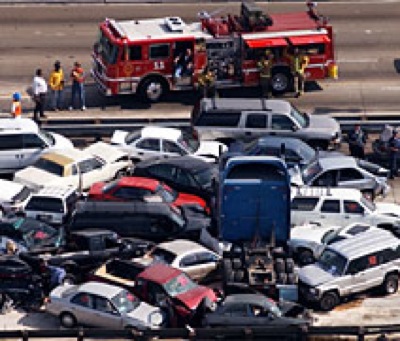
One of the first things I noticed after moving to Washington was the sheer number of bad drivers. Lane markers are treated as mere suggestions. Use of turn signals is strictly optional. It doesn’t help that outside of the downtown area, the roads are a confusing jumble. That spells disaster in a city with a large transient population unfamiliar with the city’s nooks and crannies.

But that’s all anecdotal evidence. The hard data confirm that DC drivers are a sorry lot:

Washington had the most accident- prone drivers of any U.S. city for the third straight year, according to Allstate Corp., the biggest publicly traded U.S. auto insurer.

Washington’s drivers get in a collision every 5.1 years, meaning that they have a 96 percent higher chance of being in an accident than the average American driver…

The national average for the period between collisions has been about 10 years for the six years the company has conducted the study.

Read more here.

The Iraq War Isn’t Over

Invading Iraq was one of the Bush administration’s worst mistakes. It is a waste of blood and treasure to send troops to a country that never attacked us and poses no security threat. I’ve been looking forward to the day when President Obama would announce that misguided war’s end.

Today is that day. He has declared an official end to combat operations. But the announcement rings hollow.  There are still 50,000 troops in Iraq. They are still being fired upon. They are still firing back. Their lives are still at risk every day. That sounds an awful lot like “combat operations.”

Iraq will be a free country some day. But that requires massive institutional reform. That kind of sea-level change will take a generation or more. And it has to come from within. It cannot be imposed from without by a foreign army.

Armies can fight wars. They cannot build nations. Freedom is not a top-down construction. It is a bottom-up process. It is well past time to withdraw all troops from Iraq and put a real end to combat operations.

America does have a role in Iraq’s future. Engaging in trade and commerce with Iraqis will help build the economy there, while benefiting consumers in both countries. Tourism and cultural exchange can build up good will for a nation currently viewed by many Iraqis as an occupier.

Most importantly, intellectual exchange can give Iraq’s future leaders an understanding of liberalism that they can make their own and adapt to Iraq’s unique circumstances.

It’s a long and messy road. But nobody can take the first step until combat operations actually end. We are still 50,000 troops away from that noble goal.

Expensive Jobs

Through June, the government spent about $620 billion of stimulus money. The Obama administration claims that the spending has saved or created 2.3 to 2.8 million jobs.

For the sake of argument, let’s assume those job creation numbers are true. In fact, let’s pick the rosiest number — 2.8 million jobs.

At a price of $620 billion, that comes out to $221,428.57 per job. Startlingly inefficient.

Now consider that that $620 billion had to come from somewhere else. Some of that money came from taxes. That leaves less money left over for consumers and businesses to spend. Some of the stimulus money was borrowed. That leaves less capital for private companies borrow.

The private sector tends to spend less than the government to create a job. Since stimulus spending is spending more money to create fewer jobs than the private sector, it is actually causing net harm to the job market.

In place of the spending stimulus, I humbly offer a deregulatory stimulus. CEI VP Wayne Crews and I offer some specific proposals here.

Money for Nothing

A man collected 12 years of salary and benefits from his government job in Norfolk, Virginia. Nothing unusual about that… except that he “had not reported to work in years.”

Yes, this is an outrage. But maybe the world would be a better place if more government employees took that approach to their jobs.