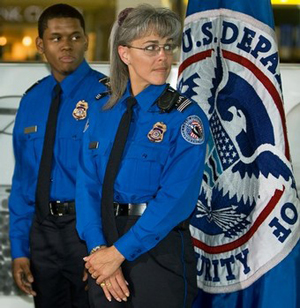
Cory Doctorow posts a TSA whopper over at BoingBoing. A group of soldiers was returning to the U.S. from Afghanistan.They were allowed to carry their (unloaded) rifles on board. Their nail clippers were confiscated.

Cory Doctorow posts a TSA whopper over at BoingBoing. A group of soldiers was returning to the U.S. from Afghanistan.They were allowed to carry their (unloaded) rifles on board. Their nail clippers were confiscated.
Comments Off on Priceless
Posted in Security Theater
Tagged afghanistan, boingboing, cory doctorow, nail clippers, Security Theater, soldiers, tsa, tsa confiscation, veterans

Via Business Insider.
According to this graph, the higher the percentage of a country’s males aged 25-34 live with their parents, the higher that country’s sovereign debt. Remember, though — correlation does not equal causation.
For one, this graph lists 11 Eurozone countries. But that’s out of a total of 25 Eurozone countries. Was there a reason the other 14 were left out? Maybe they fit the trend. Maybe they don’t. But since they aren’t there, we don’t know.
Even so, surely for some people, living with their parents for so long is caused by a lack of ambition and initiative. Those are two key ingredients for entrepreneurship and growth, which are important debt reducers. And a lack of them could be one cause of higher social spending, which increases debts.
The story this graph tells makes intuitive sense. But one wonders how much it matters compared to the many other factors in play.
Posted in Economics, Fun with Statistics

Yacahuda Harrison, 49, likes to play chess. He and six of his friends were playing the classic strategy game in an Upper Manhattan park. Their game was broken up by “A squad of cops in bulletproof vests,” The New York Post reports.
This is because it is illegal for adults to be in said park unless they are accompanied by a child under 12 years old. The law is intended to keep molesters away from children.
No children were in the park when Harrison’s chess game was busted.
He and his accomplices were ticketed and have a December 28 court date.
Posted in Nanny State, Regulation of the Day
Tagged chess, child molesters, excessive force, manhattan, new york, New York Post, nypd, overreaction, overreactions, parks, pedophiles, y.a. harrison, yacahuda harrison

Vice President Joe Biden recently said that every great idea of the last two-plus centuries came from government. My colleague Alex Schibuola and I rebut him over at The Daily Caller using Adam Smith’s book The Theory of Moral Sentiments as our weapon of choice. Biden, it turns out, is an almost perfect example of what Adam Smith described as the “man of system.” This is not a good thing.
As Smith put it:
The man of system … is often so enamored with the supposed beauty of his own ideal plan of government, that he cannot suffer the smallest deviation from any part of it … He seems to imagine that he can arrange the different members of a great society with as much ease as the hand arranges the different pieces upon a chess-board.
The problem, of course, is that human beings are not chess pieces. They have their own wants and desires. They move on their own. The man of system does not take this into account. This is why his plans fail time after time, even if he has the best of intentions.
Read our whole article here.
For those of you interested in learning more about Adam Smith, I couldn’t recommend him more highly. Don’t be scared off by his 18th-century prose style. Sit down with either of his books for less than an hour and you’ll develop an ear for it.
I don’t agree with everything Smith said; he invented the labor theory of value. But he was a keen observer of human nature. He was also a kindly soul, who wanted man to be free, happy, and prosperous. The overarching theme of his thought is mankind as social creature. Our social instincts color how we form our notions of morality (the impartial spectator theory), and explain why economies function the way they do (peaceful exchange, as opposed to simple theft).
The Theory of Moral Sentiments is available for free at the Online Library of Economics and Liberty. You can also get a hard copy or a Kindle edition from Amazon.
For help wading through and digesting Smith’s arguments, I recommend Russ Roberts and Dan Klein’s six-part podcast series about the book, and D. D. Raphael’s short and readable The Impartial Spectator: Adam Smith’s Moral Philosophy.
Other quality secondary sources on Smith include E.G. West’s short-yet-thorough biography, and P.J. O’Rourke’s On the Wealth of Nations, which pairs Smith’s economic theories with O’Rourke’s mordant wit.
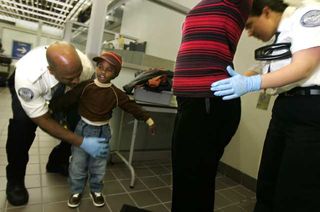
Pajamas Media’s Andrew Ian Dodge links to my OpenMarket.org blog post from yesterday and points out that scanners and pat-downs aren’t necessarily an either/or choice. Sometimes it’s both, as he found out the hard way. Read what he went through here.
TSA’s policies are at least as degrading as they are ineffective.
Comments Off on It Gets Worse
Posted in Security Theater
Tagged airport security, andrew ian dodge, enhanced pat-downs, full body scans, openmarket, pajamas media, pat-downs, Security Theater, tsa
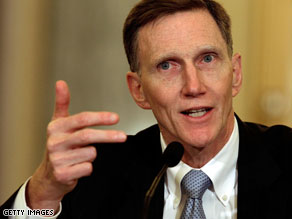
TSA chief John Pistole offered to give enhanced pat-downs to senators at a hearing today on TSA’s new screening policies. Over at the AmSpec blog, I break down the cause of the controversy and point out that there’s a lot more to the story than national security.
The curiously-named Rapiscan is one of two companies that makes full-body imaging machines. As former CEI Brookes Fellow Tim Carney reports, Rapiscan’s CEO is an Obama donor who accompanied the President on his recent trip to India.
Rent-seeking being a bipartisan phenomenon, the company also paid President Bush’s former Homeland Security Secretary, Michael Chertoff, to promote Rapiscan’s full-body scanners.
Comments Off on Shouldn’t He Buy Them Dinner First?
Posted in Security Theater
Tagged deepak chopra, enhanced pat-downs, full body scans, john pistole, michael chertoff, national security, pat-downs, rapiscan, Security Theater, tsa

Over at the AmSpec blog, I look at the just-wrapped House ethics trial against Charlie Rangel. Worth noting: while that Damoclean sword was hanging over Rangel’s head, 80 percent of his district’s voters though him worthy of another term.
Nothing against Rangel; he has his problems, but he’s good on some issues, such as wanting to end the Cuban embargo. But the ease with which even ethically-challenged incumbents get re-elected is a sign that our democracy is not healthy.
Comments Off on The Power of Incumbency: Charlie Rangel Edition
Posted in Elections, Political Animals
Tagged american spectator, amspec blog, charlie rangel, congress, damoclean sword, ethics, house, incumbency, rangel ethics trial, re-election, sword of damocles
This video doesn’t get all the particulars right, but it gets most of them. And boy, does it have some good zingers. It has also gotten over 800,000 views; sometimes people do listen to good economics. Enjoy.
Posted in Business Cycles, Economics, Monetary Theory
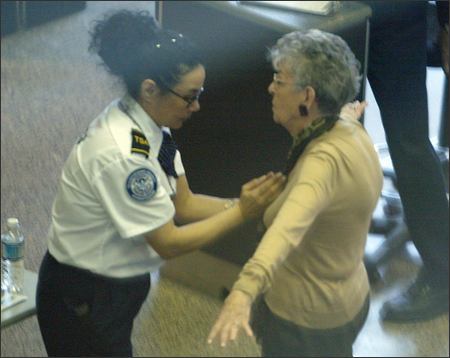
The TSA has crossed a line. Its new security procedures require employees to either touch passengers’ genitals or take pictures of them. The public backlash is loud and growing. My colleagues Michelle Minton, Brian McGraw, and Ivan Osorio have all covered the issue. Here are what other people around the country are saying:
-Tim Carney reports that the CEO of Rapiscan, a scanner manufacturer, is an Obama donor and accompanied the President on his recent trip to India.
-A group of activists has declared November 24 to be National Opt-Out Day. November 24 is the day before Thanksgiving, and will be one of the year’s busiest travel days. Since pat-downs take more time than full-body scans, the goal is to clog security until TSA removes full-body scanners from airports. I will be participating.
-The proprietor of Our Little Chatterboxes, a blog about child development issues, recounts her encounter with the TSA’s new pat-down procedures. She writes, “[The TSA employee] felt along my waistline, moved behind me, then proceeded to feel both of my buttocks. She reached from behind in the middle of my buttocks towards my vagina area… She then moved in front of my and touched the top and underneath portions of both of my breasts… She then felt my inner thighs and my vagina area, touching both of my labia.”
-The blogger at Insert Title Here tells his story, with video. He was threatened with a $10,000 civil suit.
–The Chicago Tribune’s Steve Chapman wrote an excellent column, noting that “The U.S. Marshals Service recently admitted saving some 35,000 images from a [full-body scanning] machine at a federal courthouse in Florida. TSA says that will never happen. Human experience says, oh, yes, it will.”
–Art Carden calls for abolishing the TSA. “The airlines have enormous sums of money riding on passenger safety, and the notion that a government bureaucracy has better incentives to provide safe travels than airlines with billions of dollars worth of capital and goodwill on the line strains credibility,” he writes.
-The Drudge Report posts a picture of a TSA agent fondling a nun’s private parts.
Posted in Security Theater
Tagged abolish the tsa, airport security, art carden, brian mcgraw, chicago tribune, drudge report, insert title here, ivan osrio, michelle minton, national opt-out day, our little chaterrboxes, Security Theater, sexual assault, steve chapman, tim parney, timothy p. carney, tsa

Associate Director of Technology Studies Ryan Radia gives his take on a Supreme Court case concerning California’s ban of violent video game sales to minors. Keeping such things away from children is traditionally a job for parents.
The case has implications that reach far beyond video games. Because censorship is such a subjective thing, allowing it could have a chilling effect on forms of expression from art to music to film. The First Amendment specifically prohibits the government from sanitizing culture. That is up to the people themselves.
Comments Off on CEI Podcast — November 15, 2010: Free Speech and Video Games
Posted in CEI Podcast, Free Speech, Technology
Tagged california, censorship, Free Speech, freedom of speech, ryan radia, scotus, supreme court, video games, violent video games


