On Internet TV – Airline Fees and Unintended Consequences

At about 5:24 EST tonight, I’ll be on Wall Street Journal‘s live tv show to talk about Spirit Airlines’new “Department of Transportation Unintended Consequences” fee for all ticketbuyers. The fee is a snarky response to a new DOT regulation limiting re-booking fees, and I blogged about it here.

The link to the live feed is here if you’d like to watch.

Talking Past Each Other

A couple of interesting articles I read this week touch on an important truth: libertarians and the left have quite a bit in common. Neither side much cares to admit it, but it’s still true. The Moorfield Storey blog points out that modern classical liberalism began as an opposition movement to conservatism:

Classical liberalism was a revolutionary movement challenging the status quo of the day. It was not as consistent in application of its principles as libertarians would prefer, but it was a dramatic step forward in the history of liberty. Classical liberals opposed the alliance between church and state; they wanted to end the property system of the day, where might alone transferred property into hands of privileged, landed elites who grew wealthy out of monopoly privileges bestowed by the Crown.

Later, when modern socialism was born in the mid-19th century, classical liberalism occupied the middle ground between conservatives and socialists. Over time, as capitalism became more and more established, conservatives began to see that as the tradition they wanted to conserve, and gradually moved in that direction.

As socialist and communist governments took power across the world in the 20th century, classical liberals started to ally with conservatives more than the left. The Old Order, while unpleasant, was less lethal than Stalin or Mao’s wrath. But socialism is dead now, and the left has much more common ground with classical liberals than in the bad old days. Still, the two sides still rarely talk. This is a problem for both sides.

Many on the left are innocent of economic knowledge, and could stand to learn some. Libertarians, on the other hand, are often economics-obsessesed. That’s not good, either. Regularly engaging the left can help. Economists who are only economists are boring creatures with little to offer intellectually. That’s why they need to study other disciplines, and other philosophies. Not convert to them, but engage them. Learn from them. Incorporate the good, reject the bad.

If classical liberals want to talk to progressives, they need to realize that, while efficiency and utility are important concepts, classical liberals also need to emphasize their rebellious heritage and how they, too, stand up for the little guy.

Point out how markets help the poor. Nowadays, even people in poverty usually have cell phones, flat-screen tvs, air conditioning, and cars. This is not to be dismissed as “Duh, what’s your point?” The point is that this level of prosperity is unheard of in human history, and it only happened when societies dropped their traditional hostility to commerce and markets. It’s what Deirdre McCloskey calls the Great Fact.

There is still so much progress yet to be made — most of the world’s wealth hasn’t been created yet. Liberalization has been, and will continue to be, the world’s greatest anti-poverty program. Yes, markets are efficient, too, and that’s great. But their unparalleled poverty reduction power (and we have tried many unsuccessful parallels) is what is important, and why the left should be more open to them.

Classical liberals have things they need to learn from the left. The abolition of slavery and monarchy were massive achievements. But there is still progress to be made on gay rights, racial equality, women’s rights, and other issues. Remember, one of classical liberalism’s basic tenets is that everyone has equal rights. Things are a lot better than they used to be, but we’re not there yet. And just because those issues aren’t terribly relevant to nerdy middle-aged white males doesn’t mean those issues are unimportant. They matter. Those are libertarian issues every bit as much as they are progressive issues.

Another topic the left and classical liberals need to broach is public choice theory. This is a fancy way of saying that if a corporation can use government to hobble its competitors, then it probably will. Lessons abound for how to effectively use government. Mark Pennington writes:

Having listened to me speak for an hour on the power of incumbent firms to ‘capture’ regulatory agencies an attending student who was an activist in the Socialist Workers Party asked me, ‘when did you become a Marxist?’ Needless to say, for someone who considers himself a radical ‘anti-Marxist’ I was taken aback by this approach! What the question exemplifies though is an attitude that is widespread in academic circles – the assumption that an interest in power imbalances that favour business interests must equate with one having leftist or socialist sympathies. The idea that there might be a classical liberal/free market understanding of ‘power relations’ as exemplified by public choice theory is a possibility that simply hasn’t occurred to this particular species of left-winger.

That’s precisely why classical liberals and progressives need to communicate more. Talk to each other, not at each other. They are different philosophies, but each can learn much from the other. And they could make a lot of progress on their common issues.

Similar arguments can be made for why classical liberals should work with the right, too. Again, they’re very different philosophies. But why have enemies when you can have friends?


CEI Podcast for February 2, 2012: The FDA’s Latest Power Grab

Have a listen here.

Fellow in Consumer Policy Studies Michelle Minton breaks down the FDA’s behind-the-scenes push to regulate dietary supplements nearly as strictly as prescription drugs.

Regulation of the Day 208: Re-Booking Flights

Four of air travelers’ five biggest complaints are about the TSA. Right up there on the list with everyone’s favorite sexy-searchers has to be airlines’ habit of nickel-and-diming customers for checked baggage, blankets and pillows, and most anything else that isn’t bolted to the cabin floor.

This business practice, called unbundling, does help keep ticket prices low, as I’ve previously explained. But it’s still annoying; people are transaction-averse.

The Department of Transportation, knowing a good PR opportunity when it sees one, recently passed a rule forbidding one type of extra charge. Airlines may no longer charge re-booking fees if passengers re-book their flights within 24 hours of first purchasing them. Many passengers will no doubt welcome the change. The trouble, which the DOT does not acknowledge, is that it isn’t free. CNN’s Aaron Cooper explains:

The airline says the regulation forces them to hold the seat for someone who may or may not want to fly. As a consequence, someone who really does want to fly wouldn’t be able to buy that seat because the airline is holding it for someone who might or might not end up taking it.

In other words, there will be more empty seats, which costs the airline potential revenue. Passengers will also have a harder time finding a seat on nearly-full flights. That’s why Spirit Airlines, a low-fare airline that practices an extreme form of unbundling, is adding a $2 “Department of Transportation Unintended Consequences Fee”. Re-bookers’ gains come at everyone else’s loss.

It isn’t often that businesses stand up to regulators. More and more, they can be seen holding hands and gazing into each others’ eyes while dreams of increased budgets and decreased competition dance through their heads. That’s why Spirit’s pointed sense of humor here is refreshing. The DOT isn’t taking too kindly to Spirit’s Economics 101 lesson, but then again, they’re the ones who forgot about tradeoffs. They’re everywhere.

Image

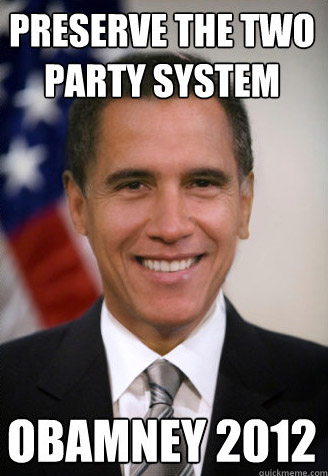
Worth at Least a Thousand Words

obamney preserve 2 party system

(via Tim Cavanaugh)

Economic Optimism

Mark Mills and Julio Ottino argue that despite current troubles, our economic future is a bright one:

In January 1912, the United States emerged from a two-year recession. Nineteen more followed—along with a century of phenomenal economic growth. Americans in real terms are 700% wealthier today.

In hindsight it seems obvious that emerging technologies circa 1912—electrification, telephony, the dawn of the automobile age, the invention of stainless steel and the radio amplifier—would foster such growth. Yet even knowledgeable contemporary observers failed to grasp their transformational power.

In January 2012, we sit again on the cusp of three grand technological transformations with the potential to rival that of the past century. All find their epicenters in America: big data, smart manufacturing and the wireless revolution.

Read the whole thing.

Regulation Roundup

-The Anacostia Cab Association is a D.C.-based company that hires willing employees to give rides to willing customers. The city is cracking down on them at their competitors’ behest.

-Both U.S. Senate candidates in Massachussets want to strictly limit political speech. They believe their campaigns should have free rein, but they don’t want other people to have the ability to publicly express their opinions. Jeff Jacoby has more in a wonderful column titled “Shut Up, They Explained.”

-The 2012 Federal Register is already up to 4,456 pages. It’s still January.

-The most bizarre regulation of the year could well be this Alabama bill “prohibiting the sale or manufacture of food or products which contain aborted human fetuses.” SB 1418 would ostensibly ban embryonic stem-cell research in the state.

-A local ordinance in Suffolk, Virginia prohibits driving motorized vehicles under their own power within city limits.

-The IRS is once again making noises about wanting to do your taxes for you. I’ve written before on why this is a bad idea, but it looks like I may have to explain myself a little more clearly.

The New Theories of Moral Sentiments

Dalibor Rohac profiles Deirdre McCloskey and her unconventional approach to economics in today’s Wall Street Journal:

Ms. McCloskey sees a problem in the way that economic models are dominated by a strange, sociopathic character—”Max U” as she calls him, referring to the standard economic problem of maximizing utility subject to various constraints. Her own scholarly work has become increasingly focused on bringing love, hope, faith, courage and other virtues back into economics…

[R]ecall that in 1759 Adam Smith earned his reputation by publishing “The Theory of Moral Sentiments,” in which he accounted for the emergence of sympathy and moral judgments. It was only in the 20th century that ethics disappeared from economics, partly as a result of the increased mathematization of the discipline. Ms. McCloskey says it was a fundamental error for economists to start making their arguments in terms of “Max U” alone. “In fact, ‘Max U’ would be a much more sensible person if he had gender change and became ‘Maxine U,'” she chuckles.

Read the whole thing.

CEI Podcast for January 26, 2012: Visa Reforms for Farm Workers

Have a listen here.

The state of Georgia recently passed strict new requirements for immigrant farm workers. Immigration Policy Analyst Alex Nowrasteh looks at the results of a new report released by the state. Workers are fleeing to other states, causing a labor shortage. Some farmers find they lose less money by actually letting their crops rot in the fields rather than comply with state and federal rules.

Is Bush or Obama the Bigger Regulator?

President Obama correctly pointed out in his State of the Union speech that he passed fewer regulations in his first three years than President Bush. Over at the Daily Caller, Wayne Crews crunched the numbers and found that Bush passed 12,588 regulations to Obama’s 10,810.

That’s an average of 4,196 rules per year for Bush, and 3,603 for Obama — nearly two fewer rules per day. For those who believe that Bush was a free-marketeer, Obama has given us another nail for that myth’s well-sealed coffin.

But that doesn’t mean President Obama is less of a regulator than his predecessor. He has passed fewer rules, but they tend to cost more. Regulations are classified as “significant” if they cost over $100 million per year. There are different technical definitions for “significant,” “economically significant,” and “major.” And the Federal Register gives different counts than NARA, the National Archives and Records Administration.

With those caveats in mind, the Federal Register data have President Bush passing 30 economically significant regulations in his first three years. Obama passed 953.

The difference is more than a factor of 30. Roughly one quarter of one percent of Bush’s rules were economically significant.  Almost 9 percent of Obama’s are.

What the President said on Tuesday is technically correct. But, as with almost all political statements, there is more to the story.