Category Archives: Technology

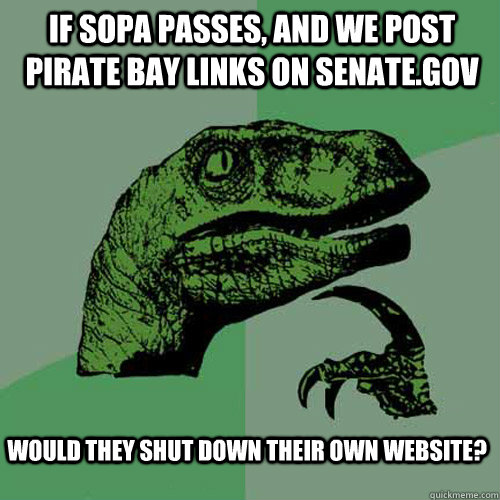
Philosoraptor’s Wisdom

Good question.

Siri and Modernity’s Iron Laws

I’m fond of saying that the two iron laws of modernity are 1) things are getting better, and 2) people think they’re getting worse.

One more piece of evidence that these laws hold: this article complaining about Siri. Siri is a voice-activated program that comes with new iPhones. Users can ask their phone where, say, the nearest Thai restaurant is. Just say it out loud. No typing. In seconds, Siri gives out a dozen options, with maps, directions, and even menus.

It’s an amazing piece of technology, and it will only improve in the coming years. And this guy grouses that Siri “won’t tell me how much battery life is left, or turn my Wi-Fi antenna on or off.” What an astonishing mindset. It is disheartening that when faced with such cool innovations, people invariably find ways to complain about them.

On the other hand, if consumers weren’t such harsh sovereigns, many of today’s innovations might never happen in the first place. Modernity’s second iron law — people think things are getting worse — is a double-edged sword.

Google’s Antitrust Troubles

Holman Jenkins sums it up:

Google will be accused of having a “monopoly” on search, though its market share is only 65%, and it charges consumers nothing for its services.

CEI Podcast for September 1, 2011: The Blocked AT&T-T-Mobile Merger

Have a listen here.

The Department of Justice sued this week to stop the proposed AT&T-T-Mobile merger. Associate Director of Technology Studies Ryan Radia thinks this is a mistake. The evidence that the merger would make the wireless market less competitive is unconvincing. Nobody knows if the merger will succeed or not. Either way, consumer harm is unlikely.

AT&T-T-Mobile Merger Delayed

A few months ago, the FCC said it would hand down a decision on whether to allow AT&T and T-Mobile to merge within 180 days. August 26 was day 83. The FCC decided to reset the clock to zero. So now it will be as long as another 6 months before the FCC announces its verdict.

There’s a comment to made here about regulatory uncertainty. There’s another one to make about the value of the FCC keeping its word. But instead I’ll concentrate on Sen. Al Franken’s recent remarks. “I am very suspicious of consolidation of power,” he told MinnPost.com.

“Big is bad” is an old argument. Age has not given it wisdom, however. Suppose a super-size phone company like a merged AT&T-T-Mobile is so big, clunky, and inefficient that it has to charge higher prices. What a golden opportunity for smaller, leaner competitors like Verizon and Sprint to swoop in and gain market share.

Now suppose instead that the merger gives AT&T and T-Mobile better economies of scale and a faster, more reliable network. Consumers flee their previous networks to join a better, cheaper one. This is hardly consumer harm – which after all, is the usual rationale for antitrust regulations.

Nobody knows if the proposed merger will work or not. But a company’s size doesn’t have much to do with whether a merger should be allowed. If a merger gives diseconomies of scale, consumers will punish it. If it improves service and prices, consumers will reward it.

Unlike the FCC, markets are impartial. Consumers are the proper arbiters of this proposed merger. Let them hand down the verdict.

CEI Podcast for August 25, 2011: Mr. Fuddlesticks

Have a listen here.

Mr. Fuddlesticks is an anonymous YouTube user who posted embarrassing videos about the Renton, Washington police department. They convinced a judge to let them request Mr. Fuddlesticks’ personal information from Google, YouTube’s parent company. While the charges were eventually dropped, Research Associate Nicole Ciandella thinks this highlights a major problem in applying telephone-era laws to the Internet era.

Regulation of the Day 182: PowerPoint Presentations

A political party in Switzerland is seeking to ban Microsoft PowerPoint presentations in meetings. The Anti-PowerPoint Party (APPP), founded in May by Matthias Poehm, claims that wasted time from sitting through PowerPoint presentations costs the Swiss economy $2.5 billion per year. The party estimates Europe-wide costs to be $160 billion.

In Switzerland, 100,000 signatures is enough to trigger a referendum on almost any issue. The 245-member (and growing!) APPP is currently rounding up signatures for a referendum on PowerPoint presentations. Poehm, who founded the party to promote his new book, The PowerPoint Fallacy, urges public speakers to use flipcharts instead.

Poehm deserves credit for being a creative promoter. And I share many of his sentiments about PowerPoint. But PowerPoint policies are best set by individuals, not binding referenda. His book, now available in several languages, will hopefully persuade many individuals to spare their colleagues some tedium. But politicizing the issue, humorous though it is, might not be the best way to improve the quality of public speaking in Switzerland.

CEI Podcast for March 28, 2011: Human Achievement Hour

Have a listen here.

Human Achievement Hour founder Michelle Minton talks about the annual celebration of human creativity and innovation that happens at the same time every year as Earth Hour. Ecology and economy are quite compatible. One definition of progress, after all, is doing more with less. When people are left free to achieve and innovate, that is exactly what happens, to the environment’s benefit — and mankind’s.

CEI Podcast for March 17, 2011: Are Biotech Crops Coming to Kenya?

Have a listen here.

CEI Senior Fellow Greg Conko discusses his recent trip to Kenya where he met with members of Parliament and other officials about the best way to regulate the introduction of genetically modified crops to the country.

Are Text Messages an Antitrust Issue?

Text messages cost 20 cents to send, even though they use a fraction of a penny of bandwidth. What gives? Antitrust authorities want to know.

Over at The American Spectator, I explain that it is likely a case of unbundling:

Maybe phone companies are unbundling texting from their other services. That way the only people who pay for text messages are the people who use them. If phone companies don’t have to provide texting service for people who don’t want it, they can keep costs down and charge lower prices.

This is much more fair to customers:

Why not just give all customers unlimited texting and charge a higher monthly bill? That would punish people who don’t text, such as this writer. By eschewing the flat rate and tolerating a few texts per month from family and friends who haven’t been properly trained, non-texters can save $50 or more per year.

Monopolists (and oligopolists) don’t behave that way. Companies competing against each other on price do. Trustbusters are forgetting something else, too. If a monopoly exists at all, it is very temporary.

It turns out that a young company called Beluga makes a free texting application for smartphones. Few things are as temporary as monopoly (or oligopoly) power. Since Beluga bypasses the texting cartel, you can have unlimited texting without the $5 monthly fee. Think of it as Skype for the text messaging set.

Read the whole article here.