Category Archives: Security Theater

Regulation of the Day 97: Full Body Scans and Child Protection Laws

Sometimes, when two regulations love each other very much, they get together and have little baby regulations. This is happening right now in Britain.

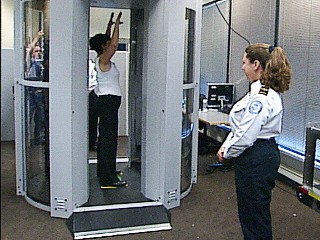
Full body scans are coming into use at many UK airport security checkpoints. Since screeners essentially see all passengers naked, the scans run afoul of child protection laws for passengers under 18.

The thought of pedophiles using the body scan images for their own sick ends is decidedly creepy. So the British government is taking steps to keep that from happening. Those steps include:

-Exempting everyone under 18 from being scanned. This defeats the security purpose of the scanners.

-Moving the scanner operators out of sight of passengers. That keeps the scanner images anonymous. But it doesn’t prevent perverts from seeing things they shouldn’t.

There is an easier way: don’t do full body scans. They do more to make people feel safe than to actually make them safe.

Reinforced cockpit doors, proactive passengers, and checked baggage screening are much more effective. And they’re already in place. Besides, terrorist attacks are rare. Full-body scans are an over-reaction. The resources spent on them have other, better uses.


Terrorism Is Rare

Radley Balko points to an article that shows exactly how rare terrorism is.

The figure that caught my eye was the last one. There were 647 deaths due to airborne terrorism over the last last ten years. There were 7,015,630,000 passengers over the same period. Yes, that figure is higher than current world population. That’s because each time someone flies, they count as one passenger. You take ten trips, you’re counted ten times. That represents each opportunity to become a terrorist victim, and is therefore the correct measure to use.

Each time you board a plane, your odds of being a victim of terrorism are about  1 in 10,408,947 (my own calculations yielded 1 in 10,843,323, but the point holds either way). Your odds of being struck by lighting are over twenty times higher!

Terrorists are so rare that they can’t win by killing people. There are too many of us and too few of them. Terrorists can only win by scaring people. Making them overreact. Making them trade away their freedom for for the illusion of security. The TSA, which is based on exactly that, represents the terrorists’ greatest victory yet.

That’s why people need to know just how safe we really are, even with all of the terrorists out there. The more we know, the less scary they become. And fear is their only effective weapon. If we take it away, the terrorists lose.

Regulation of the Day 90: The National Poultry Improvement Plan

Having solved all the nation’s other problems, the federal government has a National Poultry Improvement Plan. Run in conjunction with state governments, “The main objective of this program is to use new diagnostic technology to effectively improve poultry and poultry products throughout the United States.”

Because the government puts so much time and attention into issues like chicken health, it is neglecting its core duty: protecting citizens from attack. Last week’s terrorist attack should be a wake-up call for the government to drop non-essential tasks and concentrate on what it should be doing.

Regulation of the Day 73: Snow Globes as Terrorist Threat

snow-globe

Some of the TSA’s critics say the agency its own reductio ad absurdum. TSA’s latest action does nothing to improve security, but much to prove its critics correct. Snow globes are now banned from carry-on luggage (hat tip: Radley Balko).

This means one of two things: either grandmothers with snow globes in their carry-ons are the biggest terrorist threat facing the country, or the TSA is doing something wrong.

The way to prevent terrorism is to make terrorism difficult. Banning snow globes doesn’t make terrorism any more difficult.

Yes, larger snow globes probably violate the TSA’s three-ounce limit for liquids. But they are not bombs. They are, in fact, snow globes.

Moving On

As so often happens, Gene Healy hits a home run.

On the anniversary of 9/11, what’s clear is that, despite the cliche, September 11th didn’t “change everything.” In the wake of the attacks, various pundits proclaimed “the end of the age of irony” and the dawning of a new era of national unity in the service of government crusades at home and abroad. Eight years later, Americans go about their lives, waiting in restaurant lines, visiting our ”great destination spots,” enjoying themselves free from fear — with our patriotism undiminished for all that. And when we turn to politics, we’re still contentious, fractious, wonderfully irreverent toward politicians, and increasingly skeptical toward their grand plans. In other words, post-9/11 America looks a lot like pre-9/11 America. That’s something to be thankful for on the anniversary of a grim day.

Traffic Cameras On the Outs?

There’s a new sheriff in Pinal County, Arizona. No more speed cameras on his highways: “[new Sheriff] Babeu said speed cameras created dangerous road conditions and offered little financial benefit for the county.”

He’s right. Accidents and fatalities both went up after the cameras were installed. Similar stories have played out in other camera-friendly jurisdictions, including where I live.

Still, don’t get your hopes up too much about the new sheriff. I don’t think he quite gets it. The article ends: “[Babeu] wants to bring red-light cameras to the county.”

Kudos to President Obama

This blog has a dim view of politicians. But intellectual integrity demands that we give praise where due, as well as criticism. And the Obama administration certainly seems to be putting its best foot forward in its opening days.

Not only is Guantanamo Bay shutting down, but President Obama has made a few other positive moves on government openness and some of the Bush administration’s civil liberties shortcomings. Radley Balko details them here and here.

More, please.

UK Town to Abolish Traffic Cameras

silly camera

The UK has quietly become one of the most-surveilled societies on earth. The isle sports an eye-popping one surveillance camera for every fourteen people.

The town of Swindon is finally pushing back — if for the wrong reasons — by opting out of a traffic camera program. The town council accurately claims that the cameras generate money, but not safety. The real objection, of course, is that the money raised goes to London, not Swindon.

So their motives may not be pure, but at least the results should be good. Accident rates tend to go up at camera-bearing intersections; authorities sometimes shorten yellow light times to nab more drivers running red lights.

Let us hope more localities follow Swindon’s lead, whatever their motivation.

Orwell Returns to Arlington

Arlington County’s red light cameras are coming back this summer.

The ostensible reason is safety. OK, fair enough. But statistics show that accident rates actually tend to go up at intersections that have cameras installed. How does that happen?

Yellow light times are often shortened. That way the cameras nab more drivers running reds and can issue more tickets. That means more revenue for local governments. It also means more accidents for drivers.

This pattern has played itself out everywhere from Colorado to Texas to DC. At least one politician has publicly acknowledged that his city has the cameras for revenue-generating purposes. The safety angle? That’s just PR.

Now the cameras are coming back here.

Thanks, Arlington.

Surveillance Cameras and Crime

The Economist has concise monthly features on different cities online. This month’s Washington, DC edition has a short note on surveillance cameras placed in high-crime neighborhoods.

Surveillance cameras have precipitated a drop in crime in certain neighbourhoods, according to the District police. Violent crime rose by about 1% in Washington, DC, last year, but fell by 19% in areas within 250 feet of the cameras… council members are questioning whether they do anything more than simply push crime into other neighbourhoods.

Cato’s Jim Harper said much the same thing not too long ago.