Category Archives: Science

An Evolutionary Banquet

Chapter 5 of Brian Fagan’s excellent Cro-Magnon opens with the following quotation from the paleontologist Björn Kurtén:

“Imagine a dinner table set for a thousand guests, in which each man is sitting between his own father and his own son. At one end of the table might be a French Nobel laureate in a white tie and tails, and with the Legion of Honor on his breast, and at the other end a Cro-Magnon man dressed in animal skins and with a necklace of cave-bear teeth. Yet each one would be able to converse with his neighbors on his left and right, who would either be his father or his son. So the distance from then to now is not really great.”

It’s a similar conceit to the Evolution Stadium described by Richard Wrangham in Catching Fire: How Cooking Made Us Human, which remains one of the most thought-provoking books I’ve read.


“The coming frenzy of sex and death will last up to six weeks.”

So says the Washington Post, warning of an upcoming brood of 17-year cicadas that will swarm the region once the ground temperature reaches 64 degrees — which could happen as soon as late April. While this brood won’t be of quite the same magnitude as the one that gave me an unnerving welcome to DC back in 2004, we are still in for a harrowing experience.

In Which the World is Both Very Large and Very Small

This interactive graphic shows the relative size of objects from strings (if they exist) to galactic clusters and beyond. Check it out.

Evolution Stadium

How far removed are we from our proto-human ancestors? Not as much as one would think. Richard Wrangham has a creative way to illustrate that in the beginning of his book Catching Fire: How Cooking Made Us Human:

Although the australopithecines were far different from us, in the big scheme of things they lived not so long ago. Imagine going to a sporting event with sixty thousand seats around the stadium. You arrive early with your grandmother, and the two of you take the first seats. Next to your grandmother sits her grandmother, your great-great-grandmother. Next to her is your great-great-great-great-grandmother. The stadium fills with the ghosts of preceding grandmothers. An hour later the seat next to you is occupied by the last to sit down, the ancestor of you all. She nudges your elbow, and you turn to find a strange nonhuman face. Beneath a low forehead and big brow-ridge, bright dark eyes surmount a massive jaw. Her long, muscular arms and short legs intimate her gymnastic climbing ability. She is your ancestor and an australopithecine, hardly a companion your grandmother can be expected to enjoy. She grabs an overhead beam and swings away over the crowd to steal some peanuts from a vendor.

Evolution may happen at glacial pace from our perspective. But if you zoom out a bit, it happens incredibly fast. Interesting stuff.

Sagan on Certainty

Wisdom and humility from Carl Sagan:

Humans may crave absolute certainty; they may aspire to it; they may pretend, as partisans of certain religions do, to have attained it. But the history of science – by far the most successful claim to knowledge accessible to humans – teaches that the most we can hope for is successive improvement in our understanding, learning from our mistakes, an asymptotic approach to the Universe, but with the proviso that absolute certainty will always elude.

We will always be mired in error.

-Carl Sagan, Demon-Haunted World, location 627 in the Kindle edition.

For my own thoughts on this kind of capital-C Certainty, see here, here, here, and here.

The Physics Nobel and Human Achievement

While we’re on the topic of human achievement, The Daily Caller was kind enough to run an article I wrote about this year’s physics Nobel laureates, Saul Perlmutter, Brian Schmidt, and Adam Reiss. They discovered the accelerating universe. Here’s a taste:

Perlmutter, Schmidt, and Reiss have shrunk man’s already tiny position in both space and time. But they — and we — still stand tall. If little old us can look through a metal tube with glass discs stuck in it (or radio telescopes, which rely on light we can’t even see), and infer from dim and ancient supernovae, millions of light years away, that the universe’s expansion is accelerating — well, that’s a very big achievement for such a small species.

And we’re capable of much, much more. Our universe may die in ice in the distant future. But until then, we will live well. Or rather, we will so long as human achievements like Perlmutter, Schmidt, and Reiss’ are encouraged, valued, and rewarded.

Read the whole thing here. Interested readers might also enjoy Mario Livio’s book The Accelerating Universe and Fred Adams and Greg Laughlin’s Five Ages of the Universe: Inside the Physics of Eternity.

The Neuroscience Behind Partisanship

I’m very much enjoying Michael Shermer’s new book The Believing Brain. It’s about how the brain forms beliefs, why people hold on to their beliefs so strongly, and why people believe in weird things like ghosts and conspiracy theories.

On p. 260, Shermer quotes from a study (pdf) by Drew Westen, et al, where his team ran fMRI scans on the brains of political partisans to see what parts of their brains were firing when engaged in political dispute:

We did not see any increased activation of the parts of the brain normally engaged during reasoning. What we saw instead was a network of emotion circuits lighting up… Essentially, it appears as if partisans twirl the cognitive kaleidascope until they get the conclusions they want, and then they get massively reinforced for it, with the elimination of negative emotional states and activation of positive ones.

There you have it: scientific proof that partisans aren’t quite right in the head.

Cell Phones Don’t Cause Cancer

Over at the Daily Caller, I debunk the fear that long-term cell phone use can cause brain tumors. San Francisco and Maine already have warning label regulations on the books. Rep. Dennis Kucinich has introduced federal warning label legislation. Here are the main reasons they’re wasting their time:

-Activists promoting the scare only ever mention brain tumors. But you hold your cell phone in your hand. You hold it next to your ear and your jaw. Why no mention of those cancers? Suspicious.

-Most phones only emit one watt of energy. The human body generates about a hundred times that much energy during normal, everyday activity. Adding a single watt to that baseline does nothing to contribute to the DNA damage that can lead to tumor growth.

-Cell phone photons are so weak, they fall short of DNA-damaging energy levels by about a factor of 500,000. So you might have something to worry about if you strapped half a million cell phones to your body. That would be getting crushed to death, not cancer. Phones don’t operate at cancer-causing frequencies.

Cell Phone Cancer Scare Refuses to Die

Some people are scared that cell phones cause brain tumors. There are enough of these bedwetters that San Francisco just passed a new law to “require all retailers to display the amount of radiation each phone emits.”

For most phones, that’s roughly one watt; the legal limit in the U.S. is 1.6 watts.

Studies have yet to find a link between cell phones and brain cancer. The main reason is that it is physically impossible; one watt of radiation just isn’t enough to cause any tissue damage.

The human body naturally generates about 100 times as much energy at rest, and 1000 times as much during exercise. One measly watt isn’t enough to affect anything.

One wonders why the bed-wetters are only worried about brain cancer; cell phones are held in the hand. And unlike the brain, which is shielded by hair, scalp, and skull, the hand is completely unprotected from cell phone radiation. If cell phones did cause cancer, activists should be at least as worried about skin and bone cancers in the hand.

But they aren’t. One reason is that those cancers don’t sound as scary as brain tumors do; it’s harder to get people worked up and frightened.

The other reason is that cell phones don’t cause cancer. Not in the hand. Not in the brain. Not in the face, the, jaw, or any other body part might take the brunt of the single watt of energy our cell phones emit.

The Color of Dinosaurs

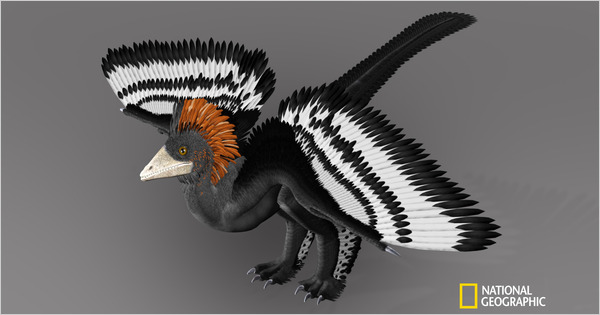
Scientists have figured out how to tell what color some dinosaurs were just by looking at their fossils.

Here’s how they did it:

Dr. Prum and his colleagues took advantage of the fact that feathers contain pigment-loaded sacs called melanosomes. In 2009, they demonstrated that melanosomes survived for millions of years in fossil bird feathers. The shape and arrangement of melanosomes help produce the color of feathers, so the scientists were able to get clues about the color of fossil feathers from their melanosomes alone.

Human ingenuity never ceases to amaze.