Category Archives: Regulation of the Day

Regulation of the Day 205: Singing the National Anthem

Francis Scott Key wrote the national anthem in 1814. He set his lyrics to an old English drinking song with an intentionally difficult melody. The range spans roughly an octave and a half, which is a challenge for any singer. Revelers in pubs would challenge each other to sing the melody without screwing it up; punishments for mistakes would often involve beer.

Even professional singers can’t always get through “The Star-Spangled Banner” unscathed, as Christina Aguilera found out at last year’s Super Bowl.

We’ll never know what Key would have thought of contemporary singers’ habit of improvising and embellishing his song with their own touches. But we do know that Indiana state Sen. Vaneta Baker, an Evansville Republican, is not a fan.

Sen. Baker introduced a bill that would require singers “to sign a contract agreeing to follow the guidelines and would set a possible $25 fine for violators.” It only affects performances at the state’s public schools and universities, as well as private schools that receive state funds. If her bill passes, it would not affect this year’s Super Bowl, which will be played in Indianapolis.

Singing out of key does not violate the terms of the contract. Not singing it “the way that we normally have it sung or heard throughout most of our state and our country” would. The bill would let schools set their own standards. But they will also be required to keep archives of every national anthem performance going back at least two years.

Given the amount of paperwork schools already have to deal with, this is just a bad idea. Surely Sen. Baker has better things to worry about in these troubled economic times.

Regulation of the Day 204: How to Buy Liquor

UPDATE: Welcome, Reason Hit & Run readers! More Regulations of the Day are here.

Self-checkout lanes have been popping up in grocery stores across the country over the last several years. Some people worry that without the adult supervision of a cashier, underage kids might be able to illegally buy alcohol at these self-checkout lanes. California state Rep. Fiona Ma even introduced a bill that took effect on January 1 that prohibits Californians of any age from using self-checkout lanes to purchase alcoholic beverages.

Has this been a huge problem in the past? Two independent studies have been done to find out. A 2009 UCLA study, cited by Rep. Ma to support her bill, found that underagers failed in 80.5 percent of their attempts. A separate study done by researchers at San Diego State, found that young hooligans had a 90.6 percent failure rate.

So yes, kids can buy booze at self-checkout lanes. But it’s probably less successful than other methods. As Joe Eskenazi put it in SF Weekly’s blog, “The best way to get alcohol remains to rely on a fake ID, theft, or someone’s skeezy 23-year-old cousin.”

Of course, there is another factor in play here, and likely Rep. Ma’s real motivation. That factor is rent-seeking. Many grocery cashier jobs are unionized. The more people use self-checkout lanes, the less they use the cashiers. Unions don’t appreciate the competition, so they work with lawmakers like Rep. Ma to legislate their preferences over consumers’.

According to Maplight.org, labor interests donated $150,450 to Rep. Ma’s campaign fund in 2009-10. They are by far her largest contributors.

This is an example of what economist Bruce Yandle calls a Baptist-and-bootlegger problem. Back in the old days, many Baptist preachers favored Prohibition because they believed drinking was morally wrong. Bootleggers favored Prohibition, too. Black market profits are far higher than in legal markets. So the bootleggers would manipulate the Baptists into favoring a bad policy by using the language of morality.

Fast-forward to today. Almost nobody wants increased underage drinking. And unions don’t want competition. So the bootleggers make up a story about how automated checkout lanes are causing runaway underage drinking. Social conservatives jump on board, wanting to strike a blow for morality. The bill gets passed, the Baptists feel good, and the bootleggers financially benefit. So do legislators.

Consumers, of course, are left out of this coalition.

Regulation of the Day 203: Sledding

If you live in a part of the country where the winters are cold and snowy, some of your most cherished childhood memories probably involve sledding down a snow-covered hill. But in Beaver Borough, Pennsylvania, regulators guard that activity very carefully.

For one, children under 12 are required to wear helmets while sledding. That’s not particularly onerous, though there is an argument to be made about parental discretion. Sledding is also banned in some parks, though it is allowed in others. The Borough recently circulated a newsletter to confused residents explaining what’s allowed where.

The real kicker is that out-of-town children are not allowed to go sledding in Beaver Borough, on pain of a $25 fine. If out-of-towners are in Beaver Borough to visit friends or relatives, they’ll need to find something else to do for a family outing.

The town did this on the advice of its insurance company. Jon Delano, a local journalist, contacted the insurer to ask how a sledder’s home address could possibly affect any liability concerns. Perhaps sensing that this makes no sense, the company would not talk to him.

Of course, police officers have better things to do than find out where sledders live. Hopefully they realize that as they drive past families taking turns going down the hills of Roosevelt Park.

Regulation of the Day 202: Farting Pigs

It isn’t often that one sees Nobel-winning economist Ronald Coase’s name and pig farts in the same sentence. Thanks to a recent court decision in Germany, this is one of those times.

There is a farmer in Osnabrück, Germany who owns 1,500 pigs. They might be clean creatures in the wild, but farm pigs can be smelly. This man’s pigs are especially malodorous, possibly because he feeds them raw onions. It got so bad for his downwind neighbors that they went to the city council.

Authorities ordered him to stop feeding onions to his pigs, and fined him €2,500. After his day in court, a judge sided with the farmer and against his neighbors, and rescinded the fine.

Enter Coase. He believed that disputing parties should be treated as equals. There doesn’t necessarily have to be one winner and one loser. They can both be made better off.

Coase also had the insight that the neighbors would be willing to pay some price for, ahem, improved air quality. And the farmer would be willing to pay some price to keep feeding onions to his pigs; maybe he believes that yields better-tasting ham or has some other benefit.

Knowing all that, the parties can reach a mutually agreeable solution by sitting down and bargaining with each other. What actually happened in this case was that the judge took the farmer’s side. There was a winner and a loser. If the farmer and his neighbors had been allowed to engage in Coaseian bargaining, both sides could have won.

If the neighbors paid the farmer not to use onions, the farmer would lose the benefits of onion-fed pigs, but would be compensated for that loss. So he wouldn’t be any worse off, and might even be better off, depending on the price. And the neighbors would be better off, too.

If the farmer paid his neighbors to endure the bad air, they’d still be holding their noses, but now they would do it willingly. And the farmer could still enjoy the economic benefits of his onion-fed pigs.

Either case would give a fairer outcome than the court decision.

Whichever option they decide on at the Coaseian bargaining table, both parties would walk away happy. That’s why, when it’s feasible – when transaction costs are low, in economics jargon  – Coaseian bargaining is superior to top-down regulations or judicial decisions. Finding the missing market and letting the parties make an exchange in it can make everyone better off. Why have a winner and a loser when there can be two winners?

In the meantime, I’m glad I don’t live in Osnabrück.

Regulation of the Day 201: Playground Chatter

Quebec officials are starting to listen in on what children are talking about on school playgrounds during recess. Are they trying to catch wind of terrorist plots? Stamp out juvenile drug use? Put a stop to bullying? None of the above, actually:

Diane De Courcy, the board’s chairwoman, said the approach will be persuasive, not punitive.

“There will be no language police,” she said. Instead, monitors who overhear children using their mother tongue during recess will simply remind them of the rules.

“If they are automatically switching to another language, (the monitor) will gently tap them on the shoulder – not on the head – to tell them, ‘Remember, we speak French. It’s good for you.’

Yes, speak French. It’s good for you.

A kindlier, more tolerant, and more realistic view is that people – even children – are perfectly capable of deciding for themselves which language they shall speak. Let them.

Regulation of the Day 200: Flying Food

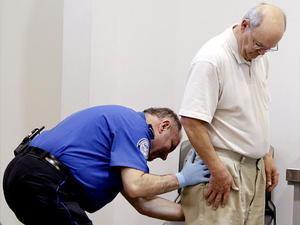
Millions of Americans are taking to the skies to spend time with their families over Thanksgiving. Many of them will be carrying leftovers on their return trips. Fortunately, the TSA is fully prepared to defend the airways against terrorist turkeys and rogue desserts. Here is a list of food and other holiday-themed items that run afoul of the TSA’s 3-1-1 rule:

Cranberry sauce, creamy dips and spreads (cheeses, peanut butter, etc.), gift baskets with food items (salsa, jams and salad dressings), gravy, jams, jellies, maple syrup, oils and vinegars, salad dressing, salsa, sauces, soups, wine, liquor and beer.

That means you’ll have to put them in checked baggage if you have a decent amount. They are far too dangerous to bring on the plane in a carry-on.

There are also specific guidelines for pies and cakes:

Note: You can bring pies and cakes through the security checkpoint, but please be advised that they are subject to additional screening.

I feel safer already.

Regulation of the Day 199: How to Catch a Tuna

Carlos Rafael owns over 40 fishing boats that work the waters off of New Bedford, Connecticut. One his boats recently caught an 881-pound bluefin tuna — one of the biggest catches ever made (the record is 1,496 pounds). Authorities quickly confiscated the fish.

Fishing is a heavily regulated industry, and Rafael took every precaution to make sure his giant catch was within the rules:

Rafael, who in the last four years purchased 15 tuna permits for his groundfish boats to cover just such an eventuality, imme­diately called a bluefin tuna hot line maintained by fishery regu­lators to report the catch.

When the weather offshore deteriorated, the Apollo decided to seek shelter in Provincetown Harbor on Nov. 12. Rafael imme­diately set off in a truck to meet the boat…

However, when Rafael rolled down the dock in Provincetown there was an unexpected and unwelcome development. The authorities were waiting.

So he had a permit, he let authorities know right away, let them know it was an accidental catch, and they still took it away. Why?

Because Rafael’s men caught it with a net. Bluefin tuna are only allowed to be caught with fishing rods.

A dejected Rafael told the Cape Cod Times, “We didn’t try to hide anything. We did everything by the book. Nobody ever told me we couldn’t catch it with a net.”

At this point, it appears that Rafael will not be charged with a crime. The government, however, will sell his fish and keep the money. Most people would call this stealing; the government calls it asset forfeiture.

Regulation of the Day 198: Talking about Water

In a ruling so dumb that only a panel of intellectuals could have written it, the EU has decided that companies may not claim that water cures dehydration. Dehydration occurs when there is not enough water in the body.

This decision was not reached lightly:

The ruling, announced after a conference of 21 EU-appointed scientists in Parma and which means that bottled water companies cannot claim their product stops people’s bodies drying out, was given final approval this week by European Commission President Jose Manuel Barroso.

Not everyone is on board, though:
UKIP MEP Paul Nuttall said: ‘I had to read this four or five times before I  believed it.

‘It is a perfect example of what Brussels does best. Spend three years, with 20 separate pieces of correspondence before summoning 21 professors to Parma, where they decide with great solemnity that drinking water cannot be sold as a  way to combat dehydration.’

He added: ‘Then they make this judgment law and make it clear that if  anybody dares sell water claiming that it is effective against dehydration they  could get into serious legal bother.

‘This makes the bendy banana law look positively sane.’

You heard him right. The EU regulates the curvature of bananas.

I’d write more about the water ruling’s free speech implications and how indicative it is of Brussels’ attitude towards commerce, but there’s really no need to. This regulation is its own reductio ad absurdum.

Regulation of the Day 197: Planking

Planking is an odd, odd trend. Plankers are people who pose for pictures by lying face down on the ground in unusual places, stiff as a plank of wood; hence the name. It isn’t clear how the fad started, but a quick Google image search for “planking” will give results of people planking everywhere from a swimming pool to a camel’s back to the spare tire on the back of an SUV.

Winston Castelo, a legislator in the Philippines, has had enough. That’s why he introduced the Anti-Planking Act of 2011. There is a transportation labor dispute happening in Manila right now, and there have been some strikes. Some groups of protesters have taken to planking in the middle of the street, tying up traffic. Hence the anti-planking bill.

The protesters shouldn’t be doing that, obviously. Not only is it rude, it’s probably illegal. Offenses like jaywalking and disturbing the peace are already on the books.

People all over the world have been poking fun at Congressman Castelo’s odd sense of priorities. Good for them, I say. Threats to freedoms even as trivial as planking should not be taken lying down.

Regulation of the Day 196: Babysitting

California legislators are set to pass a bill that would reduce the number of babysitters. Not on purpose, of course. But when you make babysitters more expensive, parents won’t hire as many of them. California Sen. Doug LaMalfa lists some of the bill’s requirements:

Under AB 889, household “employers” (aka “parents”) who hire a babysitter on a Friday night will be legally obligated to pay at least minimum wage to any sitter over the age of 18 (unless it is a family member), provide a substitute caregiver every two hours to cover rest and meal breaks, in addition to workers’ compensation coverage, overtime pay, and a meticulously calculated timecard/paycheck.

The intentions behind this bill are noble, one assumes. But when it comes to regulations, good intentions don’t matter. Results do. And it’s pretty easy to see that if it passes, this bill will result in a lot of unhappy nights at home for frustrated parents – and a lot less income for sitters who have been priced out of a job.

You can read the full text of the bill here (PDF). It would also raise unemployment for maids, nannies, and anyone else who makes a living helping others around the house.