Category Archives: Publications

Congress Should Create a Repeal Committee

There are a lot of old, musty, unused, and obsolete laws on the books. Congress should repeal them as part of its basic hygiene, but members have little incentive to do so. A standing repeal committee could help. David Deerson and I look at how such a committee might work in a piece over at RealClearPolicy:

The job would be a big one. All in all, the Code of Federal Regulations (CFR) rambles on for 169,000 pages, many of which could be dispensed with and replaced with nothing. For example, one of the 50 titles in the CFR is dedicated entirely to the Panama Canal, which hasn’t been under United States jurisdiction since 1999. Elsewhere, an entire chapter consists of guidelines for dealing with the Y2K computer crisis that didn’t happen 12 years ago…

As old Washington hand Joseph Gibson points out in his book, A Better Congress, a repeal committee would almost certainly face strong opposition from members of other committees, who would see it as a threat to their own prerogatives. To soften this opposition, he suggests involving the committee with jurisdiction over the statute to be repealed through a secondary referral—subject to time limit to ensure that the committee cannot sit on a proposed repeal indefinitely.

Read the whole thing here.

FDA Rules Won’t Work, Will Harm Small Farmers

The FDA recently decided to delay implementing about $1.4 billion of food safety regulations until after the November election. The ​USA Today​ editorial board argues in today’s paper that the FDA should stop dragging its feet and enact them now. They were kind enough to give Greg Conko and me some space to put forth an opposing view. We think the FDA should scrap the rules entirely for two reasons: ineffectiveness and rent-seeking:

These rules, being drafted to implement last year’s food-safety law, will waste billions of dollars on antiquated practices unlikely to do much good. They will, however, aid giant food corporations by hobbling smaller competitors and make it harder for companies of all sizes to adopt innovative safety methods and technologies.

Enacted in response to 2010’s massive egg recall, the law will spend nearly $1 billion to double the number of inspections on farms and in food processing facilities. That may sound appealing, but it only means that most facilities will be inspected every five years instead of every 10. Designated “high-risk” facilities would be inspected just once every three years.

Read the whole thing here.

Regulation and the Setting Sun

Agencies are well-equipped for passing regulations, but not for repealing them. This becomes a problem as the years march on, and dusty old rules that don’t apply in today’s world retain the force of law. Over at RealClearPolicy, David Deerson and I propose an easy fix: automatic sunsets for all new regulations. Here’s how it would work:

Just as every carton of milk has an expiration date, sunset provisions automatically end agencies, programs, and regulations after a fixed period of time, unless specifically reauthorized by Congress. We already know the idea works. Several states already have sunset laws in place. They typically establish a sunset committee or commission, which reviews programs and agencies whose time is almost up and makes recommendations to the legislature. The National Conference of State Legislatures estimates that Texas saves $42 for every dollar it spends on sunset reviews.

Read the whole thing here.

The Case for a Repeal Amendment

Nobel-winning economist James Buchanan distinguishes between two kinds of analysis: pre-constitutional and post-constitutional. Pre-constitutional analysis focuses on the rules of the game; post-constitutional analysis focuses on how people behave under those rules once they’re in place. The current rules of America’s political game result in 3,500-plus new regulations every year, trillion-dollar deficits, and other major problems.

The solution isn’t to put different people in charge. The status quo’s incentive structures guarantee that the results will stay about the same, no matter who is in power. Instead, real reform can only happen at the institutional level. Change the rules of the political game in a way that gives politicians an incentive to keep their worst impulses in check. If you want different results, you need different rules.

Over at Real Clear Policy, my colleague David Deerson and do a bit of pre-constitutional analysis on one rule change that could do a lot of good:

[A]dd a repeal amendment to the U.S. Constitution, one that would allow two-thirds of state legislatures to repeal any federal law or regulation they see fit. A repeal amendment would enhance federalism and make democracy more meaningful to citizens by bringing it closer to them.

When most people think of the government’s separation of powers, they think of the three branches of the federal government—executive, judiciary, and legislative. In a federalist system such as ours, the separation of powers between the federal government itself and the states is just as important.

Read the whole thing here.

Quick Thoughts on the Health Care Ruling

The Supreme Court upheld the health care bill, as you’ve no doubt heard by now. Over at the Daily Caller, I add a few quick thoughts about how Randy Barnett’s Commerce Clause argument also applies to Congress’ taxation power, on the Court’s reluctance to check the other branches’ excesses, and how happy rent-seeking insurance companies must be right now.

Read the whole thing here.

Ten Thousand Commandments and Growing

Over at The Washington Times, Wayne Crews and I praise President Obama’s recent regulatory reforms. They’re small, but they’re better than nothing:

The estimated savings total up to about $10 billion over five years. Cass Sunstein, who heads Mr. Obama’s Office of Information and Regulatory Affairs at the Office of Management and Budget, sees this as a significant achievement. Of course, federal regulations cost more than 500 times that much – more than a trillion dollars annually – so this is a curious use of the word “significant.”

We also lay out some potential next steps:

  • Implement a bipartisan, annual Regulatory Reduction Commission to vote up or down on a package of rules to eliminate in one sweep.
  • Institute a freeze on federal rule-making in order to rediscover federalism. Many health and safety matters are best left to states.
  • Hold hearings on Sen. Mark R. Warner’s “one-in, one-out” requirement for any new rule, which, for some reason, he isn’t talking about much lately but should be.
  • Increase exemptions for small businesses, which can least afford regulatory costs.

Read the whole thing here. More reform ideas are in the new 2012 edition of Wayne’s “Ten Thousand Commandments” study.

No to Broccoli Mandate, Yes to Health Insurance Mandate?


I was looking over the latest Reason-Rupe poll and found something strange: 87 percent of people think a federal broccoli mandate would be unconstitutional, while 62 percent think a health insurance mandate would be unconstitutional. That’s a 25 percent difference even though the basic principle is exactly the same. These two mandates were compared during this week’s Supreme Court oral arguments on the health care bill.

Over at the Daily Caller, I go over some possible explanations for the different results and conclude:

Public opinion has precisely nothing to do with whether a policy is a good idea or not; anyone who thinks otherwise would do well to read Shirley Jackson’s short story “The Lottery.” But since I think that government should not have the power to mandate that people buy certain products — think of the lobbying and rent-seeking by companies that stand to benefit! — it is heartening that the majority of Americans think the same way as I do about broccoli. And, to a lesser extent, health insurance.

More importantly, we’ll soon find out how the Supreme Court polls on the broccoli mandate issue. Er, health insurance mandate. Same principle.

Read the whole thing here.

Back to Work


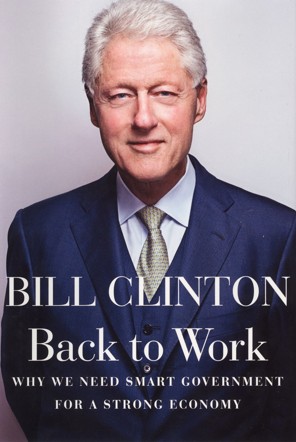
Over at RealClearPolicy, I review Bill Clinton’s latest book, Back to Work.

One of the book’s main themes is contrasting the philosophies of “you’re on your own” and “we’re all in this together.” This is, of course, a false dichotomy.

This immediately made me think back to that bible of “you’re on your own” free-market thought, Adam Smith’s The Wealth of Nations. It spends over 1,000 pages proving that if man were on his own, he would starve. People need to cooperate and exchange to prosper. Free trade, division of labor, and other Smithian concepts are inherently “we’re all in this together.” People can only achieve great things by working together. I have yet to see anyone actually argue “you’re on your own,” ever.

The review is mostly about the book’s philosophy and rhetoric. I have further thoughts about its suggested economic policies, which I will post about soon.

My Job Creation Proposal

Over at The American Spectator, I break down the debate over regulation’s impact on the job market and propose one regulation that could create countless jobs:

As everyone knows, winter is coming. And many of the nation’s least-employed states will see a lot of snow this year. Already, giant snowplows are beginning to traverse the highways and byways of Michigan, Ohio, and other states going through hard times. With these plows, one man can do the work of a hundred.

I say we ban snowplows and hand out some shovels.

Think about it for a minute. In Michigan alone, nearly 520,000 people are looking for a job and can’t find one. Tens of thousands of miles of roads zig and zag across the state. If this winter lives up to lofty Midwestern standards, it’s possible that every last one of those 520,000 could work at least part time clearing the way for their fellow citizens. And all because of regulation!

I do enjoy economic humor. Read the whole thing here.

Yes, Regulation Does Keep Unemployment High

Over at RealClearMarkets, my colleague Wayne Crews and I argue that the law of demand holds. Hard to believe that’s actually controversial, but that’s Washington for you. Here’s our conclusion:

Eberly was put in an uncomfortable position when she came to Washington. Just as a lawyer’s job is to vigorously defend clients even if she knows they are guilty, Eberly’s job is to vigorously defend policies that are obviously harmful to the economy. Try as she might, she cannot argue against the law of demand.

Regulations make hiring costlier and thus make jobs scarcer. And regulatory uncertainty makes companies reluctant to hire employees they might not be able to afford down the road. Case closed.

Read the whole thing.