
Ryan Young
Senior fellow at the Competitive Enterprise Institute. All opinions here are my own, and not necessarily CEI’s.
Questions? Comments? Send me an email.
Follow me on Twitter – @RegoftheDay
-
Join 218 other subscribers
Twitter Feed
Tweets by RegoftheDayArchives
Categories
- #NeverNeeded (48)
- Books (531)
- CEI Podcast (197)
- Correspondence (36)
- Economics (1,261)
- Antitrust (117)
- Bailouts (21)
- Business Cycles (42)
- Competition (35)
- Development Economics (13)
- Minimum Wage (37)
- Monetary Theory (50)
- Price and Wage Controls (22)
- Price Gouging (2)
- Public Choice (135)
- Spending (128)
- Stimulus (59)
- Taxation (72)
- The Market Process (40)
- Trade (271)
- education (19)
- Everybody Panic (14)
- Executive Power (12)
- Export-Import Bank (52)
- Financial Regulation (4)
- Free Speech (40)
- Fun with Statistics (10)
- General Foolishness (153)
- Great Thinkers (117)
- Health Care (43)
- History (183)
- Housekeeping (40)
- Immigration (51)
- Inequality (14)
- inflation (6)
- Innovation (44)
- institutions (3)
- International (155)
- labor (26)
- Law (89)
- Literature (58)
- Media (43)
- Media Appearances (174)
- modernity (6)
- Nanny State (118)
- nationalism (5)
- Philosophy (173)
- Argumentation (26)
- Certainty (20)
- Pith (48)
- Political Animals (358)
- Predicting the Future (9)
- prohibition (9)
- Psychology (5)
- Publications (165)
- Reform (25)
- regulation (858)
- Regulation of the Day (235)
- Science (94)
- Security Theater (93)
- Sports (150)
- Technology (89)
- The Arts (26)
- Music (15)
- The New Religion (108)
- Mankind's Doom (24)
- The Old Religion (14)
- The Partisan Mind (64)
- Transparency (2)
- Uncategorized (568)
Blogroll
Al's Ramblings (Brewers Blog)
Radley Balko (The Agitator)
Caleb Brown
Cafe Hayek
Cato Institute Blog
Coordination Problem (Peter Boettke, Pete Leeson, Steve Horwitz, et al)
William Easterly
EconLog (Bryan Caplan, David Henderson, Arnold Kling)
Jacob Grier
Gene Healy
Steven Landsburg
Jeremy Lott
Megan McArdle
Chris Moody
Carl Oberg
Open Market (CEI)
Tom Palmer
Reason Hit & Run
Jason Vines
Category Archives: Political Animals
Slow News Day
Comments Off on Slow News Day
Posted in Elections, General Foolishness, Political Animals
Vote for Me
Politico: Vitter in new ad: ‘I failed my family’
Comments Off on Vote for Me
Posted in Elections, General Foolishness, Political Animals
Slow News Day
The Washington Post: How tall is Jeb Bush?
Comments Off on Slow News Day
Posted in Elections, General Foolishness, Political Animals
Deceptive Headlines
Comments Off on Deceptive Headlines
Posted in General Foolishness, Political Animals
Revealing Quotes
From a Politico story on the U.S. Chamber of Commerce possibly gearing up to oppose politicians with certain pro-market stances in future primary elections:
Chamber spokeswoman Blair Holmes said the group supports “pro-business candidates in every election, regardless of whether they are a Republican, Democrat, incumbent or challenger.”
The distinction between pro-business and pro-market is important; for one example, see here. Never confuse the two.
And as Holmes correctly points out, the divide does not respect party lines. Both parties have largely pro-business leadership. It’s some of their upstart underlings, and much of the public, who are pro-market. Hence the Chamber’s primary threats.
Comments Off on Revealing Quotes
Posted in Elections, Export-Import Bank, Political Animals, Trade
17th Century Fart Jokes
A commentary on the rule of law from p. 95 of Nicholas Vincent’s Magna Carta: A Very Short Introduction:
Oliver Cromwell, chief architect of the most violent of the 17th-century revolutions, informed as Lord Protector that he was acting contrary to Magna Carta, is said to have replied that ‘their Magna Farta should not control [Cromwell’s] actions’.
The author also did an excellent podcast with Russ Roberts on EconTalk, which you can listen to here.
Comments Off on 17th Century Fart Jokes
Posted in Books, History, Law, Political Animals
Is John Boehner’s Lawsuit The Best Way To Rein In The Executive Branch?
House Speaker John Boehner plans to sue President Obama over perceived abuses of the separation of powers. Over at the Daily Caller, I argue that Boehner has a point that the executive branch has grown too powerful. But the problem can’t be solved by a mere court case:
But suppose the lawsuit succeeds. It still wouldn’t solve the fundamental problem driving the growth of executive power. As Cato Institute presidential scholar Gene Healy put it, “If the Obama presidency has driven Americans mad, perhaps that’s because we’ve embraced a demented notion of the presidency itself,” one Healy describes as some mixture of Superman, Santa Claus, and Dr. Phil. When it comes to the presidency, we have met the enemy, and it is us.
When George W. Bush promised, without irony, to “rid the world of evil,” people believed him. With his post-9/11 approval ratings reaching the upper 80-percent range, Congress granted Bush expanded powers through the USA PATRIOT Act and other measures. The result was not the end of evil; it was the TSA, warrantless NSA surveillance, and host of other civil liberties abuses.
President Obama has not improved the situation; read the whole thing here. Also check out Gene Healy’s excellent 2008 book Cult of the Presidency, and its short e-book sequel, False Idol, both of which I could not recommend more highly.
Comments Off on Is John Boehner’s Lawsuit The Best Way To Rein In The Executive Branch?
Posted in Political Animals, Publications
Incumbents in Trouble?
According to a new poll, only 22 percent of respondents intend to vote for their current representative. Nearly 70 percent intend to vote for a challenger.
While this blogger finds the sentiment encouraging, it is likely just bluster. Incumbents will almost certainly continue their usual 90 percent-plus re-election rate. In most cycles, more members retire than are defeated by challengers. The number of retirements is currently in the low 20s, and there will likely be a few more. If the number of incumbent defeats is higher than that, all the better, though it is unlikely.
Comments Off on Incumbents in Trouble?
Posted in Elections, Political Animals
CEI Podcast for January 30, 2014: State of the Union
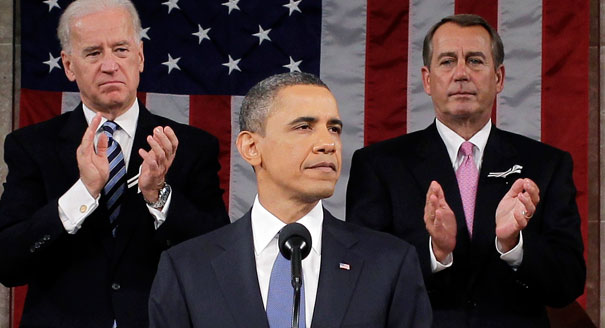
Vice President for Strategy Iain Murray analyzes the President’s 2014 State of the Union speech.
Comments Off on CEI Podcast for January 30, 2014: State of the Union
Posted in CEI Podcast, Political Animals
State of the Union: Economic Band-Aids for Poverty and Unemployment
One of progressivism’s most admirable traits is its concern for the little guy. But many progressive policies for alleviating poverty, unemployment, and other social problems don’t work as advertised. This is because those policies often focus only on the desired outcome, and ignore the deeper processes that ultimately generate those outcomes. This misplaced focus was on full display in President Obama’s State of the Union speech.
This is a subtle point that would benefit from an analogy. Suppose, while slicing vegetables, that you accidentally cut your finger. The sensible thing to do is put on a band-aid. But in the long run, you are far better off knowing and practicing proper knife safety. The band-aid eases the immediate problem. But if you focus on the long-term process of safety, you are far less likely to get hurt in the first place.
Now apply this thinking to the President’s call for passing the $10.10 federal minimum wage bill currently winding its way through Congress. A lot of people aren’t making very much money. The obvious thing to do is legislate a raise for them. Pass it! Some people will clearly benefit; no doubt many of them will appear at press conferences if the increase is enacted. But there is a tradeoff. Those raises are offset by reduced hours and even firings for other people.
There is also an unseen cost to the minimum wage: workers who are never hired in the first place. These minimum wage casualties cannot be trotted out in front of cameras because we don’t know who they are. But we do know that they exist. They are mostly young, and they are disproportionately minorities. These workers lack experience and skills because they haven’t lived long enough to gain them yet. It may not be worth it to pay an employee at that skill and experience level $10.10 per hour.
Pricing people out of employment prevents them from getting the experience they need to get higher-paying jobs later in life. It makes the old paradox even more painful: without experience, you can’t get the job, but without the job, you can’t get experience.
The chase after an end result—higher wages for low-skilled workers—ignores the larger social processes at work in the economy. In the long run, wages are tied to productivity. The more a worker produces, the more his services are worth to his employer. Instead of mandating higher wages, a process-oriented reformer emphasizes policies that allow workers to be more productive.
A deregulatory stimulus along the lines of what Wayne Crews and I have been proposing for some time would do nicely; workers would spend less time complying with rules and more time being productive, and thus better paid. It would also remove obstacles to innovation and technological advance that are the long-run drivers of increasing productivity and wealth creation. When that process is blocked, wages stagnate.
Unfortunately, the topic of regulation did not come up even once during the entire speech. Hopefully this does not reflect the administration’s priorities.
The same outcome-over-process oversight is in the President’s proposal to extend–restore, in his words–unemployment benefits. If someone loses their job, the obvious thing to do is to give them a helping hand while they look for a new job. But again, unemployment insurance has tradeoffs that at least offset the advantages.
People respond to incentives. And unemployment benefits reduce one’s incentive to look for a job. They allow some people to wallow in discouragement longer than they otherwise would. Other people decide that receiving benefits can let them wait until a higher-paying job opens up, instead of having to take an available, if unappealing job right away. The result is unnaturally high unemployment. This is not the policy’s intention, but it is very much its result.
More effective policies would make the hiring process easier. Reducing compliance burdens would reduce the regulatory friction scraping against otherwise-promising new hires.
As companies grow, more and more rules affect them. When a company reaches 4 employees, it becomes subject to the Immigration Reform Act and its associated paperwork. At 15 employees, the Americans with Disabilities Act comes into play, and the Family and Medical Leave Act announces its presence at 50 employees. There are many others.
Many companies stop hiring when they come up against these thresholds, because they can’t afford them. Reducing these burdens would do far more to ease the sting of unemployment than extending unemployment benefits.
As in past years, the President used Tuesday’s State of the Union speech to describe the equivalent of band-aids for injury-prone cooks. But he seems unaware that the long-run process of practicing kitchen safety is what it takes to ultimately reduce the amount of culinary casualties. As in the kitchen, so in the economy.
Comments Off on State of the Union: Economic Band-Aids for Poverty and Unemployment
Posted in Economics, Political Animals, The Market Process

 Inertia Wins!