Category Archives: Political Animals

Anthony de Jasay – The State

Anthony de Jasay – The State

This book consists of five chapters. The first imagines what society would look like without any state at all; the last imagines a total state. The chapters in between look at in-between states. De Jasay shares deep insights in social contract theory. For example, states compete with each other in a Hobbesian state of nature, even if individuals no longer do.

Jasay is also skeptical of utilitarianism as a guide to public policy. Because interpersonal utility comparisons are impossible, it is impossible to honestly tell other people what is best for them. This is a major impediment to well-intentioned arguments for state intervention.

Thomas Hobbes – Leviathan

Thomas Hobbes – Leviathan

One of the earliest and best expositions of social contract theory. Hobbes also had a more accurate view of human nature than Locke or especially Rousseau, with whom he is often contrasted. The third and fourth parts of Leviathan are bogged down by theology and needless definitions of terms, and Hobbes’ royal absolutism is based more on arguments by assertion and authority than on reason or empiricism. Still, Leviathan has earned its place in political philosophy’s canon.

Don’t Trust Political Memes, and Don’t Share Them

Think of this post as a public service message.

In some ways, memes are the 21st century version of the comic strip or the political cartoon. They can be quite funny, and they make their point in just a second or two. Memes have been a boon for comic-strip-style humor. Someone needs to fill the void left by Calvin and Hobbes and The Far Side, and a lot of people have ably volunteered. Anyone with a joke and basic computer skills can make a funny meme, and millions of people can share the fun. National distributors no longer serve as gatekeepers and censors, allowing some unique talents to shine that would have remained dark just a decade or two ago. This has been a wonderful development.

But for many reasons, political memes are typically riddled with factual errors and offer little more than confirmation bias. They should be shunned, not shared.

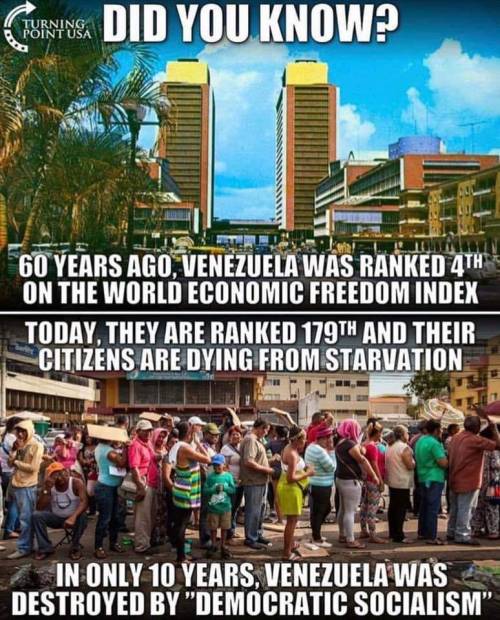
Here is a quick statistics lesson from one political meme I saw making the rounds recently. That’s not to pick on this meme specifically. There are millions like it, just as bad, floating around the Internet. This is just one I happened to see, though I should note that Turning Point USA has a poor reputation, even by its genre’s low standards.

Also keep in mind that this meme is on the correct side of its issue. Imagine how wrong the wrong ones can be! As Frederic Bastiat wrote, “The worst thing that can happen to a good cause is, not to be skillfully attacked, but to be ineptly defended.”

Here is the meme:

turning point meme

Here is a list of things it gets wrong.

1: This meme is undated and cites no sources.

2: There is no publication titled “World Economic Freedom Index.”

3: For indexes that do exist, their data do not go back 60 years. They go back to 1970 for the Fraser/Cato index, and 1995 for the Heritage/WSJ index.

4: Venezuela does rank 179th in the 2018 Heritage/WSJ index. But it gives no rankings from roughly 60 years ago. If the 4th place figure comes from a different index, that is not a valid apples-to-apples comparison. But we don’t know where that figure comes from. None is cited. Google doesn’t turn one up, either. For all we know, some intern could have just made it up, and now people are sharing it.

5: Hugo Chavez was first elected in 1998. His brand of socialism was 14 years old when Turning Point USA was founded in 2012, not 10 years before this undated meme was created.

That’s five errors in one meme that took less than ten minutes to dig up. That says more about Turning Point USA and political memes in general than it does about Venezuela’s ongoing tragedy.

Don’t trust unsourced political memes, don’t share them, and take people who heavily rely on them as seriously as they deserve–even, or especially, if they share your ideological priors.

Edmund Burke – Reflections on the Revolution in France

Edmund Burke – Reflections on the Revolution in France

I read this as part of an attempt to understand populism. Burke, an 18thcentury Englishman, favored the American Revolution, but opposed the French Revolution. This seems strange at first glance. But it actually makes quite a bit of sense.

Burke saw the American Revolution as a restoration of traditional British values, such as the rule of law. The French Revolution consciously rejected tradition and tried to create a brand new man from scratch. The result was the rule of the mob, not the rule of law, and the Terror.

The parallels to today’s rise of populism on the left and especially the right during the last few years make Burke quite relevant; suffice it to say that despite, or perhaps because of his conservatism, he would not be a Trump supporter.

Burke overemphasizes tradition in my opinion, and takes a few ugly stances in the book common to his time, especially regarding Jews. But he is a perceptive analyst, and his arguments are as powerful against today’s populist threats as they were against the ones in Burke’s time.

Best Books of 2018: Suicide of the West & Enlightenment Now

Re-posted from cei.org.

Review of Suicide of the West: How the Rebirth of Tribalism, Populism, Nationalism, and Identity Politics Is Destroying American Democracy (Crown Forum, 2018) by Jonah Goldberg and Enlightenment Now: The Case for Reason, Science, Humanism, and Progress (Viking, 2018) by Steven Pinker.

Goldberg’s “Suicide of the West” is a literate, snappily written, and often humorous defense of Enlightenment values and a broadside against populism. Steven Pinker’s “Enlightenment Now” has a similar theme, backed by an astounding collection of empirical data.

The cooperative social norms that make mass prosperity possible are completely unnatural, Goldberg argues. They are also the best thing that ever happened to humanity, as both argue. The current populist trend is a primal yawp from our baser instincts. It is also the biggest danger the Miracle faces, as Goldberg terms the post-1800 wealth explosion. The average person has gone from three dollars a day to more than 100 dollars a day, at least in countries that more or less adopted Enlightenment values and institutions.

If you doubt the degree of human betterment that has happened over the last two centuries, and how tightly intertwined they are with liberal values and institutions (liberal in the correct, classical sense), even a cursory skim of the first 345 pages of Pinker will show you in great detail. It really is a Miracle, and the most important development in human history since the invention of fire.

Readers who focus on the authors’ criticisms of President Trump are missing the bigger picture. The populist mindset, or rather emotion-set, and not this or that politician, is the biggest threat facing the modern Miracle. President Trump and his analogues in Italy, Mexico, Venezuela, Brazil, and elsewhere are temporary. But the gut-level impulses that make them electable are part of human nature. That is the concern here, not a president who will evanesce from the political scene after a term or two.

Populism is not a left or right phenomenon. It is an anti-Enlightenment worldview based on the immediate, the concrete, and the emotional. A lot of people feel that living standards are declining, and that people aren’t getting a fair shake. The data say otherwise, but a lot of people just feel that way, and form their beliefs accordingly. As Goldberg puts it:

Populist movements do tend to be coalitions of losers. I do not mean that in a perjorative sense but an analytical one. Populist movements almost by definition don’t spring up among people who think everything is going great and they’re getting a fair shake. (p.367)

For many people, their reptile brains override the more analytical parts. If you want to see populist emoting in action, a typical political argument on Twitter, Facebook, or cable news will do. Confirmation bias is rampant, contrary evidence is dismissed, language gets strident, and sometimes things get personal. The flames are as hot as they are shallow, whether they blow from the left or the right. But people still get sucked right in. We’re wired to behave that way.

Populism is having a moment right now, just as it did during the Progressive Era in the early twentieth century, and in the German romanticist movement in the century before that (though that movement was redeemed by some beautiful art and literature). Populism will have more moments in the future. The question is if its latest yawp is merely a blip, or a longer-run rejection of the ideas that make progress and modernity possible.

Like populism, Enlightenment thought works outside of a left-right framework. But unlike populism, it operates on a longer, more cool-headed time horizon. This type of liberalism—again, in the correct sense of the word—is more concerned with abstract cultural values and long-term institutional structures. Having the right long-term process matters more than immediately getting the right immediate results.

Pinker and Goldberg both argue that this patient, abstract approach also explains classical liberalism’s limited appeal. Even when our heads often know better, our hearts are still in hunter-gatherer mode.

It is hard to write news stories about the long-term trends the Enlightenment approach emphasizes. A struggling hometown business with a dozen employees is more emotionally compelling than the fact that worldwide, 137,000 people climbed out of absolute poverty today. One of these stories is rather more important than the other. But it doesn’t fire up people’s reptile brains, so it flies under the radar. Pinker illustrates this phenomenon with graph after graph on a relentless array of policy issues, and Goldberg shows how this affects the quality of both political debate and the politicians in that debate.

Goldberg and Pinker are not alone. Matt Ridley’s The Rational Optimist and Michael Shermer’s The Moral Arc are other quality entries in the genre. Both authors, especially Goldberg, acknowledge the influence of CEI Julian Simon Award winner Deirdre N. McCloskey and her Bourgeois trilogy.

Readers interested in primary sources will find some of the best Enlightenment thought in Adam SmithDavid HumeThomas JeffersonF.A. Hayek, and James Buchanan. Populists, knowingly or not, draw from sources ranging from Jean-Jacques RousseauGoethe, and Nietzsche up to twentieth century progressives such as Louis Brandeis and Ralph Nader, as well as right-wing populists such as Pat Buchanan and Steve Bannon. Pinker argues that President Trump’s world view is, probably unknowingly, eerily similarly to Nietzsche and Rousseau. Understanding them imparts a better understanding of what makes the current administration tick.

If you don’t have the time to read both books, Reason’s Nick Gillespie had an enlightening conversation with Goldberg in June, and Pinker gave a lecture at the Cato Institute in March. There is some overlap between the two books, but they are far from redundant. The authors’ different personalities and different emphases make for two different, complementary, and important works.

Aristotle – The Politics

Aristotle – The Politics

Another fundamental work in its discipline. Despite never having read it until now, it still felt like review. This may be because it has influenced every major work since. Aristotle goes through the positives and negatives of the three major forms of government: monarchy, aristocracy, and democracy.

Drawing from The Nicomachean Ethics and its emphasis on moderation, Aristotle prefers the mean version of each type of government to its extreme versions. Ever the taxonomist, Aristotle spends a good chunk of the book discussing weak, medium, and strong variants of all three forms of government.

Aristotle also takes a stab at constructing his ideal state, though not to the same level of detail as his teacher Plato did in The Republic. In line with the times, Aristotle has only a grudging acceptance of trade and commerce, arguing for ports to be built at a distance from the polis to keep moral degradation away, and to trade only for things the polis cannot produce for itself.

Aristotle – The Nicomachean Ethics

Aristotle – The Nicomachean Ethics

Aristotle’s major work on ethics. It was named for either Aristotle’s son or father, who were both named Nicomachus. Basically lecture notes from his classes, this later work supersedes the earlier Eudemian Ethics. The major theme here is the golden mean. Courage lies between cowardice and rashness; liberality lies between being a cheapskate and a spendthrift; moderation in all things.

Aristotle’s views on slavery, women, and a few other topics show this work’s age. But the overall impression is one of human decency, if with a somewhat stiff and formal demeanor. Closely connected with The Politics, which was written later, The Nicomachean Ethics focuses mostly on the individual and those close to him. The Politics applies similar thinking outward to larger social and political life. Unlike many modern political combatants, Aristotle thought ethics and politics to be related.

What Do the Midterms Mean for Trade?

Trade was a highly contentious issue during President Trump’s first two years. He has doubled tariffs, other countries have enacted equivalent retaliatory tariffs, and tensions are unlikely to ease anytime soon. This unease will not change under a newly divided Congress. The midterm elections will have significant implications for trade policy in the short, medium, and long runs.

The biggest short-term question will be what happens to the renegotiated NAFTA, called the United States-Mexico-Canada (USMC) Agreement. Congress is currently in the middle of a 90-day window to vote on the revised agreement, but Republicans are lukewarm on it. Many Republicans share economists’ skepticism of President Trump’s trade protectionism. At the same time, they are reluctant to buck a Republican president—some Republicans have even gone one further and reversed their stances on trade and other issues in deference to the president. Lame duck Republicans will likely punt to the next Congress in an attempt to avoid cognitive dissonance.

That’s where the new Democratic House majority comes in. The new NAFTA/USMCA changes very little in terms of actual trade policy. But it has significant symbolic value as a political victory for President Trump. Democrats would love to deny Trump this victory. But they will also be reluctant to cause further tensions with Canada and Mexico’s governments, staunch allies which endured many slights during the negotiating process, both domestically and from President Trump. They would like to have something to show for their indignities, even if it’s just getting President Trump out of their hair for a bit. This could push foreign policy-minded Democrats in favor of passing NAFTA/USMCA. At this point, it is hard to predict which impulse is stronger.

This is also partially because Democrats are just as divided as Republicans on trade issues. Traditional Democrats often favor a more-or-less open approach to trade, not terribly different from the average pre-Trump Republican. The original NAFTA and the creation of the World Trade Organization happened under Bill Clinton, and President Obama signed about half a dozen trade agreements that liberalized trade on net. Going further back, President Kennedy signed a major trade bill in 1962 that led to a successful round of international negotiations bearing his name that sharply reduced tariffs around the world. Franklin D. Roosevelt’s Secretary of State, Cordell Hull, presciently argued that if goods do not cross borders, soldiers will.

Democrats have slowly become more protectionist in recent years, with Sen. Charles Schumer (D-NY) even arguing for a 27.5 blanket tariff against Chinese goods in the mid-2000s. This makes him roughly 2.5 percentage points different from President Trump, which sounds about right. But Trump’s vocal advocacy of government-managed trade has pushed many Democrats somewhat back towards the free trade side.

At the same time, the party’s labor and environmental wings tend to oppose free trade. Labor interests often see protectionism as a rent-seeking opportunity to kneecap competitors. Many environmental activists reflexively oppose policies that create wealth and development. The party’s ideological left flank also tends towards protectionism; Sen. Bernie Sanders (I-VT) is uncomfortably similar to President Trump on trade.

In the medium term, between now and the 2020 election, President Trump hopes to pursue trade agreements with the United Kingdom, European Union, and Japan. As with NAFTA/USMCA, House Democrats will be eager to deny President Trump a political victory. The question is whether Democrats can overcome their own protectionist elements enough to be an effective opposition party.

The biggest long-term policy that could come out of the new congressional alignment is similar to the biggest possible upside to regulatory reform: a renewed separation of powers. Under the Constitution, only Congress has the power to tax. But Congress delegated away much of its tariff-setting authority to the president during the 1960s and 1970s. That is how President Trump was able to enact so many tariffs without congressional input. Democrats should rein in a too-powerful executive branch and reclaim Congress’ intended constitutional taxing authority.

Trade will be a busy issue for at least the next two years. Unlike their Republican colleagues, the new Democratic House majority can be an effective check against President Trump’s government-managed trade policies. But they have to keep their own populist impulses in check in order to do so effectively. Perhaps Iain Murray’s and my “Traders of the Lost Ark” can serve as a guide, as well as excellent primers by Don Boudreaux and Pierre Lemieux.

What Do the Midterms Mean for Regulatory Reform?

A divided Congress probably means the status quo will reign on regulation. This is a mixed bag from a free-market perspective. President Trump made some positive reforms upon taking office, but they were via executive order, and can be easily overturned by a future president—Congress needs to pass legislation to give reforms any staying power. Barring a lame duck miracle, that won’t happen now. Republicans blew a rare opportunity.

President Trump’s executive order reforms include a one-in-two-out rule for new regulations, and a requirement for agencies to add zero net regulatory costs—a de facto regulatory budget, which the Competitive Enterprise Institute has been advocating for more than 20 years. Agencies are not exactly transparent with their data. But based on what we do know, it’s possible that total regulatory burdens have not only stopped growing, but might have even gone down by as much as 1 percent over the last two years.

The main reform priority is the rulemaking process itself. It’s nice to get rid of this or that unfair, obsolete, or burdensome rule, but those are just symptoms. The root problem is the process that allows such regulations through in the first place. Better results require better rules. This cannot be overemphasized.

Congressional Democrats mostly oppose process-level regulatory reforms. Legislation to make recent reforms permanent, or enact further reforms, are unlikely to pass on their watch. But there is one long-running trend that should bring at least some Democrats over to reformers’ side: separation of powers.

Over the last several decades, Congress has slowly but steadily delegated away more and more of its legislative powers to executive branch agencies. Congress will usually pass a little more than 100 bills in a given year; agencies will issue more than 3,000 regulations. Considering who currently runs the executive branch, congressional Democrats are more open than usual to pleas for a more healthy separation of powers, and increased executive branch transparency. This is only a possibility, but well worth pursuing.

At a more concrete level, House Democrats will be unable to legislatively undo President Trump’s executive orders; the GOP Senate won’t allow it. At the same time, if the Senate passed reform legislation, the House wouldn’t let it through. What one hand giveth, the other taketh away.

Even so, it is important to reintroduce reform bills such as the REINS Act, Regulatory Accountability Act, Regulatory Improvement Act, and more. They will almost certainly not pass in the 116th Congress. But keeping the reforms alive in ready legislative form will make them easy to pass if political wins change, and provide opportunities for constructive dialogue about the importance of process reform, transparency, and the separation of powers—concepts which apply to issues far beyond regulatory reform.

In short, when it comes to regulatory reform in the next Congress, not much will happen. But there is much to do.

There’s a Metaphor in There Somewhere

DCist: The National Zoo’s Naked Mole-Rats Still Have Not Chosen Their Queen