
Category Archives: Philosophy

Talking Past Each Other

A couple of interesting articles I read this week touch on an important truth: libertarians and the left have quite a bit in common. Neither side much cares to admit it, but it’s still true. The Moorfield Storey blog points out that modern classical liberalism began as an opposition movement to conservatism:

Classical liberalism was a revolutionary movement challenging the status quo of the day. It was not as consistent in application of its principles as libertarians would prefer, but it was a dramatic step forward in the history of liberty. Classical liberals opposed the alliance between church and state; they wanted to end the property system of the day, where might alone transferred property into hands of privileged, landed elites who grew wealthy out of monopoly privileges bestowed by the Crown.

Later, when modern socialism was born in the mid-19th century, classical liberalism occupied the middle ground between conservatives and socialists. Over time, as capitalism became more and more established, conservatives began to see that as the tradition they wanted to conserve, and gradually moved in that direction.

As socialist and communist governments took power across the world in the 20th century, classical liberals started to ally with conservatives more than the left. The Old Order, while unpleasant, was less lethal than Stalin or Mao’s wrath. But socialism is dead now, and the left has much more common ground with classical liberals than in the bad old days. Still, the two sides still rarely talk. This is a problem for both sides.

Many on the left are innocent of economic knowledge, and could stand to learn some. Libertarians, on the other hand, are often economics-obsessesed. That’s not good, either. Regularly engaging the left can help. Economists who are only economists are boring creatures with little to offer intellectually. That’s why they need to study other disciplines, and other philosophies. Not convert to them, but engage them. Learn from them. Incorporate the good, reject the bad.

If classical liberals want to talk to progressives, they need to realize that, while efficiency and utility are important concepts, classical liberals also need to emphasize their rebellious heritage and how they, too, stand up for the little guy.

Point out how markets help the poor. Nowadays, even people in poverty usually have cell phones, flat-screen tvs, air conditioning, and cars. This is not to be dismissed as “Duh, what’s your point?” The point is that this level of prosperity is unheard of in human history, and it only happened when societies dropped their traditional hostility to commerce and markets. It’s what Deirdre McCloskey calls the Great Fact.

There is still so much progress yet to be made — most of the world’s wealth hasn’t been created yet. Liberalization has been, and will continue to be, the world’s greatest anti-poverty program. Yes, markets are efficient, too, and that’s great. But their unparalleled poverty reduction power (and we have tried many unsuccessful parallels) is what is important, and why the left should be more open to them.

Classical liberals have things they need to learn from the left. The abolition of slavery and monarchy were massive achievements. But there is still progress to be made on gay rights, racial equality, women’s rights, and other issues. Remember, one of classical liberalism’s basic tenets is that everyone has equal rights. Things are a lot better than they used to be, but we’re not there yet. And just because those issues aren’t terribly relevant to nerdy middle-aged white males doesn’t mean those issues are unimportant. They matter. Those are libertarian issues every bit as much as they are progressive issues.

Another topic the left and classical liberals need to broach is public choice theory. This is a fancy way of saying that if a corporation can use government to hobble its competitors, then it probably will. Lessons abound for how to effectively use government. Mark Pennington writes:

Having listened to me speak for an hour on the power of incumbent firms to ‘capture’ regulatory agencies an attending student who was an activist in the Socialist Workers Party asked me, ‘when did you become a Marxist?’ Needless to say, for someone who considers himself a radical ‘anti-Marxist’ I was taken aback by this approach! What the question exemplifies though is an attitude that is widespread in academic circles – the assumption that an interest in power imbalances that favour business interests must equate with one having leftist or socialist sympathies. The idea that there might be a classical liberal/free market understanding of ‘power relations’ as exemplified by public choice theory is a possibility that simply hasn’t occurred to this particular species of left-winger.

That’s precisely why classical liberals and progressives need to communicate more. Talk to each other, not at each other. They are different philosophies, but each can learn much from the other. And they could make a lot of progress on their common issues.

Similar arguments can be made for why classical liberals should work with the right, too. Again, they’re very different philosophies. But why have enemies when you can have friends?
Sagan on Certainty

Wisdom and humility from Carl Sagan:

Humans may crave absolute certainty; they may aspire to it; they may pretend, as partisans of certain religions do, to have attained it. But the history of science – by far the most successful claim to knowledge accessible to humans – teaches that the most we can hope for is successive improvement in our understanding, learning from our mistakes, an asymptotic approach to the Universe, but with the proviso that absolute certainty will always elude.

We will always be mired in error.

-Carl Sagan, Demon-Haunted World, location 627 in the Kindle edition.

For my own thoughts on this kind of capital-C Certainty, see here, here, here, and here.

No, Rousseau, Man Is a Social Animal

No man is an island. Economics is based on that fact. You can’t make an exchange, and markets cannot emerge, with solitary people leading solitary lives. Evolution bears this out. Our predecessors, from at least Australopithecus on down, lived in bands and tribes. Not alone. They lived, loved, ate, fought, and died together. We are evolved to need each other.

Rousseau, who died over 70 years before Darwin’s Origin of Species, thought differently. His Original Man in the state of nature assumes away our innate social tendencies. From his false premises come many of his false conclusions:

He [Rousseau] begins with a portrait of natural man as a solitary animal devoid of reason and speech, a being whose limited needs can be easily satisfied without depending on anyone, whose soul is restricted to the sole sentiment of his existence without any idea of the future, as near as it may be.

Robert Zaresky and John T. Scott, The Philosophers’ Quarrel: Rousseau, Hume, and the Limits of Human Understanding, location 381 in the Kindle edition.

From that miserable Rousseauian Eden, we are fallen. Thank goodness.

How to Lose an Argument

Thomas Erskine defended Thomas Paine after authorities decided to persecute him for the radical ideas contained in his Rights of Man. Here, Erskine tells a story that explains to Paine’s prosecutors why someone who threatens force during an argument is almost surely wrong:

You must all remember, gentlemen, Lucian’s pleasant story: Jupiter and a countryman were walking together, conversing with great freedom and familiarity upon the subject of heaven and earth. The countryman listened with attention and acquiescence while Jupiter strove only to convince him; but happening to hint a doubt, Jupiter turned hastily around and threatened him with his thunder. ‘Ah, ha!’ says the countryman, ‘now, Jupiter, I know that you are wrong; you are always wrong when you appeal to your thunder.’

Quoted from J.B. Bury, A History of Freedom of Thought, pp. 130-31.

He’s right. An argument can only truly be won on the merits.The world would be a better place if more people realized that.

Libertarianism.org Launches

Cato has held the libertarianism.org domain name for a long time. They used it to promote David Boaz’s Libertarianism: A Primer and The Libertarian Reader, both published in 1997. But the site has been dormant for many years.

After much hard work, libertarianism.org relaunched yesterday as an all-encompassing resource on classical liberalism. It has reading lists of classic libertarian books — as well as the best books critical of liberalism. It has short and long videos of thinkers like Hayek, Friedman, and Rothbard. It has articles on everything from rights theory to the history of liberalism. There is also a blog.

I’m at work right now, so I can’t browse through it as much as I’d like. But something tells me I will be spending a fair amount of time there when I’m not at the office. In the meantime, take a look for yourself if you like.

Hayek and Conservatives

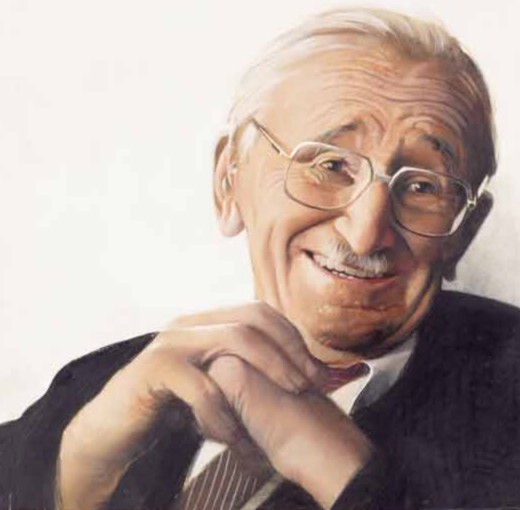
F.A. Hayek is an unlikely conservative hero. After all, this is a man who titled one of his most famous essays “Why I Am Not a Conservative.” He self-identified as a liberal – in the original sense of the word, which more or less means what we would today call libertarian. Since liberalism took on an entirely different meaning during the 20th century, Hayek wrote that he would settle for being called an Old Whig. But he could not stand to be called a conservative.

For one, he believed that “the conservative does not object to coercion or arbitrary power so long as it is used for what he regards as the right purposes. He believes that if government is in the hands of decent men, it ought not be too much restricted by rigid rules.”* Sounds an awful lot like the Bush years.

Sure, No Child Left Behind will radically grow federal involvement in education, which is properly a state and local issue. But we have good intentions! Sure, the PATRIOT Act could easily be abused. But it’s ok, because our guys are in charge! They’d never overstep their boundaries.

Conservatism, Hayek argued, is not a rigorous philosophy. It is “essentially opportunist and lacks principles.”**

That’s why I was surprised to see that the Heritage Foundation, a proudly conservative think tank, published an abridged edition of Hayek’s classic 1944 book The Road to Serfdom. Heritage’s economic policies are reasonably free-market, at least when Democrats are in power. So it makes sense that they would be Hayek fans, even though they aren’t ideological soulmates. But I am wary that they are promoting him as a conservative thinker; he was not.

Still, popularization is one of the most important tasks a think tank can perform. It is also one of the most neglected. Kudos, then.

The heart of The Road to Serfdom is Hayek’s version of a slippery slope argument. It is an easy charge to level at the current administration, which could be another motivation for Heritage.

Hayek and Heritage would agree: government intervention tends not to get the results it seeks; intentions are not results. Frustrated economic planners believe the only solution is more intervention. When that fails, still more meddling ensues. And on, and on. Then one day the people wake up to find they have lost their freedom.

The lesson is to not give in to the urge to use the hammer of government to drive home the nails of social problems. There are better ways, and less destructive hammers with more precise aim.

That’s the popular understanding of The Road to Serfdom. But Hayek pointed out in 1973 that there is more nuance to his book:

What I meant to argue in The Road to Serfdom was certainly not that whenever we depart, however slightly, from what I regard as the principles of a free society, we shall ineluctably be driven to go the whole way to a totalitarian system.  It was rather what in more homely language is expressed when we say:  “If you do not mend your principles you will go to the devil.”

The Bush and Obama administrations have joined together to double the size of government in one short decade. Their spending and regulating has driven debt through the roof, slowed economic growth, and kept millions of jobs from being created.

Worse, this bipartisan binge of government activism is showing no signs of slowing down. Many people think we’re already well down the road to serfdom. It looks bleak. But it isn’t really. It is reversible; the road to serfdom is a two-way street. We can go back, so long as we remember the principles of a free society.

The trouble is that conservatives seem to forget the libertarian portions of their philosophy every time they win an election. That’s why I’m glad that Heritage is popularizing Hayek with an abridged, easy-to-read version of The Road to Serfdom. I just hope they don’t portray him as a symbol of an ideology he publicly rejected.

More people of all political stripes need to read Hayek and be exposed to his arguments. More people need to learn why government does harm, even when it tries to do good. More people need to learn how easy it is to go down the road to serfdom — and that our cars can go in reverse, too.

The more people realize this, the higher the odds that they will keep conservative politicians in check post-election. If the Bush-Obama disaster has taught us anything, it’s that the seduction of power makes even good men go to the devil.

I hope Heritage’s popularization of Hayek sends that important lesson far and wide — while acknowledging that he doesn’t fit into the progressive/conservative spectrum; Hayek was nothing if not an independent thinker.

*F.A. Hayek, The Constitution of Liberty, p.401.

**Ibid.

Humility Is a Virtue

Penn Jillette has a column up at CNN.com titled “I don’t know, so I’m an atheist libertarian.” Well worth reading.

I don’t believe the majority always knows what’s best for everyone. The fact that the majority thinks they have a way to get something good does not give them the right to use force on the minority that don’t want to pay for it. If you have to use a gun, I don’t believe you really know jack. Democracy without respect for individual rights sucks. It’s just ganging up against the weird kid, and I’m always the weird kid.

How did we get here and how do we save everyone? I don’t know, but I’m doing the best I can. Sorry Piers [Morgan, CNN host], that’s all I got.

An Illiberal Liberal

Brad DeLong writes that “America’s best hope for sane technocratic governance required the elimination of the Republican Party from our political system as rapidly as possible.”

There are two things wrong with that statement. One is that he wants a technocratic government. Top-down. Orderly. Planned. But we live in a bottom-up world. Everything from language to Wikipedia to the economy itself is is a spontaneous order. They grow and evolve despite, not because of, direction from above. The most beautiful designs have no designer.

The other flaw is that DeLong favors a one-party state. Such regimes have been tried many times over the years. The results have rarely been humane.

I am neither conservative nor a Republican. But I sure am glad that America has two parties instead of one. That second party is proof that some people can’t shut other people out of the political discourse simply for disagreeing. Freedom of speech and thought are the cornerstones of a liberal society. DeLong rejects them at our peril.

On the traditional left-right spectrum, DeLong is on the left side. But that never has been an accurate way of identifying ideologies. A progressive should never be mistaken for a liberal. Yet most people make that mistake every day.

I’ve written before that Bush and Obama’s policies differ in degree, but not in kind. They are amazingly similar, both in domestic and foreign policy. Yet people insist on calling one a conservative, and the other a progressive. They are placed at opposite ends of the spectrum. How curious. How inaccurate.

A more accurate dichotomy than progressive-conservative is liberal-illiberal. I’m a proud liberal; DeLong might be surprised to find his illiberalism nestled right next to his detested George W. Bush.

George Will on Liberalism’s Ascendancy

If anything good came out of the Bush years, it’s that they disabused a lot of people of conservatism. George Will, traditionally a solid conservative, is among them. He has always had a latent liberal streak (“liberal” in the word’s original sense). It began surfacing more frequently early in the Bush years as a reaction to that administration’s illiberalism.

Now, during what policy-wise is Bush’s third term, he has this to say in a column about Nick Gillespie and Matt Welch’s new book The Declaration of Independents:

America is moving in the libertarians’ direction not because they have won an argument but because government and the sectors it dominates have made themselves ludicrous. This has, however, opened minds to the libertarians’ argument.

The essence of which is the commonsensical principle that before government interferes with the freedom of the individual, and of individuals making consensual transactions in markets, it ought to have a defensible reason for doing so. It usually does not.

Nietzsche on Women

I am currently engrossed in William L. Shirer’s The Rise and Fall of the Third Reich. It is a superbly well-written — and chilling — history of one of illiberalism’s purest expressions.

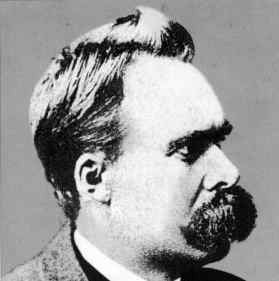
Nietzsche, the unthinking man’s favorite philosopher, had a large influence on Hitler’s thought. He contributed, among other things, to the National Socialists’ less-than-enlightened views on women. Discussing that influence in a footnote on page 100, Shirer gives two Nietzsche quotes worth repeating:

Men shall be trained for war and woman for the procreation of the warrior. All else is folly.

And, from Thus Spake Zarathustra:

Thou goest to woman? Do not forget thy whip!

Bertrand Russell, ever sharp of tongue, and knowing of Nietzsche’s lifelong aversion to the fairer sex, rebutted on p. 730 of his History of Western Philosophy:

[N]ine women out of ten would get the whip away from him, and he knew it, so he kept away from women, and soothed his vanity with unkind remarks.

Game, set, match.