
Category Archives: Nanny State

Regulation of the Day 223: Fred Flintstone Cars


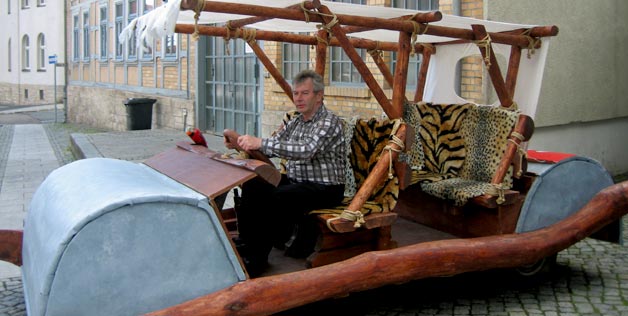
Sebastian Trager is an engineer in Germany who loves The Flintstones. He recently built a replica of Fred Flintstone’s car that looks almost exactly like the original. The only significant nod to modernity is that instead of being foot-powered, it has a 1.3 liter engine. Regulators, ever afraid that someone, somewhere might be having fun, quickly told Trager that he may not drive his car on German roads.

One reason is that German regulations require all cars to have windshield wipers. Trager didn’t think to install them, mainly because his Flintstone-mobile doesn’t have a windshield.

Other items are more substantive. Looking at pictures of the car, it also lacks side and rearview mirrors, and seatbelts. One imagines that it also lacks airbags. It also lacks turn signals, though Trager could use hand signals to alert fellow motorists when he’s about to turn.

After all the work Trager put into his creation, hopefully he’ll find a way to get at least some use out of it. It would be a shame to see this sparkling example of German engineering go to waste.

Or maybe he should have followed movie buff Paul Harborne’s example and created a replica Ghostbusters car instead.
Who Benefits from Paternalism?

One of the most neglected questions in the paternalism debate — largely unasked by both sides — is, who benefits? Harvard’s Ed Glaeser has an answer:

“Advocating soft paternalism is akin to advocating an increased role of the incumbent government as an agent of persuasion.”

-Edward L. Glaeser, “Paternalism and Psychology,” (Regulation vol. 29, no. 2, p. 38, 2006).

Paternalist policies have built-in public choice concerns that all but ensure  results very different from their intentions. Something Mayor Bloomberg and his fellow travelers should keep in mind.

Regulation of the Day 217: Etiquette

Civility is at the very heart of civilization. Those two words, along with other words such as “city” and “citizen,” come from the Latin “civitas,” which means a body of citizens bound by common laws and rules. In other words, civilized people agree to be nice to each other. Think of how both you and the cashier usually say “thank you” when you buy your morning coffee, even if you’re complete strangers. Getting along in modern life would be impossible without at least passable manners.

Which brings us to today’s Regulation of the Day. La Toba, Spain’s mayor, Julian Altienza Garcia recently issued a 65-plank Courtesy Charter making it illegal to commit tactless acts in public from burping to slurping soup. To this writer’s knowledge, La Torba does not have a reputation as a bastion of barbarity.

The charter even contains a mandate of sorts – children are required to spend some time with their grandparents on a regular basis. It is not known how Spain’s Supreme Court would rule if they were to decide on the grandparent mandate’s legality.

Some of the other offenses include:

  • Nosepicking
  • Touching your genitals
  • Flatulence
  • Yawning without covering your mouth
  • Coughing without covering your mouth
  • Talking with your mouth full

None of these breaches of decorum are punishable beyond a dirty look and a wag of the finger. People convicted of other minor offenses will, however, be able to have their fines waived if they take etiquette courses. Mayor Garcia defends his Courtesy Charter, saying “It is a compendium of basic rules of politeness that are being lost and should not be forgotten.”

He’s right that manners are important. They shouldn’t be forgotten. And it certainly is useful to have a written etiquette primer. In fact, many already exist. You can look here, here, here, and here, for starters. But even if Mayor Garcia’s job description is as broad as he believes it to be, his constituents would be better served if he turned his attention to more pressing matters than other peoples’ boogers.

Regulation Roundup

It’s time for another fresh batch of weird regulations:

Regulation of the Day 216: Selling Ice Cream to Kids


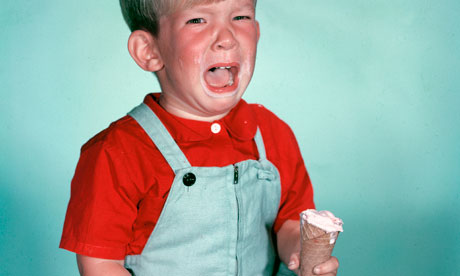
It can be hard for parents, but they need to tell their kids “no” from time to time. Letting children know that they can’t always get what they want is an important lesson in life. In Brooklyn’s Park Slope neighborhood, not all parents are up to the task.

Across the country, ice cream vendors will stroll through parks in the summer months; they go where ice cream trucks dare not tread. A lot of their sales are to kids. And parents know what happens when you get between a kid and ice cream: screaming, wailing, and gnashing of teeth are only the beginning. It isn’t fun.

That’s why some Park Slope parents want to ban ice cream vendors from parks. One parent wrote on a message board, “I should not have to fight with my children every warm day on the playground just so someone can make a living!”

One sees where her priorities are in these hard economic times.

This being Brooklyn, there is another wrinkle. The New York Post reports:

But Sarah Schenck says just say no to frozen confections.

Schenck, a mother of two and co-founder of the eco-friendly parentearth.com, said statistics back her up.

“Nobody wants to be a crank, but one in three kids are going to be obese or diabetic by high school,” she said. “When my kids see other kids get ice cream, they just start begging me. I just don’t think these are the fights we should be having.”

Most people have more nuanced views than Schenck; everything in moderation and all that. But there are people who think like her, and they are not afraid to use regulation to get their way. We should tell them no.

Regulation of the Day 214: Flipping the Bird


Steven Pogue, 64, was cited by police for flipping the bird while driving in Ballwin, Missouri. He was exonerated on free speech grounds, and the city is now moving to repeal the law.

Such impolite behavior is par for the course in New York City, among other places. Should such rude people find themselves in a certain part of eastern Missouri, they now have nothing to fear.

The ordinance in question prohibits motorists from extending body parts outside vehicle windows. It was intended more to prevent people from sticking their legs out of windows than to discourage profanity, though at least one officer thought the ordinance also applied to middle fingers.

Your mild-mannered correspondent has also, admittedly, been known to let loose now and then. Usually it’s while in pain, though the DC area’s spectacularly inept drivers do occasionally draw my ire. But should linguistic decorum be a matter of law? In this case, discretion should be the better part of valor.

A local ACLU spokeswoman comments that “Repealing the law fits within our nation’s finest traditions of allowing free expressions without fear of arrest.” Right on.

Similar cases have been successfully fought in Philadelphia, and with less success in Milwaukee.

Regulation of the Day 209: Playing on the Beach


When President Obama and his family took a recent vacation to Hawaii, paparazzi snapped some pictures of the big guy playing a game of pickup football on the beach. It’s a good thing he wasn’t in Los Angeles, or he might have been fined. A recent ordinance made it illegal to throw balls and even Frisbees on the city’s beaches.

After the public raised a hue and cry, the city’s Board of Supervisors liberalized the ordinance. Kind of. Now Angelenos are allowed to play a game of catch on the beach – if they ask the lifeguard first, or get a permit. And if they don’t follow orders, they can still be fined. This lighter touch is still awfully heavy.

You can read the entire 37-page ordinance here.

Other highlights:

  • “No person shall dig a hole deeper than eighteen inches (18”) into the sand… except at Director’s discretion, in consultation with Fire Chief, for film and/or television production purposes only.” (p. 16)
  • “[A] person shall not camp on or use for overnight sleeping purposes any beach[.]” (p. 20; Oregon has a similar law)
  • “No person shall operate any model airplane, boat, helicopter, or similar craft… except in an area that may be established and/or designated for such use by the Director, and subject to all rules and regulations pertaining to such area.” (p. 28)
  • “A person shall not use, possess, or operate in the Pacific Ocean opposite any beach regulated by this Part 3 a fishing pole, spear, sling, or other spear fishing equipment… within 100 feet of any person[.]” (p.34. Worth asking: is the “opposite any beach” clause sending a message to spear fishers in Japan, China, and other countries on the opposite side of the Pacific?)

Regulation of the Day 205: Singing the National Anthem

Francis Scott Key wrote the national anthem in 1814. He set his lyrics to an old English drinking song with an intentionally difficult melody. The range spans roughly an octave and a half, which is a challenge for any singer. Revelers in pubs would challenge each other to sing the melody without screwing it up; punishments for mistakes would often involve beer.

Even professional singers can’t always get through “The Star-Spangled Banner” unscathed, as Christina Aguilera found out at last year’s Super Bowl.

We’ll never know what Key would have thought of contemporary singers’ habit of improvising and embellishing his song with their own touches. But we do know that Indiana state Sen. Vaneta Baker, an Evansville Republican, is not a fan.

Sen. Baker introduced a bill that would require singers “to sign a contract agreeing to follow the guidelines and would set a possible $25 fine for violators.” It only affects performances at the state’s public schools and universities, as well as private schools that receive state funds. If her bill passes, it would not affect this year’s Super Bowl, which will be played in Indianapolis.

Singing out of key does not violate the terms of the contract. Not singing it “the way that we normally have it sung or heard throughout most of our state and our country” would. The bill would let schools set their own standards. But they will also be required to keep archives of every national anthem performance going back at least two years.

Given the amount of paperwork schools already have to deal with, this is just a bad idea. Surely Sen. Baker has better things to worry about in these troubled economic times.

Regulation of the Day 203: Sledding

If you live in a part of the country where the winters are cold and snowy, some of your most cherished childhood memories probably involve sledding down a snow-covered hill. But in Beaver Borough, Pennsylvania, regulators guard that activity very carefully.

For one, children under 12 are required to wear helmets while sledding. That’s not particularly onerous, though there is an argument to be made about parental discretion. Sledding is also banned in some parks, though it is allowed in others. The Borough recently circulated a newsletter to confused residents explaining what’s allowed where.

The real kicker is that out-of-town children are not allowed to go sledding in Beaver Borough, on pain of a $25 fine. If out-of-towners are in Beaver Borough to visit friends or relatives, they’ll need to find something else to do for a family outing.

The town did this on the advice of its insurance company. Jon Delano, a local journalist, contacted the insurer to ask how a sledder’s home address could possibly affect any liability concerns. Perhaps sensing that this makes no sense, the company would not talk to him.

Of course, police officers have better things to do than find out where sledders live. Hopefully they realize that as they drive past families taking turns going down the hills of Roosevelt Park.

Regulation of the Day 197: Planking

Planking is an odd, odd trend. Plankers are people who pose for pictures by lying face down on the ground in unusual places, stiff as a plank of wood; hence the name. It isn’t clear how the fad started, but a quick Google image search for “planking” will give results of people planking everywhere from a swimming pool to a camel’s back to the spare tire on the back of an SUV.

Winston Castelo, a legislator in the Philippines, has had enough. That’s why he introduced the Anti-Planking Act of 2011. There is a transportation labor dispute happening in Manila right now, and there have been some strikes. Some groups of protesters have taken to planking in the middle of the street, tying up traffic. Hence the anti-planking bill.

The protesters shouldn’t be doing that, obviously. Not only is it rude, it’s probably illegal. Offenses like jaywalking and disturbing the peace are already on the books.

People all over the world have been poking fun at Congressman Castelo’s odd sense of priorities. Good for them, I say. Threats to freedoms even as trivial as planking should not be taken lying down.