Category Archives: International

Iranian Dissident Wins 2010 Friedman Prize

Akbar Ganji, who spent six years in prison for writing articles critical of the Iranian government, is the winner of the 2010 Milton Friedman Prize. You can read more about Ganji’s story here. May his dream of a free, liberal, and democratic Iran come true.

How to Fix Immigration’s Black Market

Alex Nowrasteh and I have a piece in today’s Detroit News arguing that liberalization, not regulation, is the way to shrink immigration’s massive black market. Our main points:

-New rules that came into effect this month, such as raising the minimum wage for H-2A visa holders (that’s the visa for low-skilled agricultural workers) makes cheaper undocumented workers look more attractive for employers. They actually harm legal workers.

-Other new regulations, including background checks, workplace inspections, and mountains of paperwork, cost thousands of dollars per employee. These regulations also make black market workers look more attractive.

-The way to reduce illegal immigration is liberalization. For agricultural workers, that means making their H-2A visas inexpensive, easy to obtain, and keeping the bureaucracy to a minimum.

-When legal channels cost too much in time and money, people will turn to illegal channels every time. That’s how the world works. Getting rid of immigration’s black market begins with admitting that fact.

Regulation of the Day 126: Cheese-Rolling Races

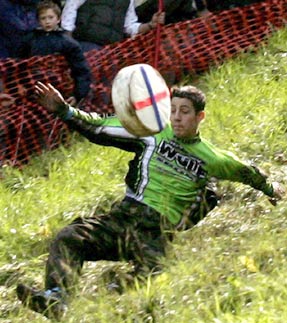
One of Great Britain’s most light-hearted traditions is the cheese-rolling race. Every year on the May Bank Day holiday, wheels of cheese are rolled down Cooper’s Hill in Brockworth, Gloucester. Adventurous and/or foolhardy souls roll down the hill in hot pursuit; the one who gets a hold of the cheese before reaching the bottom of the hill wins. You can watch a video of last year’s race here. Winners get to keep the cheese as a prize.

Cheese-rolling races have been held at Cooper’s Hill since the 1800s. Until this year, that is. Health and safety regulators shut down this year’s event because it has become too popular. The Daily Mail reports:

More than 15,000 spectators turned out last year, which, at three times the site’s capacity, means it has ‘outgrown the location’.
Richard Jefferfies, one of the organi[z]ers, said: ‘‘We have had to cancel on the advice of the police and local authorities this year because of the issues of health and safety and other aspects.

‘As well as concerns about the safety of the crowd and the competitors, local landowners were also worried by the amount of damage done by people climbing over fences and that sort of thing.’

It is hoped the races will return next year.

Regulation of the Day 115: Pancake Races

Pancake races are a Lenten tradition that date as far back as the 15th century. Contestants navigate a course as quickly as they can while holding a frying pan and flipping a delicious pancake a certain number of times.

The races are most popular in Britain. But other countries hold them, too. For over fifty years, the town of Liberal, Kansas has competed against Olney in England by setting up standardized courses in each town and comparing racing times. The Americans, despite being relatively new to the sport, actually have the all-time edge on the Brits, 33-25.

The secret to winning is to cross the finish line before your opponents do. That usually means running. The problem is that sometimes, running violates British health and safety regulations.

An official warned the racers before the St. Albans pancake race:

“Due to the wet weather conditions and health and safety regulations, in this year’s race, there will be no running allowed. Only walking is permitted. Any team that runs will be disqualified.

“It is a genuine health and safety concern. People fall over in the dry, they will certainly fall over in the wet.”

Three teams defied orders and pursued excellence as fast as they could. They were disqualified.

(Hat tip: Jonathan Moore)

Inside North Korea

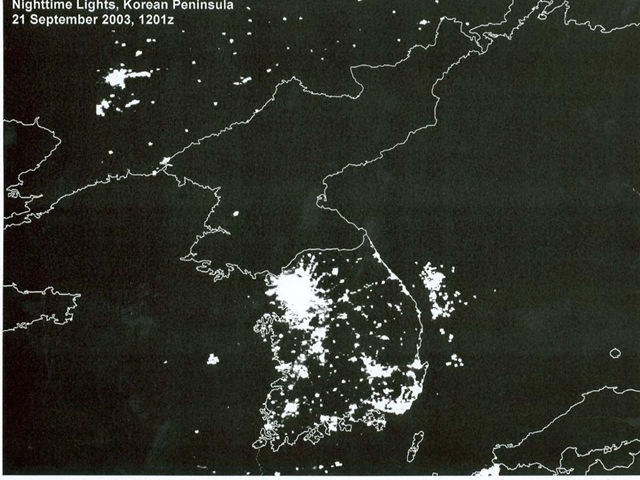
The satellite image above  is one of the most eloquent arguments for capitalism and freedom that I have ever seen. Liberalism is light. Literally. And just as literally, its rejection means darkness. Some pictures say far more than a thousand words.

Which brings me to an online documentary on North Korea over at VBS.tv that I just finished watching. It’s about an hour long in all. Not only did these guys actually travel to Pyongyang, which is difficult enough, they managed to film their experience on the sly. And despite being threatened with jail more than once, they brought back a lot of footage. To my western eyes, this was quite a sight to see.

The host has a bit of the stereotypical, boorish, Ugly American in him. Not sure he makes the best ambassador. But it took a lot of guts to do what he did. If you want some first-hand footage of life in a totalitarian state, this is about as close as you can get. Worth watching.

Bin Laden Admonishes U.S. on Global Warming

The old religion meets the new religion:

Osama bin Laden’s latest reason to condemn the United States has to do with climate change.

The al Qaeda leader in a new audio message published by al Jazeera, bin Laden verbally attacks the U.S. and other industrialized nations for polluting the planet.

Regulation of the Day 104: Haggis

Haggis is the national dish of Scotland. It has also been banned in the United States since 1989. Some of its ingredients are illegal for humans to consume in the U.S.

I won’t list what those ingredients are; they’re a bit hard to stomach (that would also be one of the ingredients). But having tried a small amount of haggis while in Scotland, I can testify that it doesn’t taste as bad as it sounds.

Fortunately, the haggis ban may soon be reversed. There has been no evidence of harm from eating offal ingredients. People have been eating haggis for centuries and been just fine. American shores may soon be teeming with the latest Scottish culinary innovations, including haggis nachos and haggis pizza.

Regulation of the Day 100: Posting YouTube Videos

The Italian government is considering making it illegal for its citizens to post videos on the Internet without a license.

The free speech implications are obvious. But could the proposal also be a move to restrict unwanted economic competition against Italy’s state-dominated media?

Regulation of the Day 89: Purple Dye

Ancient Roman consuls – equivalent to our presidents – wore togas edged in purple to mark their high status. As Republic became Empire, new emperors were said to “ascend to the purple.”

Purple clothing was a status symbol for most of human history. It was the ancient equivalent of the Mercedes-Benz. Originally discovered in the glands of shellfish (reputedly by Heracles’s dog!), it took 12,000 of the creatures to get just 1.5 grams of dye. Purple garments could be as rare and costly as gold in some places.

Modern innovations such as inexpensive synthetic dyes, the Minnesota Vikings, and purple M&Ms have taken away the color’s exotic reputation. But no worry. Federal regulators are doing what they can to bring it back.

Alpinil Industries, a dye manufacturer in India, sells its carbazole violet pigment 23 cheaply. Too cheaply, it seems. Even commoners can afford to buy products colored with their purple hues!

Irate American competitors convinced the government in 2004 to put an anti-dumping duty on Alpinil’s purple dye. That raised the price to match pricey American-made dyes. Purple would once again be reserved for the rich.

Now that the tax has been in place for five years, the Department of Commerce is wrapping up an investigation to see if it has been working as intended. A repeal would be best for consumers. Don’t expect to see it happen, though.

The benefits are concentrated to a few dye manufacturers, who have a strong incentive to lobby to keep the status quo. Meanwhile, the costs are diffused onto millions of consumers, none of whom have much incentive to spend thousands of dollars in an effort to save themselves a few pennies.

Regulation of the Day 77: Banning Toys in Happy Meals

Roberto Zabrido, a government official in Spain, is “adamant that the Happy Meal and its ilk pose a risk.”

The solution? Legislation that “would ban restaurants and food manufacturers from including toys and prizes with their products.”

If Happy Meals – Happy Meals! – are Spain’s most pressing national problem, then that country is either the most trouble-free place on Earth, or else busybodies such as Mr. Zabrido have too much money and power. My bet is on the latter.

(Hat tip: Jacob Grier)