Category Archives: History

Isaac Newton’s Funeral

Throughout history, most societies have been based on status. King, noble, and peasant. Brahmin and untouchable. Mandarin and coolie. One of liberalism’s crowning achievements is tearing down those old status societies and replacing them with contract societies. In a liberal society, all people have equal rights, and must deal with each other as equals. No man is forced to grovel before a duke or a king. He may look him in the eye now.

Bill Gates and Warren Buffett are far richer than I am. But if one of them wrongs me, I get my day in court. They might have better lawyers with shinier suits than me. But we are still equals before the law.

This was a novel phenomenon in the 18th century, mainly confined to England and the Netherlands, and even far more imperfectly than today. Here’s how Isaac Newton’s funeral looked through French eyes:

Having come from a nation where aristocracy and clergy held a monopoly on power and privilege, Voltaire marveled at a society where a scientist was buried with the honors of a king.

Robert Zaresky and John T. Scott, The Philosophers’ Quarrel: Rousseau, Hume, and the Limits of Human Understanding, location 877 in the Kindle version.

Isaac Newton’s life was a landmark event in the history of science. His funeral was, unknowingly, a landmark event in the history of human freedom.

J.B. Bury on the Role of Church and State in History

When church and state compete against each other, the people are mostly left alone, and prosper. When they work together, well:

The conflict sketched in these pages appears as a war between light and darkness. We exclaim that altar and throne formed a sinister conspiracy against the progress of humanity.

J.B. Bury, A History of Freedom of Thought, p. 177.

How to Lose an Argument

Thomas Erskine defended Thomas Paine after authorities decided to persecute him for the radical ideas contained in his Rights of Man. Here, Erskine tells a story that explains to Paine’s prosecutors why someone who threatens force during an argument is almost surely wrong:

You must all remember, gentlemen, Lucian’s pleasant story: Jupiter and a countryman were walking together, conversing with great freedom and familiarity upon the subject of heaven and earth. The countryman listened with attention and acquiescence while Jupiter strove only to convince him; but happening to hint a doubt, Jupiter turned hastily around and threatened him with his thunder. ‘Ah, ha!’ says the countryman, ‘now, Jupiter, I know that you are wrong; you are always wrong when you appeal to your thunder.’

Quoted from J.B. Bury, A History of Freedom of Thought, pp. 130-31.

He’s right. An argument can only truly be won on the merits.The world would be a better place if more people realized that.

The Future of Air Travel?

For thousands of years, no human traveled faster than a horse. Napoleon’s armies were no mobile than Caesar’s. That changed almost overnight with the automobile and then the airplane. Despite that rapid progress, flight times from New York to London have barely budged in 50 years.If anything, it’s slower now that the Concorde is out of service.

That could change in the next 15-20 years with the dawn of space tourism. A spacecraft has to travel about 17,000 miles per hour to stay in orbit. A partnership between KLM airlines and a wealthy Formula One mogul hopes to make first-generational suborbital crafts that can reach 2,200 miles per hour, with an eventual goal of hitting 13,750 miles per hour.

This is good for more than space tourism — a trip from London to Sydney would take an hour and forty five minutes. That’s about the same as a flight today from New York to Chicago.

Caesar and Napoleon would be astonished. Hopefully this venture doesn’t experience the crony capitalism problems that NASA has had with a similar project.

Herbert Hoover, Father of the New Deal

Whether you love the New Deal or loathe it, its policies were not entirely new. FDR’s predecessor, Herbert Hoover, set the precedent. History remembers him as a laissez faire president; a do-nothing who simply let the Great Depression happen. This requires an odd definition of “laissez faire” and an even stranger understanding of “do-nothing” to actually be true.

A new Cato paper from St. Lawrence University economics professor Steve Horwitz takes a closer look:

In fact, Hoover had long been a critic of laissez faire. As president, he doubled federal spending in real terms in four years. He also used government to prop up wages, restricted immigration, signed the Smoot-Hawley tariff, raised taxes, and created the Reconstruction Finance Corporation—all interventionist measures and not laissez faire. Unlike many Democrats today, President Franklin D. Roosevelt’s advisers knew that Hoover had started the New Deal. One of them wrote, “When we all burst into Washington … we found every essential idea [of the New Deal] enacted in the 100-day Congress in the Hoover administration itself.”

Read the whole paper here.

The Abner Doubleday Myth

It turns out that Abner Doubleday did not invent baseball. The true story of the game’s origins is actually quite mundane — it evolved over time as a messy, Hayekian spontaneous order. No one person can claim to have invented the modern version of baseball.

The story of how Abner Doubleday was given his mythical status, however, is immensely entertaining. Apparently it came from a crazy person — literally — who wrote a letter to the founder of Spalding sporting goods. Spalding spread the story because he wanted people to believe that baseball was a uniquely American game, invented by an American. People were eager to believe him; some still are.

Joe Posnanski tells the tale well, as he does with everything he writes. Read the whole thing. It will make you laugh, and you will learn something about how easy it is for tall tales to become accepted fact. Lessons abound for the public policy world.

The Rise and Fall of Rome

Via Larry Reed, here’s a link to an animated picture that tells the story of Rome. It’s a simple picture. But it tells an amazing story. It’s fun to watch it and play the events over in my mind.

The map begins as a tiny dot in 510 B.C. That’s the year before Tarquin the Proud, the last of the Roman kings, was overthrown. That event marked the birth of the Roman Republic. Roman territory quickly grows, despite the famous Punic Wars against Carthage. Romans come to view the Mediterranean as “Mare Nostrum” — our lake.

But not forever. The Empire starts shrinking in the third century A.D., slowly at first and then with alarming speed. Population pressures in the Far East push Goths and other barbarians into Roman territory faster than they can be assimilated. They turn hostile.

Eventually the Empire splits into Eastern and Western halves. The Western halfdisappears after 476. The Eastern half survives for another millennium as the Byzantine Empire. It prospers for a while, but it spends its last few centuries as a depressing rump of what it once was.

It’s a fascinating story; in learning it, one learns much about human nature, about art, philosophy, literature, economics, politics, war, peace, church and state, and more. No wonder it has captured so many imaginations over the years.

Sound Advice for Policymakers

Echoes of both Kant, and of human decency:

“[I]t is always immoral to treat men as means and not ends.”

-Bertrand de Jouvenel, Capitalism and the Historians (F.A. Hayek, ed.), p.96

Regulation of the Day 145: Unregistered Chariots

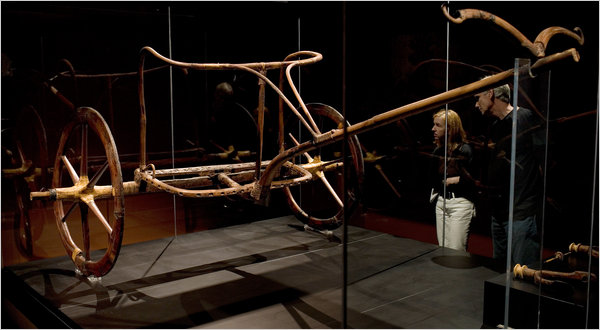
When King Tutankhamen’s tomb was discovered in 1922, six chariots were among the artifacts found inside. One of them even had some wear and tear; maybe Pharaoh had personally used it for hunting.

It is even possible that falling off that very chariot caused the broken leg that is believed to have ultimately killed him at the age of 18 or so. That chariot is now on display in New York as part of a traveling exhibition of Tutenkhamen’s artifacts.

Getting the chariot from Egypt to New York was quite an ordeal. At roughly 3,300 years of age, the wood is fragile. First it was carefully packed into a truck and driven to Cairo from the Luxor museum. Then it was loaded onto a New York-bound cargo jet. A curator was by its side at all times.

Once it arrived stateside, the New York Times tells of an unexpected regulatory hurdle through which the chariot had to pass before leaving JFK International Airport for its Times Square destination and painstaking reassembly:

When New York traffic officials reviewed the papers required for the oversize truck that would transport the chariot into Manhattan, they saw that the cargo inside was classified as a vehicle, and demanded its Vehicle Identification Number.

“I’m totally serious,” said Mr. Lach, the exhibition’s designer. “But we got it cleared up.”

Good for them. The exhibit is on until January 2 if you care to look for the chariot’s VIN yourself.

Ancient Noise Ordinances

Some types of regulations go back a very long way.  Some of this is likely only legend, but according to the historian Donald Kagan, local noise ordinances date all the way back to ancient Greece:

At the Gulf of Taranto lay the Greek city of Sybaris, whose citizens’ taste for luxurious living has provided a synonym for voluptuaries. They were said to honor cooks with golden crowns and give them the same honors for preparing a fine meal that they gave to choregoi for staging winning tragedies. They taught their horses to dance and were once defeated in battle when their opponents played tunes on the flute that lured their cavalry away. They went to parties at night and slept all day, imposing the first anti-noise legislation; even roosters were barred from the town.

-Donald Kagan, Pericles of Athens and the Birth of Democracy,  p. 125.