Category Archives: Economics

NAFTA/USMCA Ratification Politics

A story in Canada’s The Globe and Mail quotes me on the NAFTA/USMCA trade deal negotiations between Congress and President Trump. The article is behind a paywall, but here’s my cameo:

There is also the possibility that the Democrats will use it as a bargaining chip to force the administration to agree to unrelated party priorities: The Democrats are pushing for more infrastructure spending, improved health care and immigration changes.

“USMCA has a great deal of symbolic value to the Trump administration. The President will lose face if he can’t get it passed,” said Ryan Young, a trade expert at the Competitive Enterprise Institute think tank. “That means House Democrats hold all the cards. They can refuse to pass USMCA out of spite, or they can offer to ratify USMCA in exchange for concessions.”

Minimum Wages Have Tradeoffs

Quoted in an article noting that minimum wages are not a free benefit; they come with tradeoffs.

Reciprocal Tariff Act Backlash

I’m quoted in an article about backlash to the Reciprocal Trade Act. The bill would increase presidential power to raise tariffs.

Douglas Irwin – Peddling Protectionism: Smoot-Hawley and the Great Depression

Douglas Irwin – Peddling Protectionism: Smoot-Hawley and the Great Depression

A non-hyperbolic take on the most notorious tariff bill in American history. The Smoot-Hawley Act of 1930 was economically harmful, made the Great Depression even worse, and soured international relations at just about the worst possible time.

But the Depression began before Smoot-Hawley passed, so the bill can’t be blamed for causing it, which is a mistake many analysts make. The main culprit was monetary policy—a one-third contraction in the money supply distorted prices, ruined the investment climate, disrupted the financial sector, created massive economic uncertainties here and abroad

Monetary contraction also made Smoot-Hawley’s tariff hikes even more severe. For example, suppose there is a $1 tariff on a good that sells for $5. A rapid deflation lowers its nominal price to, say, $3 in nominal terms, but the tariff remains at $1. What was a 20 percent tariff becomes a 33 percent tariff for reasons having nothing to do with the Smoot-Hawley bill. Outside factors made a bad bill even worse.

Douglas Irwin – Free Trade Under Fire, 4th Edition

Douglas Irwin – Free Trade Under Fire, 4th Edition

Excellent, except for the carbon tax proposal at the very end. Knowledge problems and incentive problems doom that idea. Otherwise, while a bit long for an introductory text, this book is about as good an intro to arguments for and against free trade as there is. It is also a good guide to institutions such as the WTO and the recent move towards multilateral, bilateral, and regional trade agreements.

Agenda for the 116th Congress: Trade

The Competitive Enterprise Institute’s new agenda for Congress, “Free to Prosper,” is out. It has an entire chapter devoted to trade, which will be a busy issue for years to come. To cut to the chase, here are our specific recommendations:

  • Repeal Section 232 of the Trade Expansion Act of 1962.
  • Repeal Sections 201 and 301 of the Trade Act of 1974.
  • Refuse to pass legislation enacting retaliatory trade barriers.
  • Institute a rule explicitly forbidding the president from enacting retaliatory trade barriers.
  • Pursue a bilateral trade agreement with the United Kingdom.
  • Pursue a bilateral trade agreement with the European Union.
  • Pursue either a bilateral or a multilateral trade agreement with China.
  • Oppose industries who want to burden future trade agreements with trade-unrelated provisions on labor, environment, intellectual property, and regulatory “harmonization.”

President Trump’s doubling of tariffs has already cost the economy almost 1.8 percentage points of growth. That means 2018’s 3.4 percent third quarter growth could have been 5.2 percent instead. If the economy veers into recession in the near future, President Trump’s trade policies will likely have played a major role. Congress needs to act as soon as possible to prevent further damage.

Our trade policy recommendations follow four general themes that have bipartisan appeal—important in a newly divided Congress.

The first theme is that the executive branch has grown too powerful. Only Congress has the rightful authority to tax. The president has abused the tariff-making authority Congress delegated back in the 1960s and 1970s with Sections 232, 201, and 301. The time has come for Congress to take back that power so no president cannot further abuse it.

The second theme is to move on from the “reciprocity” model for tariffs—the idea that America will only lower its tariffs if other countries also lower theirs. American tariffs hurt American consumers and producers regardless of what other countries do. To paraphrase the renowned Cambridge economist Joan Robinson, when other countries dump rocks into their own harbors, the solution is not to dump rocks into our own harbors.

Not only have America’s higher tariffs failed to convince other countries to lower their trade barriers, our trading partners have raised their in retaliation. American consumers and producers are being hit twice as hard—once by our own tariffs, and again by other countries’ retaliations. That’s more rocks and less harbor. Congress needs to do some dredging, and quickly.

Third, Congress should work with the executive branch on liberalizing trade with other countries. New agreements with the United Kingdom and European Union should emphasize not just lower tariffs, but the concept of regulatory equivalence. Basically, this means that if a product is deemed safe for people in the UK to use, then the U.S. government should automatically deem it safe as well. Such a policy would reduce compliance costs for each country’s domestic producers, reduce frictions to international commerce, and serve as a positive foreign policy gesture to boot. Note that this is different from regulatory harmonization, in which countries agree to have identical regulatory policies. Instead of harmonization’s uniformity, equivalence has an ethos of “if it’s good enough for you, it’s good enough for me,” while allowing countries to continue to experiment with new policies that might be more effective.

China is more complicated. President Trump pulled the U.S. out of the Trans-Pacific Partnership (TPP), which still has 11 member countries, with more likely to join. The binding agreement commits China to make many of the reforms the Trump administration has unsuccessfully been pressuring China to make via higher tariffs. It is not too late for the U.S. to rejoin the TPP.

The fourth theme is that future trade agreements should stick to trade issues wherever possible. This policy horse left the barn long ago, but it is important to remember for when unintended consequences come to pass in the future. In the short term, it can be expedient to add trade-unrelated labor provisions to buy union support, or environmental provisions to buy support from green energy companies and activists. It is a legitimate question whether the agreements could pass without the support such provisions can purchase. But it is just as easy to add poison pill-style trade-unrelated provisions that could torpedo an agreement. If the long-run goal is to create more wealth for more people—and it should be—trade agreements should stick to trade issues, and separate issues should be treated separately.

For more, read CEI’s “Free to Prosper: A Pro-Growth Agenda for the 116th Congress.” Previous posts in the Agenda for Congress series:

Don’t Trust Political Memes, and Don’t Share Them

Think of this post as a public service message.

In some ways, memes are the 21st century version of the comic strip or the political cartoon. They can be quite funny, and they make their point in just a second or two. Memes have been a boon for comic-strip-style humor. Someone needs to fill the void left by Calvin and Hobbes and The Far Side, and a lot of people have ably volunteered. Anyone with a joke and basic computer skills can make a funny meme, and millions of people can share the fun. National distributors no longer serve as gatekeepers and censors, allowing some unique talents to shine that would have remained dark just a decade or two ago. This has been a wonderful development.

But for many reasons, political memes are typically riddled with factual errors and offer little more than confirmation bias. They should be shunned, not shared.

Here is a quick statistics lesson from one political meme I saw making the rounds recently. That’s not to pick on this meme specifically. There are millions like it, just as bad, floating around the Internet. This is just one I happened to see, though I should note that Turning Point USA has a poor reputation, even by its genre’s low standards.

Also keep in mind that this meme is on the correct side of its issue. Imagine how wrong the wrong ones can be! As Frederic Bastiat wrote, “The worst thing that can happen to a good cause is, not to be skillfully attacked, but to be ineptly defended.”

Here is the meme:
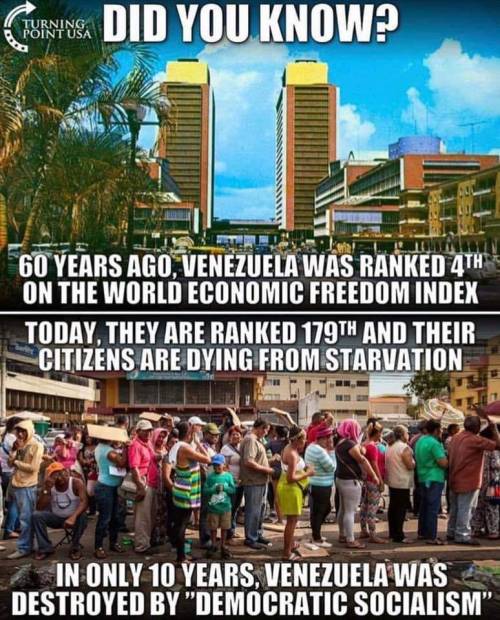
turning point meme

Here is a list of things it gets wrong.

1: This meme is undated and cites no sources.

2: There is no publication titled “World Economic Freedom Index.”

3: For indexes that do exist, their data do not go back 60 years. They go back to 1970 for the Fraser/Cato index, and 1995 for the Heritage/WSJ index.

4: Venezuela does rank 179th in the 2018 Heritage/WSJ index. But it gives no rankings from roughly 60 years ago. If the 4th place figure comes from a different index, that is not a valid apples-to-apples comparison. But we don’t know where that figure comes from. None is cited. Google doesn’t turn one up, either. For all we know, some intern could have just made it up, and now people are sharing it.

5: Hugo Chavez was first elected in 1998. His brand of socialism was 14 years old when Turning Point USA was founded in 2012, not 10 years before this undated meme was created.

That’s five errors in one meme that took less than ten minutes to dig up. That says more about Turning Point USA and political memes in general than it does about Venezuela’s ongoing tragedy.

Don’t trust unsourced political memes, don’t share them, and take people who heavily rely on them as seriously as they deserve–even, or especially, if they share your ideological priors.

$15 Minimum Wage Bill to Be Introduced Tomorrow

CEI has a press release. My comment:

“Advocates for a $15 minimum wage should look before they leap,” said Ryan Young, a CEI fellow. “A higher minimum wage has real world tradeoffs. It is not a free benefit. A higher wage will force employers to reduce non-wage pay such as insurance, breaks and personal time off, free meals or parking, and more. A hike in the federal minimum wage would also cause an estimated two million jobs to be lost and hit small businesses the hardest.”

The whole statement, also including comment from my colleague Trey Kovacs, is here.

Daniel Griswold – Mad About Trade: Why Main Street America should Embrace Globalization

Daniel Griswold – Mad About Trade: Why Main Street America should Embrace Globalization

Dan, a former colleague, takes a thorough, human-centered approach to trade that is also based on sound economics. One of the best single-volume “principles of” books in the trade literature. Highly recommended. I should have read this years ago, frankly.

Reject U.S. Reciprocal Trade Act’s Presidential Power Grab

Note: Since I wrote this post, Rep. Sean Duffy (R-WI) has announced that he will sponsor the bill.

A forthcoming bill, the U.S. Reciprocal Trade Act, written by “Death by China” coauthor Peter Navarro and other presidential advisers, seeks to expand the president’s tariff-making powers. Its goal is to encourage Beijing to open China’s markets to U.S. producers. The White House is currently seeking cosponsors for the bill, and President Trump is expected to promote it during his upcoming State of the Union address.

Congress should reject the bill. President Trump already has the power to raise tariffs without congressional authorization. While only Congress has taxing power under the Constitution, it delegated some of that power away to the president in the 1962 and 1974. The specific provisions were unused for decades until last year, when President Trump used them to roughly double tariffs.

These are the powers President Trump invoked to enact the steel and aluminum tariffs, and levies on more than $200 billion worth of Chinese goods. Further actions are possible in the near future against foreign automobiles, as well as an increase on the China tariffs.

Congress should affirm the separation of powers by rejecting the U.S. Reciprocal Trade Act’s presidential power grab. It should also take back the tariff-making powers it already granted. President Trump’s tariffs have not only raised U.S. trade barriers, they have caused other countries to raise theirs. If the tariff’s strategy’s goal is to open markets for U.S. producers, it has failed.

The correct response to a policy failure is to change it, not double down on it. In this case, the Trump tariffs have already cost the U.S. nearly 1.8 percentage points of GDP growth, raised consumer prices, caused billions of dollars of economic losses, and thousands of layoffs. GM alone is laying off 14,700 workers.

That’s bad for everyone. As for members of Congress, the GOP brand currently owns the tariffs. Re-branding is not only sound policy, it is wise politics for Republican members fresh off a 40-seat loss in the House.

Politicians of all stripes are typically reluctant to go against a president from their own party. Rejecting the U.S. Reciprocal Trade Act is a way to stand up for sound policy as well as basic principles of American government, such as the separation of powers. Congress should do more than simply decline to give the president more of its taxing power. It should take back the power it has already given away. Several bills to do this were introduced in the previous Congress, though none passed.

With the economic and political lessons learned in the previous two years, reforms stand a better chance this time around. Either way, voters deserve to know how interested Congress is in leading, rather than following.

The U.S. Reciprocal Trade Act is not the only trade bill the White House would like to sign. Navarro and other White House advisers have also drafted legislation to pull the U.S. out of the World Trade Organization, though it has not yet been introduced. As a sign of the gravitas with which the White House is treating trade issues, it is called the FART Act.

For more on what Congress should be doing on trade, see chapter 2 of the Competitive Enterprise Institute’s new “Free to Prosper” agenda for the 116th Congress.