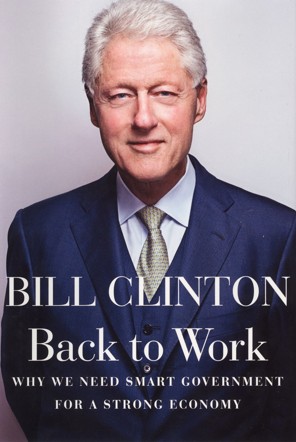
Over at RealClearPolicy, I recently reviewed Bill Clinton’s latest book, Back to Work: Why We Need Smart Government for a Strong Economy. You can read the review here. It’s a thought-provoking book, so there’s plenty I didn’t have room to say. Hence this post. Where the review focused mainly on Clinton’s philosophy and rhetoric, this post is mainly about Clinton’s economic policy proposals. I’ll still take him over Bush or Obama, but some of his policy ideas make an economist’s head shake.
Two things are worth pointing out before we dig into the weeds of policy. One is that Clinton seems to believe that you are for something if you want to increase government spending on it, and against it if you want to cut government spending on it. The logic does not necessarily follow. Many people think the federal government should not be involved in the automobile industry. Therefore, they are against American-made cars. Yes, the logic is that weak. This bit of tunnel vision is not unique to Clinton, but it weakens many of his arguments.
The other point is a surprising one. Nationalism pervades the book; this is the belief that one person matters more than another if they are a citizen of one country instead of another. One expects this from Republicans. But it’s surprising to hear from a Democrat, let alone the man who passed NAFTA. It’s as though after decades of stump speeches telling voters that they’re better than everyone else, he started to truly believe it. Many of Clinton’s policy proposals leave no possibility but to believe that he is an American nationalist; let us explore.
Trade as a Battle
Clinton repeatedly refers to other countries as “the competition.” We have to beat them, or they’ll beat us. It’s as though he believes that for China and India to have more, America must have less. This simply isn’t true, according to global GDP data. Besides falling for the zero-sum fallacy, this reveals an ugly mindset.
Suppose we beat our competitors in Clinton’s zero-sum world. Rich Americans would be redistributing wealth away from the global poor and giving it to themselves. This kind of reverse redistribution is hardly progressive.
Outsourcing
Clinton’s economic nationalism also expresses itself in his calls for factories to “insource” jobs they currently outsource overseas. Americans deserve a job more than others. In so doing, he ignores basic economic principles. One of them is that giving someone a job doesn’t therefore mean one less job for everyone else; the zero-sum fallacy strike again. Another is the division of labor.
The finer the division of labor, the greater the wealth workers can create; Robinson Crusoe lived in poverty for all his cleverness. If the U.S. were to become self-sufficient, its division of labor would be limited to about 310 million people. But it could be more than 7 billion people if the world was fully open to trade. Imagine what 7 billion people could accomplish together, if they were all able to pursue their specialized comparative advantage.
Renewable Energy
Continuing his nationalist rhetoric, Clinton calls for the U.S. to ramp up its renewable energy production, with the eventual goal of complete energy independence. To do this, we would have to divert resources from other, more productive sectors of the economy. The price of energy independence is less wealth, and a less specialized division of labor. We’d have to stop doing things we’re good at just to get the same amount of energy we already had before.
One also questions Clinton’s method of achieving energy independence. He would transfer billions of dollars from taxpayers to private businesses. He argues that this would create jobs, wealth, and would make America more energy-independent. He does not mention the opportunity costs involved — taxpayers would have have spent their money on other things they valued more if they had been allowed to keep it.
Assume that the economics of renewable energy are as bright as Clinton claims. Then there is also no need to subsidize it. Profits are deadly effective at luring entrepreneurs. If it’s economically viable, it doesn’t need a subsidy. And if it isn’t economically viable, no amount of subsidy will make it so.
Clinton also ignores public choice concerns. Taxpayer dollars tend not to be transferred to private businesses on the merits. Political connections play a large role. It is possible that subsidies given to the right companies would produce the results Clinton is after. But the possibility of that actually happening is vanishingly small. He does not address this problem in his book.
Exports
Clinton wants the U.S. to double its exports. Germany’s exports are roughly 40 percent of its GDP; the U.S. exports 11 percent. Clinton believes that increasing exports without raising imports would create jobs and wealth. While it would put people to work, it wouldn’t make them any wealthier if all the value they work so hard to create is shipped overseas.
Increasing exports would increase the amount of currency in the U.S., true. But currency is not wealth. Dollars cannot be eaten, driven, or otherwise consumed. Wealth is stuff. Goods and services. Dollars only have value because they can be exchanged for wealth. Given the choice between a car and a bunch of green pieces of paper, most people would take the car. Millions of people make that choice every year, and millions more are saving up to do just that.
Exports are the price we pay for imports. They are neither a good thing nor a bad thing in and of themselves. There is no need to artificially increase them.
Clinton’s nationalism-influenced thoughts on trade are very similar to the mercantilism that economists have been openly mocking for centuries. Considering that Clinton is the man who passed NAFTA, this is very disappointing.
Stimulus
Clinton also believes that fiscal stimulus softened the recession’s impact. He cites a study arguing that it kept employment 1.5 to 2 percent higher than it would have been without stimulus. But again, he forgets opportunity costs. Every dollar spent and every job created under the stimulus was a dollar and a job taken away from somewhere else.
Stimulus works by taking some money out of the economy and then putting it back in – less transaction costs, of course. The best possible outcome is negative. Even allowing for a Keynesian multiplier over 1, the politicking and waste that go into any large spending bill almost guarantee that the stimulus hurt the economy.
Bailouts
Clinton praises TARP and the auto industry bailouts. Even if all the loans are repaid, the bank and auto bailouts will still be costly, as George Mason University’s Russ Roberts has pointed out. This is because capitalism is a system of profit and loss. Not one or the other. Both. Profits encourage risk. Losses encourage prudence. When government removes losses from the equation, it also removes prudence. Banks take more and more risks, because they know they won’t bear the losses from the ones that don’t pan out. This does not save the financial system. It undermines it.
The auto bailouts saved the American auto industry, Clinton claims. But it didn’t need saving. A couple of firms were in danger, and the bailout saved them. But Ford, Toyota, Honda, and the many other American companies that make cars in America using American workers were doing just fine. The bailouts locked scarce resources into inefficient companies that had good political connections. The opportunity costs are massive.
Immigration
Clinton has some good immigration ideas, not least because he lets go of his nationalism on this issue. He would like to allow more high-skilled immigrants into the country, especially the ones with advanced degrees in the STEM fields – science, technology, engineering, and mathematics. These types of immigrants are far more entrepreneurial than most native-born Americans. They would create a lot of jobs, which is Clinton’s main concern.
More importantly, they would also create much more wealth in America’s relatively entrepreneur-friendly environment than in countries with less liberal institutions. It could well be that the next Google or Microsoft will never be founded because the strict H-1B visa quota kept the wrong person out.
Summary
Almost all of Clinton’s ideas outside of immigration involve more government, instead of less. This could be because of a lack of creativity. It may be because of the planner’s hubris: “I am clever. Put me in charge.” It could also be because of an antipathy to the disorderly, and unpredictable ways of creative destruction and the market process. His plans are so much tidier, so much neater.
But the source of his ideas doesn’t matter so much. It matters if they’d work or not. Would they create more wealth and jobs on net? From the economist’s perspective, the answer is yes in a few cases, but mostly no. Clinton might like his work to be treated as one of pragmatism, but it is really a work of ideology. Given how moderate his presidency was compared to either of his successors, this is disappointing.



 Inertia Wins!