
Category Archives: Books

Trade Made Renaissance Art Possible

Trade and specialization make all kinds of life-enriching innovations possible. In fact, Italian Renaissance art was one of them, a gift that continues to inspire us five centuries later. Re-opening trade with the Middle and Far East is what allowed Europe to climb out of the Middle Ages and into the Renaissance. Venice, in particular, was a hub of trading activity, as Peter Frankopan points out at Kindle location 4260 of his 2016 book The Silk Roads: A New History of the World:

By the late fifteenth century, nearly 5 million pounds of spices were passing through Venice each year… It also seems to have been the main point of entry for pigments used in paintings. Often referred to collectively as “oltremare de venecia” (Venetian goods from overseas), these included verdigris (literally, green from Greece), vermilion, fenugreek, lead-tin yellow, bone black, and a gold substitute known as purpurinus or mosaic gold. The most famous and distinctive, however, was the rich blue that came from lapis lazuli, mined in Central Asia. The golden age of European art—of Fra Angelico and Piero della Francesca in the fifteenth century, and then of artists like Michelangelo, Leonardo da Vinci, Raphael, and Titian—owed much to their ability to use colours drawn from pigments that were part of the extension of contacts with Asia on the one hand nd rising levels of disposable wealth to pay for them on the other.

So the next time you look at The Birth of Venus or the Mona Lisa, remember that trade made them possible, and artificial trade barriers could have deprived the world of profound beauty.

In fact, the process continues today. Michelangelo and his contemporaries had to make their own paints. Long-distance traders brought them the materials, but the artists themselves had to mix the ingredients. And if they didn’t do it just right, it could be a very expensive mistake. Today, you or I could walk into an art supply store and trade money worth a few hours’ labor for oil paints, or watercolors, or any other kind of paint, in almost any color imaginable. Digital art and photography don’t even need paint. Just a computer, a camera, or even a smartphone.

Trade makes humankind’s highest cultural accomplishments possible. This is just one reason it is worth defending. For more reasons, see the new CEI study “Traders of the Lost Ark.”
Even Steve Jobs Hated Comcast’s Service

Not everyone can call up a company’s CEO to bring up a complaint. But if you can, more power to you. Kudos to the late Apple co-founder Steve Jobs for doing what so many of us wish we could:

During his recuperation, he signed up for Comcast’s high-definition cable service, and one day he called Brian Roberts, who ran the company. ‘I thought he was calling to say something nice about it,’ Roberts recalled. ‘Instead, he told me “It sucks.”

-Walter Isaacson, Steve Jobs, p. 489.

Quality Insults in History

Gibbon lobs a lot of quality insults in the Decline and Fall. Some of the best are hidden in his footnotes. Here is one from note 44 of Chapter XLVI, on p. 1534 of the edition I have:

[S]ee the Annals of Eutychius and the lamentations of the monk Antiochus, whose one hundred and twenty-nine homilies are still extant, if what no one reads may be said to be extant.

A Bit Drastic, But at Least They Correctly Identified the Problem

A barbarous solution to the barbarous problem of over-legislation:

A Locrian who proposed any new law stood forth in the assembly of the people with a cord round his neck, and, if the law was rejected, the innovator was instantly strangled.

-Edward Gibbon, Decline and Fall of the Roman Empire, p. 1435.

I personally prefer peaceful solutions that reform the institutional rules that make over-legislating and over-regulation possible in the first place. But before the days of Douglass North and James Buchanan, this was apparently what people had to work with.

How to Change Trump’s Mind on Tariffs

It turns out the word “tariff” is of Arabic origin, according to Henri Pirenne, Economic and Social History of Medieval Europe, p. 145.

Lawyers Have Been Unpopular for a Long Time

From p. 1064, footnote 19 of Edward Gibbon’s Decline and Fall of the Roman Empire, the first volume of which was published in 1776:

The Germans, who exterminated Varus and his legions, had been particularly offended with the Roman laws and lawyers. One of the barbarians, after the effectual precautions of cutting out the tongue of an advocate and sewing up his mouth, observed with much satisfaction that the viper could no longer hiss.

A Quick Lesson in Antitrust: Netflix and Comcast

Every time a major corporate merger is announced, pundits predictably warn of impending doom if regulators allow it to happen. Here’s an example from Susan P. Crawford’s 2012 book Captive Audience: The Telecom Industry and Monopoly Power in the New Gilded Age (Kindle edition location 2098):

The absence of any effective regulatory regime or oversight over the cable giant makes it unlikely that Netflix will ever be able to challenge Comcast. Comcast has a number of options that will make it extremely difficult for independently provided, directly competitive professional online video to challenge its dominance.

Now that a few years have passed and the dust has settled from the Comcast-NBC merger, how has it affected Netflix? Rather differently than Crawford feared, as any student of Schumpeter could have predicted. Here is an excerpt from last week’s cover story in The Economist, “The Tech Giant Everyone is Watching”:

This year its entertainment output will far exceed that of any TV network; its production of over 80 feature films is far larger than any Hollywood studio’s. Netflix will spend $12bn-13bn on content this year, $3bn-4bn more than last year. That extra spending alone would be enough to pay for all of HBO’s programming—or the BBC’s. … Its ascent has mirrored the decline of traditional television viewing: Americans between the ages of 12 and 24 watch half as much pay-TV today as they did in 2010.

Within a year of Crawford’s book, Netflix began producing high-quality original content, an innovation she did not foresee. Her whole project was a waste of time and effort.

The lesson here is that pundits and regulators don’t know any better than you or I how a merger will turn out. And unlike investors and entrepreneurs, they don’t have their own money at stake, so they don’t have any incentive to innovate or react to changing conditions.

Of course, another lesson is that pundits and agencies will not heed that first lesson. As the same Economist story points out, “Some suspect that Netflix harbours ambitions to monopolise tv.” So the cycle repeats itself, and likely for no good reason.

For more antitrust lessons, see Wayne Crews’ study The Antitrust Terrible 10: Why the Most Reviled “Anti-competitive” Business Practices Can Benefit Consumers in the New Economy.

Ancient Openness

Openness and globalization have a long pedigree. Just count all the different cultural traditions mixing in this single paragraph, and keep in mind these guys didn’t have trains, cars, or planes:

In 668 Pope Vitellius sent Theodore of Tarsus, who had studied in Athens, to be Archbishop of Canterbury. His friend Adrian, who accompanied him, was an African, a Greek and Latin scholar. It was he who, with the Irish, propagated the culture of the ancients among the Anglo-Saxons.

-Henri Pirenne, Mohammed and Charlemagne, p. 127.

Aristotle was on to something when he described man as a social animal.

Wages, Productivity, and Trade

An iron law of labor economics is that wages are tied to productivity. Something for China trade hawks to ponder:

First, an irresistibly competitive China is a figment of the fevered imagination, since the real cost of labour will tend to remain in line with productivity.
-Martin Wolf, Why Globalization Works, p. 183.

This is why, as Chinese workers become more productive and thus higher-paid, labor-intensive industries such as textiles and basic assembly are leaving China for even lower-wage countries such as Indonesia and Bangladesh. The real key to prosperity is a mix of liberal economic institutions which enable high productivity (classically liberal, not left-liberal), and cultural institutions that value peace and prosperity. If China’s slow and stuttering cultural and economic liberalization continues, not only will it cease to be a security threat or an intellectual property thief, its people will become rich. And they will do so by enriching others through mutual exchange.

Pro-Market, Not Pro-Business

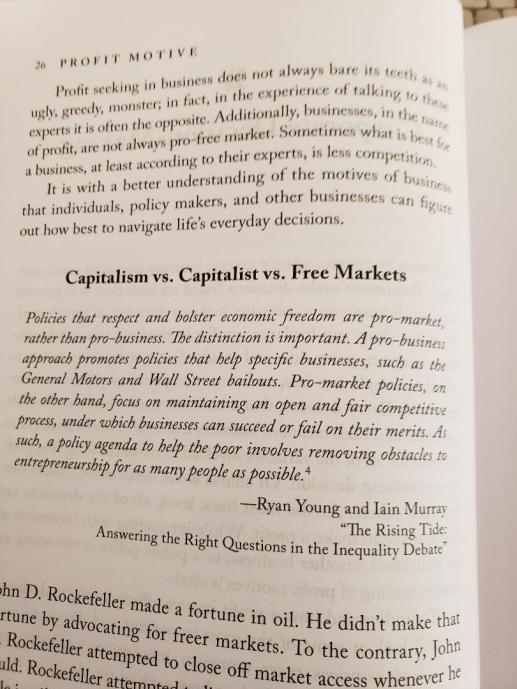
Charles Sauer’s new book Profit Motive: What Drives the Things We Do quotes from a paper Iain Murray and I coauthored:

Young Murray cite Sauer Profit Motive

The book is here. See also Iain’s and my paper “The Rising Tide: Answering the Right Questions in the Inequality Debate,” and our companion paper “People, Not Ratios: Asking the Wrong Questions in the Inequality Debate.”